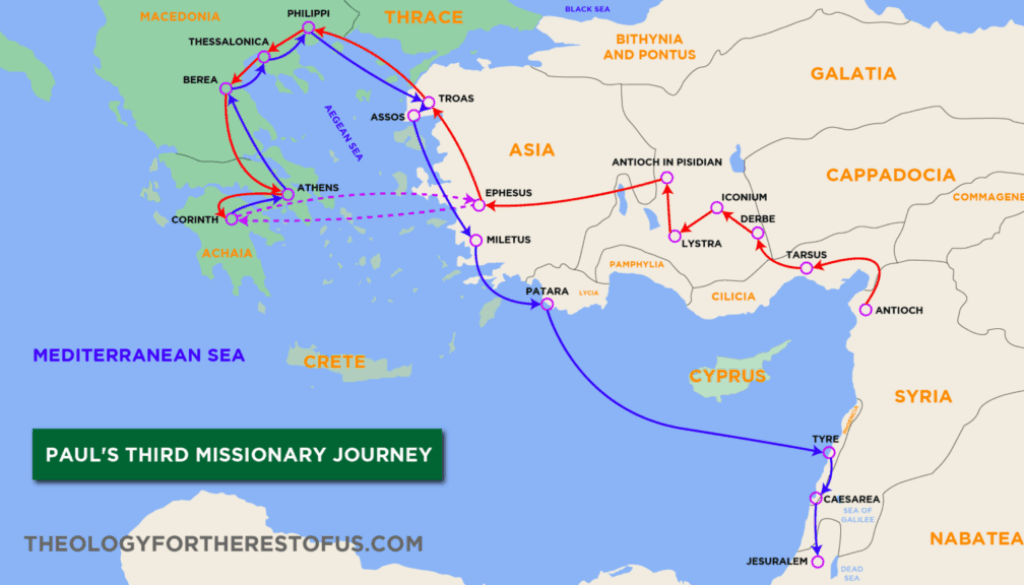
Paul’s Third Journey
Paul is on the road again. He doesn’t stay home long. This is his third missionary journey, and Ephesus is a big part of it.
Paul, Aquila and Priscilla went from Corinth the Ephesus. The three had spent a year and a half together in Corinth, working and teaching. Paul doesn’t stay long in Ephesus, but Aquila and Priscilla do. Paul promises to return later, if he can. He sets out again, not long after returning home to Antioch. While he is making his way to Ephesus, Apollo is ministering there. Let’s rejoin our journey with Paul.
Holy Spirit, open my heart and mind. Show me Your story. Point out the parts You want me to notice as we journey through this portion.
♥ ♦ ♥
Aquila and Priscilla stand on the dock, waving to Paul as he sails for Caesarea.
“What are we supposed to do now?” asks Priscilla.
“Make tents, and remain available to the Lord,” answers Aquila.
“But what are we supposed to DO to remain available to the Lord?”
“If I knew that, I would be in God’s shoes. I’m certain that, when the time is right, He will show us what to do.”
Priscilla has never been much of a ‘wait and see’ woman, but it looks like she is going to have to learn how now.
Paul concludes his journey by returning to Antioch, after stops in Caesarea and Jerusalem. But Paul cannot sit still in Antioch. He longs to be back out with the new believers. He feels especially called to return to Ephesus. But there are many stops along the way before he reaches them. The brothers gather and pray over him before sending him out again.
“Lord Jesus, You know the heart of Paul. How he desires to reach people for You. That desire was placed in him directly by You. Watch over him as he heads out, once again, to minister to the people. To spread Your gospel of grace. Bring those who are hurting to him so that he may be Your hands and feet to the people. Open doors for the work You called him to. In the mighty name of Jesus Christ, we pray this; knowing that it is Your will.”
Paul takes the overland route again. His first stop is at his hometown of Tarsus. Here he strengthens the church and addresses anything they need.
Passing again through the Ceciliani Gates, Paul’s visits all the churches of Galatia. It is wonderful seeing old friends and new converts. The churches are all growing, in spite of the persecution in the area. They stand strong in the face of the Jews who would discourage them. NO force on earth can stop the spread of the gospel!
While Paul is visiting these churches, Aquila and Priscilla continue the work in Ephesus.
As tent makers, this duo can find work anywhere. They are master craftsmen at their trade and their work draws in all the customers they can handle. It also provides them an opportunity to witness to those same customers.
When Paul departed from Ephesus, there was a ‘young’ church growing. Aquila and Priscilla are foundational members in that body. Aquila does NOT like public speaking, so the two remain behind the scenes as often as possible.
The church is growing daily and welcomes missionaries to speak before them. Their latest one is a Jew named Apollo. He is originally from Alexandrea. He is on fire for the Lord! Not only that, he knows his scriptures and elegantly points people to Jesus. One would almost call him ‘Paul like’ in his ability to point people to Jesus.
Aquila and Priscilla are excited to hear him speak. They are in synagogue while Apollo is speaking today. They follow along with his argument and his conclusion quite easily. When his message ends, they look at one another in confusion.
“What about the rest of it?” Aquila whispers to his wife.
“Does he not know about the Baptism of the Holy Spirit?” Priscilla asks.
“He seems to have stopped with John the Baptist’s ministry. Mind you, what he says is accurate, but it lacks the full hope that Paul has shared with us.”
“Maybe we should share with him the things that Paul taught,” Priscilla suggests.
“That is an excellent idea.”
The couple approaches Apollo after service ends.
“That was a great argument. We too follow Jesus. I am Aquila and this is my wife Priscilla.”
“I’m glad to meet you” Apollo replies, sincerely.
“Would you be willing to have dinner with us this evening? We would love to talk with you more about the Lord.”
“I would be honored. The brothers I have met speak highly of you.”
Aquila gives Apollo directions to where they are staying before parting company. When the couple gets home, they start planning out the points they believe Apollo needs to hear concerning the Lord.
“Understanding, and accepting the Baptism of the Holy Spirit has to be a top priority,” Priscilla stresses.
“Agreed. But that baptism was only made possible through Jesus’ death and resurrection. This is foundational! But I also want to speak with him about the gifts God says those who follow Jesus can operate here and now.”
Apollo is very grateful for Aquila and Priscilla for showing him more of the gospel and opening his eyes to parts he was missing. They made certain to back up every word with scripture, prophecy, and stories shared by the apostles.
“The prophet Isaiah tells us of the Christ’s suffering and death. He even speaks of His resurrection. David, in his psalms also shares this message with us. It is only through Christ’s death and resurrection that we are made right with God.”
Aquila quotes Isaiah’s words concerning Jesus’ substitution work. “Surely he took up our pain and bore our suffering, yet we considered him punished by God, stricken by him, and afflicted. But he was pierced for our transgressions, he was crushed for our iniquities; the punishment that brought us peace was on him, and by his wounds we are healed. We all, like sheep, have gone astray, each of us has turned to our own way; and the Lord has laid on him the iniquity of us all” (Isaiah 53:4-6).
“The prophet Ezekiel tells the people that God will put His Spirit within the people and cause them to walk in His ways. This is the Spirit that first fell on the apostles at Pentecost and is available to believers now. It is the Baptism of the Spirit, beyond the Baptism of Repentance that John preached. Yes. Repentance is essential to salvation in Jesus, but there is SO much more for those who believe.”
Apollo is ready to boldly shares all that Aquila and Priscilla shared with him, along with all that he knew before. He becomes an exceptional ‘tool’ in the spreading of the gospel of the Lord. And he desires to go beyond Ephesus. He wants to visit Achaia.
“Brothers, I feel the Lord calling me to continue to spread His word and to strengthen the new believers, as well as ‘tipping over’ those Jews who are on the cusp of the truth.”
“This is an excellent calling, but where do you want to go?”
“I want to go to Achaia (Corinth).”
Aquila and Priscilla agree with Apollo’s direction and support him with the brothers. An introduction is crafted that very evening and Apollo is sent on to Corinth. He is every bit as fervent in Corinth as he was in Ephesus.
Paul arrives in Ephesus shortly after Apollo’s departure. When he arrives, he comes across some of Apollo’s disciples. Those that had not received the full understanding. Paul hears them teaching. He listens as they expound on the knowledge they have.
Once the crowd leaves, Paul approaches them. “Did you receive the Holy Spirit when you believed?” (Acts 19:2a).
They look at Paul with questioning evident on their faces. “No, we have not even heard that there is a Holy Spirit” (Acts 19:2b).
It’s Paul’s turn to look puzzled. “Into what then were you baptized?” (Acts 19:3a).
“Into John’s baptism” (Acts 19:3b), they say with certainty of their standing.
Paul nods in understanding. These men need more of the truth and Paul is just the man to give it to them.
“John baptized with the baptism of repentance, telling the people to believe in the one who was to come after him, that is, Jesus” (Acts 19:4).
Paul goes on to fill in the rest of the ‘missing pieces’ in Jesus’ mission.
“We want to be baptized as Jesus directed,” they say.
Paul is more than happy to do this for them. And after he baptizes them, he lays hands on them and prays that they receive the Holy Spirit.
Just as it happened at Pentecost, and many various places since that day, the Spirit fills all of them. They begin speaking in tongues and prophesying. Afterwards, they share this increased knowledge with the rest of Apollo’s disciples who hadn’t heard before he left for Corinth. These disciples also joined Paul in his work.
After this encounter, Paul returns to his regular practice of speaking in the synagogues. For three months, Paul reasons and persuades the Jews, proving the case of Jesus as Christ. Many believed but some were downright stubborn in their refusal to listen. They didn’t simply refuse to believe, but actively begin speaking out against Paul and those who follow Jesus, using the synagogue as their platform.
Paul has had enough. He withdraws from the synagogue and begins teaching in the hall of Tyrannus. This is a neutral location of education; a lecture hall. Paul speaks here daily the entire time he is in Ephesus.
While teaching the people, multitudes of miracles take place for those who come to hear the gospel. The Spirit is so heavy on Paul, that anything that touches his skin can be carried away to the sick and they receive healing. Aprons and handkerchiefs were chief among these items and they allowed Paul to minister to even more people.
Reports are coming in from the church in Corinth that are disturbing to Paul. He decides to address these before they become any worse. He writes a letter to the church, identifying each problem area, giving biblical direction, and tying it all together through the threads of love and hope.
The first issue identified is division in the church over who is their ‘favorite’ teacher. Groups are forming, not because of doctrinal differences, but because of teaching styles or personalities. The three main figures identified are Paul, Apollo, and Peter.
“Listen to me! The gospel does NOT come from one earthly man. It is from Jesus Christ. No matter who the teacher is, if he is teaching Christ crucified and raised again, listen and learn. If he is teaching anything else, RUN AWAY. You are ALL brothers and sisters with Christ as your center; NONE other.”
The second issue involves sexual immorality. Paul is appalled to hear of the practices going in within the church. Immoral relationships (son and step mother) and blatant worship of other gods by indulging in their prostitutes. The people are claiming ‘freedom in Christ’ as their excuse for these practices.
“Let me be clear,” writes Paul. “Our bodies belong to Christ. What you do with it matters. You are representing HIM and that is where your freedom ends. If Jesus would do it, then it is permissible. If not, DON’T engage in this kind of behavior. This kind of sin is one that you carry with you forever. You cannot separate yourself from this, as it is your own body that is being defiled. God wants our bodies to reflect Him, now and in the life to come. What you do in this life matters.”
The third issue identified is again tied to freedom, but this time it revolves around eating foods sacrificed to idols. Some say it is fine, while others say NEVER let it touch your lips.
“In this area, the most important thing to remember is who you are being a ‘witness’ to” Paul encourages. “There is nothing wrong with eating food sacrificed to idols. They are pieces of wood, stone, or metal. They have no life and therefore cannot ‘taint’ the food. BUT if you have a brother who is bothered by this and you are with him, DO NOT EAT IT. Not because it will harm you, but because it confuses him. Abstain out of love and respect for those around you. You are not harmed by abstaining for the sake of someone else, but they may be by your indulgence. Let love for your brother lead the way.”
The fourth issue is orderliness in the services. People are talking over one another, sharing prophecies, speaking in tongues, and generally doing whatever they want whenever they want to.
“This is no way to behave,” writes Paul. “God is not the author of confusion. Those who have come to learn and worship with you are being confused and driven away. There is NOTHING wrong with tongues, or prophecy, or any of the gifts of the Spirit. What is wrong is using them whenever you choose. Can you imagine all the angels in Heaven clamoring and doing their own thing before God? It would be chaos! God desires order. If it were not so, He would not have prescribed order even in creation. There is a ‘season’, a time, and a place for every gift. Use them orderly, preferring one another’s ability to understand to your own ‘freedom.’ Again freedom begins where love lives. We are all ONE body, working together for the benefit of all.”
The MOST shocking issue brought to Paul is that some of the people don’t believe in the resurrection of Jesus. This issue is foundational and HAS to be addressed. It ties everything else together.
Paul carefully crafts this argument, using eyewitness accounts and prophecies. “For those who doubt Jesus’ resurrection, I point you to the MANY eyewitnesses. Not only Jesus’ disciples and those closest to him, but over five hundred people witnessed Him teaching at one time. Even the Roman soldiers witnessed Jesus’ resurrection. If it were not so, the religious leaders wouldn’t have made up the story of His disciples stealing His body. And because the tomb is empty, we have HOPE. If Jesus hadn’t raised from the dead, then there would be no hope. This life would be for nothing, and believing in Him would be a lie. But because He rose, He is the center of our church, He cares what we do with our bodies, He commands us to love one another, and gives us a future. Through LOVE all these things work together, and that love is only possible through Him.”
“There are mysteries still to be disclosed” Paul says, “But by holding fast to the truth, we are confident that God will reveal all when the time comes. He is our hope.”
As Paul and his ‘ministry team’ are working among the people, another group decides to ‘give it a try.’ This group is made up of seven brothers. They are Jewish and specialize in exorcisms; casting out demons. They decide to use Paul’s name and Jesus’ name to perform the wonders Paul is doing.
This group has been called by the family of a man who is demon possessed to cast it out of him. They go into the home, confident in their ability to complete the task. They confront the demon and call out against it.
“I adjure you by the Jesus whom Paul proclaims” (Acts 19:13).
The demon throws the man’s head back and laughs. “Jesus I know, and Paul I recognize, but who are you?” (Acts 19:15).
Fear grips all seven of the brothers as the demon leaps on them. The demon overpowers ALL of them and beats them. It strips them of their clothes and drives them out of the house naked! NEVER again will they use Paul’s name, nor Jesus’, for their own benefit.
The story of this event quickly circulates and even more people come to faith in Jesus. The whole area seems to be turning to Jesus and becoming believers. Many who practice magic also turning to Jesus. They bring their magic items and books to Paul, where they burn them in the fire. So many have done this that it is estimated that the cost of what is destroyed is near 50,000 pieces of silver!
Paul feels called to go to Macedonia, but delays for a short time longer. Instead, he sends Timothy and Erastus ahead of him.
“I will join you there as soon as I am freed by the Lord to leave Ephesus.”
With all this going on in town, a problem arises with those who make and sell idols. Jesus allows no idols in His kingdom. And the conversion of the people to Jesus is cutting into their business.
Demetrius, a silversmith in Ephesus calls together a group of workers in the same kinds of trade; those who crafted idols or sold items used in worship of Ephesus’ gods. When they are assembled, Demetrius begins to stir them up.
“Men, you know that from this business we have our wealth. And you see and hear that not only in Ephesus but in almost all of Asia this Paul has persuaded and turned away a great many people, saying that gods made with hands are not gods. And there is danger not only that this trade of ours may come into disrepute but also that the temple of the great goddess Artemis may be counted as nothing, and that she may even be deposed from her magnificence, she whom all Asia and the world worship” (Acts 19:25-27).
Demetrius’ desire to disrupt works better than he ever imagined. Those in attendance begin to chant and shout; “Great is Artemis of the Ephesians!” (Acts 19:28).
They rush into the streets, carrying their energy and outrage with them. People are confused as to what is going on. Mob mentality took over and the people followed the loudest leaders. Gaius and Aristarchus, two men who travel with Paul are seized on the street and dragged by the crowd into the hall where Paul normally speaks.
Total chaos reigns. Some people are calling out one thing while others call out the opposite. Most of the people don’t even know why they are caught up in this to begin with.
Alexander, a leading Jew in the area stands before the crowd, motioning with his hands for them to calm down. He is trying to deescalate the situation. When the people realize that he is a Jew, they shout, “Great is Artemis of the Ephesians!” (Acts 19:34) with one voice. This quickly becomes a chant and the people continue this chant for two hours.
Paul wants to go in and calm the people down himself, but the disciples in the area will NOT let him. It is too dangerous for him.
After two hours of chanting, the town clerk stands before the people. They recognize him and respond to his direction, finally quieting. Once the noise dies down to a level where he can be heard, he addresses the crowd.
“Men of Ephesus, who is there who does not know that the city of the Ephesians is temple keeper of the great Artemis, and of the sacred stone that fell from the sky? Seeing then that these things cannot be denied, you ought to be quiet and do nothing rash. For you have brought these men here who are neither sacrilegious nor blasphemers of our goddess. If therefore Demetrius and the craftsmen with him have a complaint against anyone, the courts are open, and there are proconsuls. Let them bring charges against one another. But if you seek anything further, it shall be settled in the regular assembly. For we really are in danger of being charged with rioting today, since there is no cause that we can give to justify this commotion” (Acts 19:35-40).
The people caught up in this mob are ashamed of their actions. They begin to melt from the scene a handful at a time. Demetrius is still angry, but he knows that the town clerk is right. They are in danger of having Rome respond with force to put down this uprising.
Gaius and Aristarchus are grateful for the rescue. They had no idea what would happen to them. They prayed fervently through the whole ordeal, trusting God with their lives.
Some in the crowd are reluctant to leave. The town clerk calls out to all. “Go back to your homes or your places of business. Nothing more is going to happen here today.”
Finally, the crowd disperses. Gaius and Aristarchus return to the brothers. They are celebrated for returning safely. Yet ALL vow to NOT allow this to stop their ministry. Persecution is part of the process of change. And Jesus told them it would happen.
Paul has already been planning on going to Macedonia. This is as good a time as any. It also serves to get him away from the mobs that might reform if he stays. Paul doesn’t leave though without encouraging those who remain in Ephesus.
“Brothers, know that the Lord is always with you. Stand firm in the gospel of Jesus Christ. Nothing of this life can separate you from the Lord. Not even death. Remain strong.”
(to be continued)
This is only the beginning of Paul’s journey and a touching on the letter He wrote to the Corinthians. There is SO MUCH MORE contained within that letter of corrective love. I know that I don’t do it justice here. I will endeavor to change that before putting everything together. For now, I hope this gets you interested enough to look into 1 Corinthians on your own.
Father God, thank You for sharing Your stories with me. I feel so inadequate to the task of bringing them to life right now. THANK YOU for causing me to pause and go back to investigate things I didn’t even realize I had missed. Thank You for bringing some order to my mind today so that I could at least include portions I never really knew tied together. Keep me ALWAYS searching Your word. I’m HUNGRY Lord to understand and see.