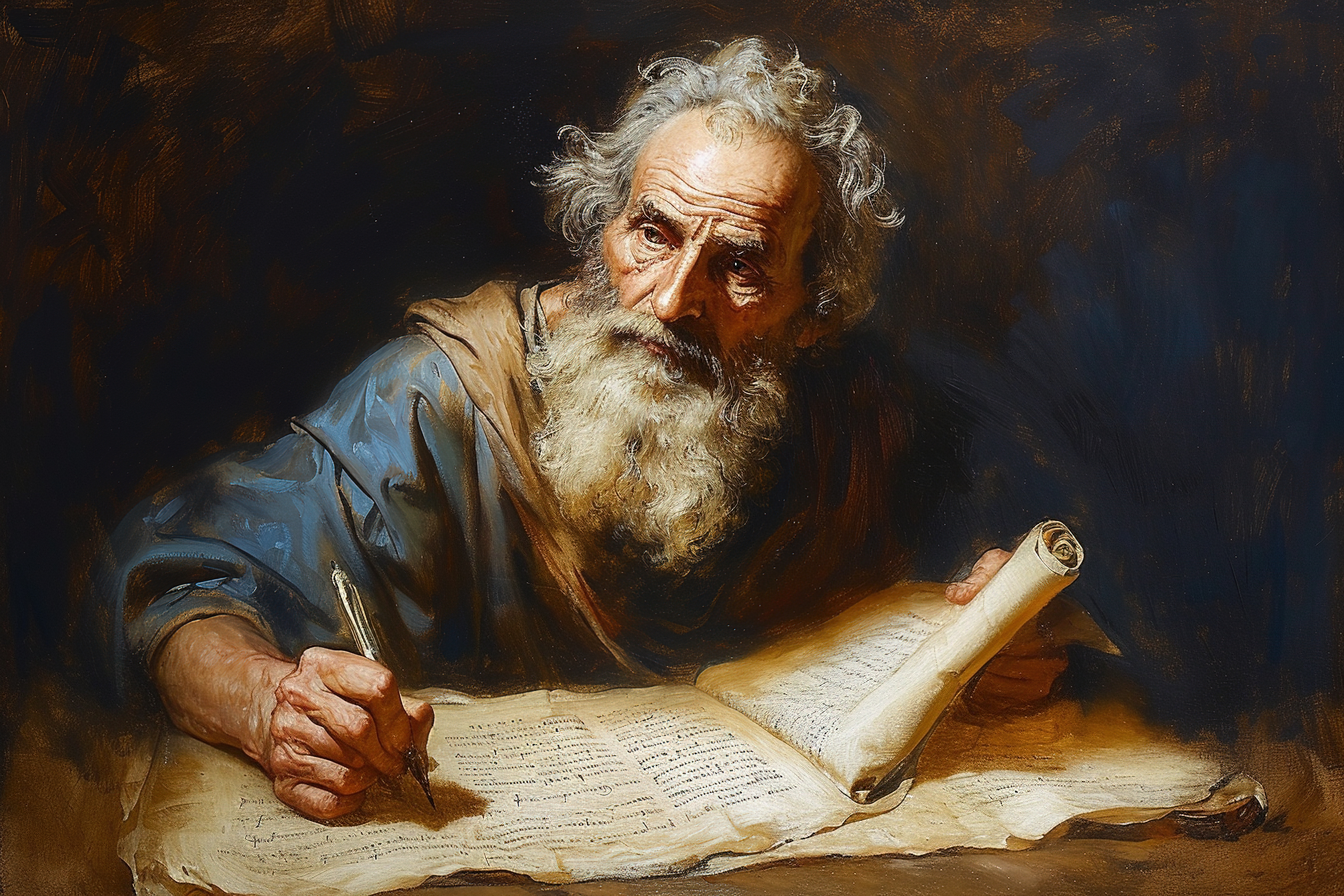

A Freed Paul Returns

Paul is free of his chains at last. He returns to the ministry of spreading the gospel to the Gentiles in every place he goes.
The book of Acts leaves us at the point where Paul is in Rome for two years, under arrest. We don’t get to hear of his release or where he goes next. We don’t even hear of his return to prison and death from the author of Acts. But these things are recorded elsewhere in scripture. In Paul’s letters to Timothy and Titus we see his movements and eventual return to prison. So let’s continue with his story.
Holy Spirit, lead me on this journey. Show me what I need to pay attention to. Let Paul’s final years come alive in my spirit. Be my ‘Guide’ on this adventure.
♥ ♦ ♥
With Peter in Rome, Paul takes his leave. Timothy travels with him, ever at his side. These two have become inseparable over the last two years. Their first destination is Spain.
James, Jesus’ brother was in Spain before his death at the hands of Herod. Paul and Timothy visit the churches James planted. They are going strong and growing in the Spirit. Paul encourages the churches heartily, but does not feel a part of them.
“Timothy, I feel the pull of my former journeys on me. I want to return to the regions of Galatia, Asia, Macedonia, and Achaia.”
“I would like that as well. We have been far from home for too many years.”
The next day, the two set out for what they consider their ‘home’. As the land route is long and treacherous, they journey back to the seaport where Paul first landed in Italy; Puteoli. While in Puteoli, Titus joins Paul and Timothy.
“It is good to see you again my son” Paul says as he embraces Titus.
When the embrace breaks, Titus makes a request. “I would like to join you in your travels.”
“Nothing would please me more” exclaims Paul.
The three spend the night in Puteoli, waiting for a ship sailing to Crete. It is easy to secure passage in the morning.
The weather is with them and they make good progress. Paul stands on deck and looks out across the ocean. He is grateful that they don’t experience any storms like when he last passed through this region. He smiles as he sees the island of Malta in the distance. He remembers fondly their hospitality.
Titus, standing beside him, notices his far away look. “What are you thinking about” he gently asks.
“I am remembering the people of Malta. How they came to the aid of our shipwrecked crew and welcomed us into their homes. Someday, I may return to them. The winter I spent with them holds many good memories.”
“Should I ask the captain to divert to there?”
“No. That will be a voyage for another day” Paul answer.
A day later the ship sails into the harbor of Phoenix on the isle of Crete. This is the place the captain of Paul’s ill-fated trip was attempting to sail to in order to winder there before going on to Rome. This will be the first time Paul steps foot in this city. Yet the memories of that trip still ring in his mind.
Paul, Timothy, and Titus disembark and begin making their way across the length of the island. They are surprised to see that no one has preceded them to this section of the world, carrying the gospel of Jesus.
“The harvest is plenty and the workers are few” Paul comments as they pass through the cities. Paul begins planting churches, as he has sone in other regions. The three missionaries spend a full year planting and organizing the churches in Crete before Paul feels called to journey on farther.
“Titus, there is still much work to be done here. I want to leave you here to continue working with the churches and organizing them.”
“I would be most honored to continue the work here. I have grown to love the people of Crete as my own.”
“I sensed that in you. That is the reason I felt comfortable to ask this of you.”
Timothy and Paul ready for the next leg of their journey. They travel to Irakleio where they set sail for Asia. Titus travels with them to the sea port and sees them safely onto another ship. He waves from the dock as the two depart.
“Safe travels. May the Lord lead your journey” Titus calls to the retreating ship.
“May he bless your time on Crete” Paul shouts back.
Paul and Timothy move to the front of the ship. They watch with excitement as the ship nears familiar harbors.
“It seems like a lifetime ago that I last set foot in Miletus” Paul muses.
“In a way it is. You are coming back a different man. One that has known the suffering of bondage” Timothy replies.
Paul laughs. “I have indeed been bound for two years but I don’t know how much ‘suffering’ I endured. Things could have been MUCH worse. I am grateful for the freedoms I received while in chains.”
“Agreed” Timothy adds. “House arrest and visitors any time isn’t the typical ‘prisoner’s plight’.”
Paul and Timothy travel to Ephesus after making landfall. It isn’t a long journey. It is however a familiar one. Every sight and sound brings back memories to them both. Timothy has been absent from this portion of the world for as long as Paul has. He stayed at Paul’s side during his imprisonment. He was Paul’s faithful companion and scribe.
Paul is immediately recognized when he enters Ephesus.
“It’s brother Paul” exclaims several of the believers in the city.
It doesn’t take long before the whole city knows and the believers rush out to welcome him back.
“Where are you staying?” “How long do you plan on staying?” “Do you have another word for the churches from the Lord?”
“Brothers! Slow down. I will be here for some time. I will answer all your questions one at a time.”
The fervor quickly dies down and the group moves to a more comfortable location; one of the nearby homes use for services. Paul begins sharing the stories of their adventures. He makes certain to include the churches they just planted in Crete and Titus’ mission there.
Paul and Timothy spend six months in Ephesus. Signs and wonders flow just as before. People continue to be drawn to the gospel.
Paul visits the church in Colossae as well. He wrote to them from prison and now gets to see them in person. They are as glad to see him as he is to see them. Paul and Timothy spend three weeks with them before returning to Ephesus.
While in Ephesus Paul receives word of trouble in the churches in Crete regarding leadership. He writes a letter to Titus to address this. It is his model for putting the leadership in the churches in order.
This letter starts out with the longest greeting Paul has ever included. He isn’t certain why, it is just what the Spirit impressed on him to include. Timothy raises an eyebrow as he transcribes Paul’s greeting.
“Paul, a servant of God and an apostle of Jesus Christ, for the sake of the faith of God’s elect and their knowledge of the truth, which accords with godliness, in hope of eternal life, which God, who never lies, promised before the ages began and at the proper time manifested in his word through the preaching with which I have been entrusted by the command of God our Savior;
“To Titus, my true child in a common faith:
“Grace and peace from God the Father and Christ Jesus our Savior” (Titus 1:1-4).
Paul gets directly to the problem.
“This is why I left you in Crete, so that you might put what remained into order, and appoint elders in every town as I directed you— if anyone is above reproach, the husband of one wife, and his children are believers and not open to the charge of debauchery or insubordination. For an overseer, as God’s steward, must be above reproach. He must not be arrogant or quick-tempered or a drunkard or violent or greedy for gain, but hospitable, a lover of good, self-controlled, upright, holy, and disciplined. He must hold firm to the trustworthy word as taught, so that he may be able to give instruction in sound doctrine and also to rebuke those who contradict it.
“For there are many who are insubordinate, empty talkers and deceivers, especially those of the circumcision party. They must be silenced, since they are upsetting whole families by teaching for shameful gain what they ought not to teach. One of the Cretans, a prophet of their own, said, ‘Cretans are always liars, evil beasts, lazy gluttons.’ This testimony is true. Therefore rebuke them sharply, that they may be sound in the faith, not devoting themselves to Jewish myths and the commands of people who turn away from the truth. To the pure, all things are pure, but to the defiled and unbelieving, nothing is pure; but both their minds and their consciences are defiled. They profess to know God, but they deny him by their works. They are detestable, disobedient, unfit for any good work” (Titus 1:5-16).
After setting the requirements for the leaders, Paul turns to Titus. He has instructions that he wants Titus to focus on with the church in his teachings. To raise up godly men and women in Christ.
“But as for you, teach what accords with sound doctrine. Older men are to be sober-minded, dignified, self-controlled, sound in faith, in love, and in steadfastness. Older women likewise are to be reverent in behavior, not slanderers or slaves to much wine. They are to teach what is good, and so train the young women to love their husbands and children, to be self-controlled, pure, working at home, kind, and submissive to their own husbands, that the word of God may not be reviled. Likewise, urge the younger men to be self-controlled. Show yourself in all respects to be a model of good works, and in your teaching show integrity, dignity, and sound speech that cannot be condemned, so that an opponent may be put to shame, having nothing evil to say about us. Bondservants are to be submissive to their own masters in everything; they are to be well-pleasing, not argumentative, not pilfering, but showing all good faith, so that in everything they may adorn the doctrine of God our Savior.
“For the grace of God has appeared, bringing salvation for all people, training us to renounce ungodliness and worldly passions, and to live self-controlled, upright, and godly lives in the present age, waiting for our blessed hope, the appearing of the glory of our great God and Savior Jesus Christ, who gave himself for us to redeem us from all lawlessness and to purify for himself a people for his own possession who are zealous for good works.
“Declare these things; exhort and rebuke with all authority. Let no one disregard you” (Titus 2:1-15).
Paul realizes now why he made such a long introduction. This gives Titus the authority of Paul’s backing and Jesus’ calling when he corrects those who would oppose him. After this revelation, he returns to the attitudes and lifestyle Titus is to insist upon from the believers, supporting it sound doctrine of faith.
“Remind them to be submissive to rulers and authorities, to be obedient, to be ready for every good work, to speak evil of no one, to avoid quarreling, to be gentle, and to show perfect courtesy toward all people. For we ourselves were once foolish, disobedient, led astray, slaves to various passions and pleasures, passing our days in malice and envy, hated by others and hating one another. But when the goodness and loving kindness of God our Savior appeared, he saved us, not because of works done by us in righteousness, but according to his own mercy, by the washing of regeneration and renewal of the Holy Spirit, whom he poured out on us richly through Jesus Christ our Savior, so that being justified by his grace we might become heirs according to the hope of eternal life. The saying is trustworthy, and I want you to insist on these things, so that those who have believed in God may be careful to devote themselves to good works. These things are excellent and profitable for people. But avoid foolish controversies, genealogies, dissensions, and quarrels about the law, for they are unprofitable and worthless. As for a person who stirs up division, after warning him once and then twice, have nothing more to do with him, knowing that such a person is warped and sinful; he is self-condemned” (Titus 3:1-11).
Paul feels comfortable ending his instructions now. This should be all Titus needs to complete the task of setting the church in order. And when his task is done, Paul would LOVE to see him again. He tells him so in his closing.
“When I send Artemas or Tychicus to you, do your best to come to me at Nicopolis, for I have decided to spend the winter there. Do your best to speed Zenas the lawyer and Apollos on their way; see that they lack nothing. And let our people learn to devote themselves to good works, so as to help cases of urgent need, and not be unfruitful.
“All who are with me send greetings to you. Greet those who love us in the faith.
“Grace be with you all” (Titus 3:12-15).
Timothy finishes transcribing Paul’s words. “Do you want me to tell Artemas or Tychicus of their upcoming mission?”
“No. I will do that task tomorrow. I think we could both use a rest tonight.”
What Paul hasn’t told Timothy is that he will be leaving him here in Ephesus, just as he did with Titus. Paul told Titus where he would be when winter comes, but he has several places to stop along the way. He plans to travel through Macedonia and visit the church in Corinth before making his winter home in Nicopolis.
In the morning, Paul calls for his two trusted companions. Artemas and Tychicus both appear before him.
“I have a letter to deliver to Titus in Crete. I want to send one or both of you. Do you have any objections or prior commitments?”
“My wife is expecting our first child any day now” Artemas says.
Tychicus shakes his head “no” indicating that he has on problem with the assignment.
“Then, Tychicus, it appears that you will be my messenger to Titus.”
“I will not fail you brother.”
“I know you won’t, for the Lord surely travels with you.”
Tychicus sets out for Crete that same day, booking passage from the seaport.
After Tychicus leaves, Paul shares his plans with Timothy.
“My son, I’m sure you remember where I told Titus I would be when winter arrives.”
“I do.”
“It will take some time to arrive there, so I will be leaving soon. However, I need you to stay on here in Ephesus, doing the same work that Titus is doing in Crete.”
Timothy’s face struggles with what expressing what he feels. On one hand, he is excited to be given such a task. On the other, he has been with Paul so long that he will feel incomplete without him. No matter what his feelings are though, he will NOT disappoint Paul.
“I will endeavor to do all that you ask of me.”
“God will work by your side. You will not be doing this alone.”
Timothy smiles at Paul’s encouragement. He knew this all along, but his heart needed the reminder. This is God’s work, NOT man’s, so his success is in God’s hands.
“Thank you brother. I needed that reminder.”
Three days later, Paul is packed and ready to continue his journey. The church gathers to pray for him before he leaves.
“Lord God, watch over our brother Paul. Put Your hedge of protection around him as he travels to the other churches. Go with him and direct his footsteps. Bless those who bless him and curse those who curse him. And bring him back to us again, if it is Your will. Amen!”
Paul feels energized by their prayers, knowing that the Lord will do exactly as they have asked. His next stop is Troas, where he will cross over to Macedonia. He wants to check in on young Eutychus. To see how God has used him since raising him from the dead.
When Paul enters Troas, he goes to the dock first to secure passage for the next day. Eutychus happens to see him as he passes through town.
“Brother Paul” Eutychus cries out.
Paul turns towards the sound of his name and sees a slightly older Eutychus hurrying towards him. A smile splits both men’s faces from ear to ear. When they are within arms distance, they embrace tightly, patting one another on the back as they do so.
“Eutychus, my boy. I was wondering what had become of you. I intended to look you up at my first opportunity.”
“I didn’t know you were coming. I heard that you had been released from prison a couple years ago, but never dreamed of running into you again. Where are you going? What are your plans?”
“I’m on my way to Macedonia to meet up with the churches, then off to Corinth and finally to Nicopolis to spend the winter.”
“That sounds like a grand adventure!”
“I wouldn’t mind a traveling companion, if you are so inclined to join me” Paul offers.
“It would be my honor, but my Ima is not well. She requires me to stay near to tend to her.”
“Have you asked the church to pray for her?” Paul asks.
“I did, and they have.”
Paul nods his head. He knows that not all prayers are answered immediately, but he would like to lend his to the group’s.
“Would you mind if I prayed for her as well?”
“Oh, Please Do” Eutychus cries.
Paul walks with Eutychus to his home. When they enter, Eutychus’ mother clasps her hands over her mouth in joy and surprise. She remembers Paul very well. He is the reason her son is alive today. She starts to rise to serve him, as any good hostess would do.
Paul puts a hand out to restrain her. “No mother, it is I who have come to serve you.”
She settles back onto her stool, wondering about Paul’s words.
Paul can see the pallor in her face and the sunken cheeks. She appears to have been ill for some time. “May I pray for you” he asks.
“Please. I welcome your prayers. I KNOW that you have the Lord’s ear.”
Paul prays for strength to return to her body and for complete healing of every disease that is trying to find a home in her body. He also prays for her peace of mind.
Withing seconds, she feels strength surging through her body, as if she was a young girl again. She gets up and begins to dance before the Lord, raising her arms and voice in praise. After several minutes, she slows to a stop.
Paul and Eutychus joined in praising the Lord while she danced, but refrained from joining her.
“I have not felt this good since I was a young girl. Thank you for your prayers and thank God for hearing them!”
“You are most welcome and fully deserving of such a gift of the Lord. I have heard good things about you from Eutychus as we walked together.”
Eutychus’ mother blushes. “I’m sure he over exaggerated my deeds, but I’m grateful just the same.”
Paul stays the night with mother and son. When morning dawns, Eutychus is packed and ready to go. He didn’t even need to ask his Ima. She came to him in the evening and told him that she wanted him to go with Paul, for his safety.
Paul smiles as he sees Eutychus’ bed roll waiting by the door and his mother packing meals for them. “I see the decision has already been made for Eutychus to accompany me on my journey. I will send him back to you once I reach Philippi.”
“He can go farther if you need him to” Eutychus’ mother offers.
“No. I know that he is needed here too. Someone will join up with me in Philippi; I’m certain of it.”
“As you wish” she replies with a bow of her head.
The Aegean Sea crossing is easy and pleasant. In no time at all, Eutychus and Paul make landfall in the harbor of Neapolis. They complete their journey, reaching Philippi in two days’ time. Paul know it will take a bit longer for Eutychus to return home, as the current and winds will be against him as he makes his sea crossing. Paul plans on keeping him for a few more days. He will be gone from home less than two weeks. Plenty of time to get a taste of travel and not too long so that his mother can’t handle things on her own.
Eutychus is excited to meet the brothers and sisters in Philippi. He is impressed that Lydia is the original organizer of the church. She met Paul just outside town and offered her home for the first meeting place of the church. The number of believers strains her home almost to the breaking point, but she continues to serve all who come.
“Lydia, it is good to see you again” Paul says when they meet up.
“I prayed that we would see your face again” Lydia says with tears in her eyes.
“I trust you received my letters.”
“We did, and we have shared them with all the churches around us. We even received a copy of some of your letters from as far away as Galatia.”
“I didn’t expect them to travel so far” Paul says with raised eyebrows.
“Your words are precious to us, as we KNOW they are directly from the Lord.”
“I’m glad to hear that, sister. I hope there are fewer occasions to write such strong letters. As I remember, the church here had little that needed correction.”
“That doesn’t mean that we haven’t taken your corrective words to other churches to heart. We want to remain pleasing to the Lord at all times. As well as honor your work on His behalf.”
Paul spends three weeks with the church in Philippi after sending Eutychus on his way home. Paul knows it was good for the young man to have this opportunity.
A month has passed since Paul arrived in Philippi. He is preparing to move on when he sees Eutychus coming towards him.
“I thought you went home to Troas.”
“I did, but a message reached the church from Ephesus and I volunteered to deliver it to you.”
“Thank you very much for your assistance. I see you have matured quite a bit since the day we met. I may have need of your services after I read this letter. Would you mind staying on for a few days?”
“I consider it an honor to be asked” Eutychus says while standing to his full height.
Paul goes into the room where he has been staying and begins reading the letter. It is from Timothy. He is running into obstacles with the believers in Ephesus. They are resisting his instructions because of his age. They doubt his ability to lead them because of his youth. Paul KNOWS that Timothy is MORE than capable of the task.
Paul shakes his head. “I suppose I need to write to Timothy, so that the believers can read it as well and see the confidence I place in him.”
Paul asks Lydia for a scribe to help him. His eyesight still makes it difficult to read and write in print that doesn’t take up large amounts of parchment.
When the scribe arrives, Paul is ready to begin. Eutychus has asked if he could be present and Paul has agreed.
“Paul, an apostle of Christ Jesus by command of God our Savior and of Christ Jesus our hope,
“To Timothy, my true child in the faith:
“Grace, mercy, and peace from God the Father and Christ Jesus our Lord” (1 Timothy 1:1-2).
Paul wonders only for a moment if he should have addressed his opening in the same manner as his letter to Titus. But the people of Ephesus KNOW the confidence Paul has placed in Timothy. They need not wonder about Timothy’s authority under Paul. Timothy’s name was on their personal letters as well.
Paul focuses first on those trying to bring in other doctrines, especially that of circumcision, again.
“As I urged you when I was going to Macedonia, remain at Ephesus so that you may charge certain persons not to teach any different doctrine, nor to devote themselves to myths and endless genealogies, which promote speculations rather than the stewardship from God that is by faith. The aim of our charge is love that issues from a pure heart and a good conscience and a sincere faith. Certain persons, by swerving from these, have wandered away into vain discussion, desiring to be teachers of the law, without understanding either what they are saying or the things about which they make confident assertions.
“Now we know that the law is good, if one uses it lawfully, understanding this, that the law is not laid down for the just but for the lawless and disobedient, for the ungodly and sinners, for the unholy and profane, for those who strike their fathers and mothers, for murderers, the sexually immoral, men who practice homosexuality, enslavers, liars, perjurers, and whatever else is contrary to sound doctrine, in accordance with the gospel of the glory of the blessed God with which I have been entrusted” (1 Timothy 1:3-11).
Paul uses his own conversion and salvation as an example again, to encourage those opposing Timothy. He also names those who are causing the most trouble.
“I thank him who has given me strength, Christ Jesus our Lord, because he judged me faithful, appointing me to his service, though formerly I was a blasphemer, persecutor, and insolent opponent. But I received mercy because I had acted ignorantly in unbelief, and the grace of our Lord overflowed for me with the faith and love that are in Christ Jesus. The saying is trustworthy and deserving of full acceptance, that Christ Jesus came into the world to save sinners, of whom I am the foremost. But I received mercy for this reason, that in me, as the foremost, Jesus Christ might display his perfect patience as an example to those who were to believe in him for eternal life. To the King of the ages, immortal, invisible, the only God, be honor and glory forever and ever. Amen.
“This charge I entrust to you, Timothy, my child, in accordance with the prophecies previously made about you, that by them you may wage the good warfare, holding faith and a good conscience. By rejecting this, some have made shipwreck of their faith, among whom are Hymenaeus and Alexander, whom I have handed over to Satan that they may learn not to blaspheme” (1 Timothy 1:12-20).
Paul turns his attention to how the people should live. He addressed some of this in his letter to Titus, but it bears repeating so the people of Ephesus will hear it as well.
“First of all, then, I urge that supplications, prayers, intercessions, and thanksgivings be made for all people, for kings and all who are in high positions, that we may lead a peaceful and quiet life, godly and dignified in every way. This is good, and it is pleasing in the sight of God our Savior, who desires all people to be saved and to come to the knowledge of the truth. For there is one God, and there is one mediator between God and men, the man Christ Jesus, who gave himself as a ransom for all, which is the testimony given at the proper time. For this I was appointed a preacher and an apostle (I am telling the truth, I am not lying), a teacher of the Gentiles in faith and truth.
“I desire then that in every place the men should pray, lifting holy hands without anger or quarreling; likewise also that women should adorn themselves in respectable apparel, with modesty and self-control, not with braided hair and gold or pearls or costly attire, but with what is proper for women who profess godliness—with good works. Let a woman learn quietly with all submissiveness. I do not permit a woman to teach or to exercise authority over a man; rather, she is to remain quiet. For Adam was formed first, then Eve; and Adam was not deceived, but the woman was deceived and became a transgressor. Yet she will be saved through childbearing—if they continue in faith and love and holiness, with self-control” (1 Timothy 2:1-15).
Paul focuses on the leaders of the church now. Timothy will certainly recognize these instructions.
“The saying is trustworthy: If anyone aspires to the office of overseer, he desires a noble task. Therefore an overseer must be above reproach, the husband of one wife, sober-minded, self-controlled, respectable, hospitable, able to teach, not a drunkard, not violent but gentle, not quarrelsome, not a lover of money. He must manage his own household well, with all dignity keeping his children submissive, for if someone does not know how to manage his own household, how will he care for God’s church? He must not be a recent convert, or he may become puffed up with conceit and fall into the condemnation of the devil. Moreover, he must be well thought of by outsiders, so that he may not fall into disgrace, into a snare of the devil.
“Deacons likewise must be dignified, not double-tongued, not addicted to much wine, not greedy for dishonest gain. They must hold the mystery of the faith with a clear conscience. And let them also be tested first; then let them serve as deacons if they prove themselves blameless. Their wives likewise must be dignified, not slanderers, but sober-minded, faithful in all things. Let deacons each be the husband of one wife, managing their children and their own households well. For those who serve well as deacons gain a good standing for themselves and also great confidence in the faith that is in Christ Jesus” (1 Timothy 3:1-13).
Paul speaks directly to Timothy, ensuring him of his trust in Timothy’s abilities to manage until he returns to him.
“I hope to come to you soon, but I am writing these things to you so that, if I delay, you may know how one ought to behave in the household of God, which is the church of the living God, a pillar and buttress of the truth. Great indeed, we confess, is the mystery of godliness:
“He was manifested in the flesh, vindicated by the Spirit, seen by angels, proclaimed among the nations, believed on in the world, taken up in glory” (1 Timothy 3:14-16).
Paul warns Timothy that not ALL the people will listen to him. This is the truth for even Paul in his teaching. Especially those who espouse the doctrine of circumcision and adherence to the Law.
“Now the Spirit expressly says that in later times some will depart from the faith by devoting themselves to deceitful spirits and teachings of demons, through the insincerity of liars whose consciences are seared, who forbid marriage and require abstinence from foods that God created to be received with thanksgiving by those who believe and know the truth. For everything created by God is good, and nothing is to be rejected if it is received with thanksgiving, for it is made holy by the word of God and prayer” (1 Timothy 4:1-5).
Paul urges Timothy to live as he KNOWS God has called him to do. For he was given direct prophecy concerning his life when the brothers laid hands on him many years ago.
“If you put these things before the brothers, you will be a good servant of Christ Jesus, being trained in the words of the faith and of the good doctrine that you have followed. Have nothing to do with irreverent, silly myths. Rather train yourself for godliness; for while bodily training is of some value, godliness is of value in every way, as it holds promise for the present life and also for the life to come. The saying is trustworthy and deserving of full acceptance. For to this end we toil and strive because we have our hope set on the living God, who is the Savior of all people, especially of those who believe.
“Command and teach these things. Let no one despise you for your youth, but set the believers an example in speech, in conduct, in love, in faith, in purity. Until I come, devote yourself to the public reading of Scripture, to exhortation, to teaching. Do not neglect the gift you have, which was given you by prophecy when the council of elders laid their hands on you. Practice these things, immerse yourself in them, so that all may see your progress. Keep a close watch on yourself and on the teaching. Persist in this, for by so doing you will save both yourself and your hearers” (1 Timothy 4:6-16).
As Timothy is young, Paul needs him to be mindful of that. Of the fact that, when he speaks to older men, he must honor that age difference and treat them with respect due one of that age. Paul also has instructions regarding dealing with widows.
“Do not rebuke an older man but encourage him as you would a father, younger men as brothers, 2 older women as mothers, younger women as sisters, in all purity.
“Honor widows who are truly widows. But if a widow has children or grandchildren, let them first learn to show godliness to their own household and to make some return to their parents, for this is pleasing in the sight of God. She who is truly a widow, left all alone, has set her hope on God and continues in supplications and prayers night and day, but she who is self-indulgent is dead even while she lives. Command these things as well, so that they may be without reproach. But if anyone does not provide for his relatives, and especially for members of his household, he has denied the faith and is worse than an unbeliever…”
Paul’s face takes on a distasteful look at such an offense. Eutychus recognizes that he is his own mother’s support. He will not fail Paul, or the Lord, in this area.
“…Let a widow be enrolled if she is not less than sixty years of age, having been the wife of one husband, and having a reputation for good works: if she has brought up children, has shown hospitality, has washed the feet of the saints, has cared for the afflicted, and has devoted herself to every good work. But refuse to enroll younger widows, for when their passions draw them away from Christ, they desire to marry and so incur condemnation for having abandoned their former faith. Besides that, they learn to be idlers, going about from house to house, and not only idlers, but also gossips and busybodies, saying what they should not. So I would have younger widows marry, bear children, manage their households, and give the adversary no occasion for slander. For some have already strayed after Satan. If any believing woman has relatives who are widows, let her care for them. Let the church not be burdened, so that it may care for those who are truly widows.
“Let the elders who rule well be considered worthy of double honor, especially those who labor in preaching and teaching. For the Scripture says, ‘You shall not muzzle an ox when it treads out the grain,’ and, ‘The laborer deserves his wages.’ Do not admit a charge against an elder except on the evidence of two or three witnesses. As for those who persist in sin, rebuke them in the presence of all, so that the rest may stand in fear. In the presence of God and of Christ Jesus and of the elect angels I charge you to keep these rules without prejudging, doing nothing from partiality. Do not be hasty in the laying on of hands, nor take part in the sins of others; keep yourself pure. No longer drink only water, but use a little wine for the sake of your stomach and your frequent ailments. The sins of some people are conspicuous, going before them to judgment, but the sins of others appear later. So also good works are conspicuous, and even those that are not cannot remain hidden” (1 Timothy 5:1-25).
Paul returns his attention to the body of believers.
“Let all who are under a yoke as bondservants regard their own masters as worthy of all honor, so that the name of God and the teaching may not be reviled. Those who have believing masters must not be disrespectful on the ground that they are brothers; rather they must serve all the better since those who benefit by their good service are believers and beloved…”
Paul urges Timothy to stand FIRM in the teachings he knows to be sound doctrine.
“Teach and urge these things. If anyone teaches a different doctrine and does not agree with the sound words of our Lord Jesus Christ and the teaching that accords with godliness, he is puffed up with conceit and understands nothing. He has an unhealthy craving for controversy and for quarrels about words, which produce envy, dissension, slander, evil suspicions, and constant friction among people who are depraved in mind and deprived of the truth, imagining that godliness is a means of gain. But godliness with contentment is great gain, for we brought nothing into the world, and we cannot take anything out of the world. But if we have food and clothing, with these we will be content. But those who desire to be rich fall into temptation, into a snare, into many senseless and harmful desires that plunge people into ruin and destruction. For the love of money is a root of all kinds of evils. It is through this craving that some have wandered away from the faith and pierced themselves with many pangs” (1 Timothy 6:1-10).
Paul pleads for Timothy’s endurance in the faith again before concluding his letter.
“But as for you, O man of God, flee these things. Pursue righteousness, godliness, faith, love, steadfastness, gentleness. Fight the good fight of the faith. Take hold of the eternal life to which you were called and about which you made the good confession in the presence of many witnesses. I charge you in the presence of God, who gives life to all things, and of Christ Jesus, who in his testimony before Pontius Pilate made the good confession, to keep the commandment unstained and free from reproach until the appearing of our Lord Jesus Christ, which he will display at the proper time—he who is the blessed and only Sovereign, the King of kings and Lord of lords, who alone has immortality, who dwells in unapproachable light, whom no one has ever seen or can see. To him be honor and eternal dominion. Amen” (1 Timothy 6:11-16).
One last instruction for the church remains. Paul addresses those who would try and lord it over those who have less, rather than helping when they see a need.
“As for the rich in this present age, charge them not to be haughty, nor to set their hopes on the uncertainty of riches, but on God, who richly provides us with everything to enjoy. They are to do good, to be rich in good works, to be generous and ready to share, thus storing up treasure for themselves as a good foundation for the future, so that they may take hold of that which is truly life” (1 Timothy 6:17-19).
Paul’s eyes soften as he speaks to Timothy as though he were embracing him; encouraging him against feeling defeated by those he cannot reach.
“O Timothy, guard the deposit entrusted to you. Avoid the irreverent babble and contradictions of what is falsely called ‘knowledge,’ for by professing it some have swerved from the faith.
“Grace be with you” (1 Timothy 6:20-21).
When the letter is ready, Paul hands it to Eutychus to deliver to Timothy. “I recognize that Ephesus is farther away from your home, but I would be honored if you would deliver this to Timothy.”
“I won’t fail you brother” Eutychus says while holding the letter as if it is a priceless object.
After Eutychus departs the next morning, Paul prepares to continue his journey as well. He bids the brothers farewell.
“I will stop again, the next time I pass this way. Until then, know that you are always in my prayers.”
Lydia gives Paul a parcel with money and food for his journey. “Be safe my brother. But most of all, go with God.”
Because Paul is in a hurry to reach Nicopolis before winter sets in, he bypasses all the other churches in Macedonia and goes straight to Corinth. It takes nearly a month of traveling before he is standing on the doorstep of the church he planted in Corinth.
Paul had the longest set of difficulties with the church in Corinth. He prays that everything is still settled from his last visit. Things were strained for a while. When the door is opened to his knock, all his fears are laid to rest.
“Brother Paul! We heard that you had been released. We prayed earnestly that you would see fit to visit us. And here you are! Our prayers are answered. Please come in.”
Paul is warmly welcomed by the body of believers. His stores are replenished immediately, without him even mentioning that he was running low. Never has he seen this group more hospitable. He doesn’t even get to empty his plate before something more is placed there for his nourishment.
“What are your plans brother?”
“I plan to travel to Nicopolis for the winter. I will stay with friends there.”
“You are welcome to spend the winter with us. We would welcome an extended stay and benefit from your teaching.”
“That sounds tempting, but I sent word to Titus, whom I left in Crete to organize the churches there, that I would be wintering in Nicopolis. I don’t have any way to contact him and advise him of any changes in my plans. I’m not certain when he will be setting sail, or where he will be landing.”
“The mountain passes can be dangerous as we approach winter. It may not be advisable to travel this late in the season.”
“I believe there is still another month before I need to be across the mountains. If it is permissible, I will stay here with you and teach in the meantime.”
“That is a great idea. You are certainly welcome here.”
Paul teaches in the evenings each day, allowing the people to continue about their normal daily routines. He works beside the leader of the church during the day as well. He makes the most out of the time he has with them, which he extends to two weeks.
“I must be off. I don’t want to get caught in a storm on the way” Paul says as he packs his belongings.
“We are sorry to see you go. This has been a wonderful two weeks. Please, stop in any time you can. God go with you in your journey.”
Paul is on the road again early the next morning. The mountain passes are high and treacherous, but Paul us used to rugged terrain. He is grateful for the heavy tunic one of the women made for him, as the passes are very windy and cold. He can smell winter in the air. Delaying any later in Corinth would definitely have made this journey impossible.
It takes two weeks for Paul to cross the mountain pass. He is cold and hungry by the time he enters Nicopolis. His friend’s home is easy to locate and warm as the door swings open.
“We were wondering if you were still coming. Titus has been here a week already. We thought you might have been delayed by one of your churches and had to winter elsewhere.”
“Corinth did ask me to stay, but I didn’t want to disappoint you or misinform Titus” Paul says with a smile. “Just got a later start because they asked for more teaching.”
Titus joins Paul as he and the home owner step inside.
“It is good to see you brother. If you hadn’t made it by the time the snow arrived, I was planning on searching for you. I’m glad I didn’t have to brave the weather.”
“Safe and sound” Paul says while patting Titus on the shoulder. “I was just a little late starting out.”
“Too many friends to visit along the way” Titus says.
“Absolutely true my son.”
“I arranged lodging for us on the edge of town. I didn’t want to impose on the brothers for the whole winter.”
“Good thinking. It is a bit to ask. But I want to visit a while before heading to our winter home.”
“I wouldn’t have it any other way” Paul’s friend interjects.
“Also, while we are here, I would intend to teach to gospel.”
“Again, we would have it no other way!”
Paul and Titus’ home serves as the gathering place for the believers on the first day of every week during their stay. Paul tried teaching in the synagogue the first Sabbath, but was immediately run out. They had heard he was coming and were ready with their argument regarding circumcision, the Law, and their denial of Jesus as the Messiah. Paul didn’t return again to their place of worship, but several of their believers came regularly to sit at Paul’s feet and learn. Before the winter ends, half of the congregation of the synagogue become believers.
Paul establishes a permanent place for the new church to gather at the home of his friend before leaving Nicopolis in the spring.
(to be continued)
We are nearing the end of Paul’s journey and his life. He has one final stop to make; Rome. Although Paul was unhindered from spreading the gospel while under house arrest, Nero takes a different view by the time Paul returns.
Father God, thank You for sharing Your stories with me. I don’t know how well I am bringing them to life, but I pray I am honoring You with them. Keep me walking on this path. It is a difficult journey for me without Paul’s actual story to guide me. Thank You for those who have fully studied these years of Paul’s life to help me fill in some of the details. I know I couldn’t search it all out on my own.
I also know that the stress in my life is dragging my spirit down and making it harder for me to engage in the stories. Help me to rise above the fear and simply trust in Your plan. I DO trust You! I just don’t know how to let go of expectations or what is truly happening. There have been low times for Steve before, and he bounced back after a while. Times I thought I would lose him. This time feels different; heavier. Carry both of us Lord through this time to the future You have for each of us; whatever that may be. Hold him in Your arms Father. Bring him comfort and peace. I will take healing as well. In Jesus’ name I pray. Amen!