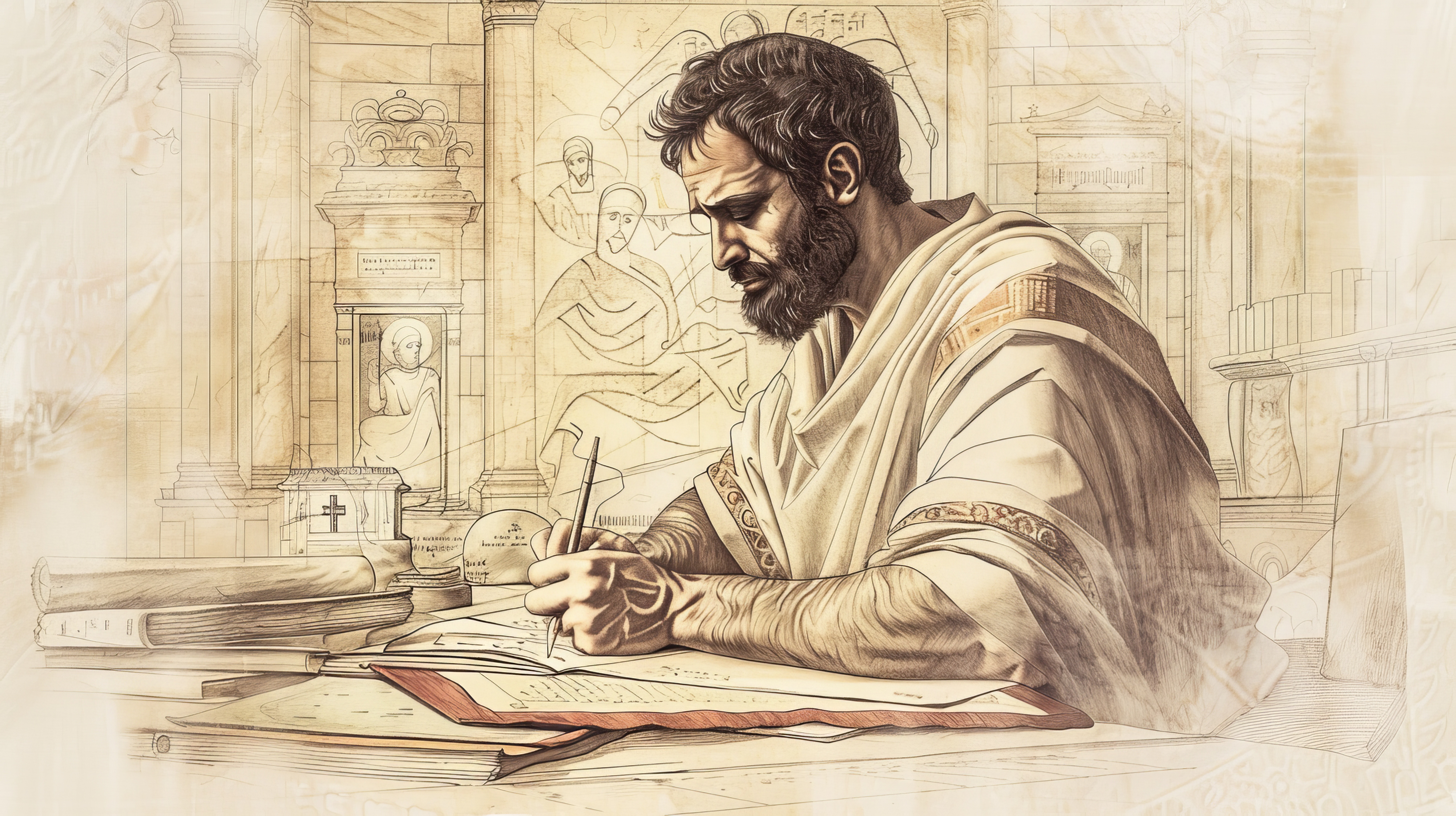

Paul Continues on the Third Journey

Paul continues on from Macedonia to Greece and Corinth during this third journey. In Corinth, he writes to the Roman church.
Paul is the most prolific writer in the New Testament. I’m finding out just where and when he found the time to write, and the purposes behind his putting pen to paper. Let’s rejoin him as he makes his way to Corinth. I apologize in advance for the length of this post, as Romans is a weighty letter.
Holy Spirit, thank You for taking me this far in Paul’s journey. PLEASE help me complete it with him. Help me to understand Romans and be able to share, at least in part, what You would have me include in Your story. I KNOW I won’t do the same job that Paul did, but lead and guide me as I continue with him on the path set out for him.
♥ ♦ ♥
Paul arrives safely in Corinth. He is warmly welcomed by the church. His first order of business is dealing with those who are still in rebellion. It is no easy task. He prays that fellowship can be restored, but that is in God’s hands.
The leaders of the church call together all those who once shared the faith with them. This is the second such meeting, as Titus called the first one and read Paul’s letter in all their hearing. Some are reluctant to come, others come out of curiosity. Still more come out of remorse and repentance. These are the ones seeking restoration of their relationship with Paul, and the Lord.
“Welcome brothers and sisters. First of all, I want to tell you that you have made my heart burst with pride at your return to the gospel. I hold no anger or unforgiveness towards any of you. I will deal personally with those who remain in their sin.”
Paul looks around the room and easily identifies a handful of men whom he will address individually a little later. Their faces are a mix of stubbornness and shame. After identifying these individuals Paul goes on to share his love for them all and his prayer that they be restored to right relationship.
“I know that the Lord is working in each of you to bring about His plan for your life. His work may be painful for some, as He must break down your barriers before He can truly touch your hearts. Others will return to Him with gladness and singing. However you come, just come!” pleads Paul.
By the end of the week, all those who were on the edge have reconciled. There are those who refuse to listen to any correction. Paul places them in the hands of the Lord. He can do no more.
With this out of the way, Paul’s heart turns towards Rome. Aquila and Priscilla have been able to return to home after the death of Emperor Claudius. Word reaches Paul in Corinth of the mounting friction within the developing church. The Gentiles who remained in Rome and the returning Jews are not mixing well. His heart goes out to them and he is impressed by the Spirit to write to them. Not only does he want to write to them, but he wants to go there personally.
This letter will not be like any other he has ever composed. It will lay out the gospel for those who have remained and those who have returned. He prays that they will unify in the name of Jesus. But first, he will have to introduce himself to them. He is well known in this region, but not in Rome.
Paul takes his time with this letter. He doesn’t want to leave anything out of the plan God set in motion from the very beginning.
‘“Paul, a servant of Christ Jesus, called to be an apostle, set apart for the gospel of God’ (Romans 1:1), ‘To all those in Rome who are loved by God and called to be saints: Grace to you and peace from God our Father and the Lord Jesus Christ’ (Romans 1:7).”
‘“First, I thank my God through Jesus Christ for all of you, because your faith is proclaimed in all the world’ (Romans 1:8). I mention you daily in my prayers. For quite a while, I have longed to come to you so that we may strengthen one another in the Lord and that I may preach the gospel in Rome.”
Timothy smiles as he transcribes Paul’s words. His boldness shines through the words.
“For I am not ashamed of the gospel, for it is the power of God for salvation to everyone who believes, to the Jew first and also to the Greek. For in it the righteousness of God is revealed from faith for faith, as it is written, ‘The righteous shall live by faith’” (Romans 1:16-17).
“God stands firm against unrighteousness, which has been with man since the beginning. Even though God shows Himself clearly is all of creation, man does not honor Him as God. Man, seeing God, turns instead to the created things instead. He bows down to images of birds, animals, creeping things and even mortal man. These hold NO power and they draw man away from God.
‘“Because of this, God gave them up to their own debased desires. They pursue their lusts wherever they lead, sexual immorality, being chief among them. ‘They were filled with all manner of unrighteousness, evil, covetousness, malice. They are full of envy, murder, strife, deceit, maliciousness. They are gossips, slanderers, haters of God, insolent, haughty, boastful, inventors of evil, disobedient to parents, foolish, faithless, heartless, ruthless. Though they know God’s righteous decree that those who practice such things deserve to die, they not only do them but give approval to those who practice them’ (Romans 1:29-32). And you judge one another as sinful while doing the same things in yourself. You have no excuse and you condemn yourselves in the process.”
Paul shakes his head is sorrow for the state of his fellow man. He too must examine his heart, least he condemn others while practicing the very same sins.
‘“We know that the judgment of God rightly falls on those who practice such things. Do you suppose, O man—you who judge those who practice such things and yet do them yourself—that you will escape the judgment of God?’ (Romans 2:2-3). Do you believe that God has special grace and kindness just for you? You presume that God’s kindness and forbearance is meant especially for you, but it is meant to bring you to repentance, not an excuse for you to continue practicing such despicable ways. For in doing so, you are storing up wrath for the day of judgment.
“He will render to each one according to his works: to those who by patience in well-doing seek for glory and honor and immortality, he will give eternal life; but for those who are self-seeking and do not obey the truth, but obey unrighteousness, there will be wrath and fury. There will be tribulation and distress for every human being who does evil, the Jew first and also the Greek, but glory and honor and peace for everyone who does good, the Jew first and also the Greek. For God shows no partiality” (Romans 2:6-10).
“Yet there is division between the Jews and Greeks among you. The Jews charge the Greeks with not following the law when they themselves do no follow it. You claim circumcision and try to enforce it on the Greeks. All the while not adhering to the law yourselves.
“You who boast in the law dishonor God by breaking the law… The name of God is blasphemed among the Gentiles because of you… For circumcision indeed is of value if you obey the law, but if you break the law, your circumcision becomes uncircumcision” (Romans 2:23-25). “For no one is a Jew who is merely one outwardly, nor is circumcision outward and physical. But a Jew is one inwardly, and circumcision is a matter of the heart, by the Spirit, not by the letter. His praise is not from man but from God” (Romans 2:28-29).
Paul thinks back to the Jerusalem Counsel where this was settled. “I wonder why this wasn’t carried back with the Jews who returned to Rome. Surely enough time has passed that all should know of the decision.” He will make certain they understand, without faulting anyone for not already adhering to the decision.
‘“Then what advantage has the Jew? Or what is the value of circumcision? Much in every way. To begin with, the Jews were entrusted with the oracles of God’ (Romans 3:1-2). Did the unfaithfulness of some discount the Law or prove God unjust. Not in the least! ‘None is righteous, no, not one; no one understands; no one seeks for God. All have turned aside; together they have become worthless; no one does good, not even one’ (Romans 3:10-12).”
“For by works of the law no human being will be justified in his sight, since through the law comes knowledge of sin. But now the righteousness of God has been manifested apart from the law, although the Law and the Prophets bear witness to it— the righteousness of God through faith in Jesus Christ for all who believe. For there is no distinction: for all have sinned and fall short of the glory of God, and are justified by his grace as a gift, through the redemption that is in Christ Jesus, whom God put forward as a propitiation by his blood, to be received by faith. This was to show God’s righteousness, because in his divine forbearance he had passed over former sins” (Romans 3:20-25).
“For we hold that one is justified by faith apart from works of the law… Do we then overthrow the law by this faith? By no means! On the contrary, we uphold the law” (Romans 3:28,31).
“I wonder if the Jews are feeling the weight of this yet” thinks Paul. He prays that they are.
“David also speaks of the blessing of the one to whom God counts righteousness apart from works: ‘Blessed are those whose lawless deeds are forgiven, and whose sins are covered; blessed is the man against whom the Lord will not count his sin’” (Romans 4:6-8).
“Is this blessing then only for the circumcised, or also for the uncircumcised? For we say that faith was counted to Abraham as righteousness. How then was it counted to him? Was it before or after he had been circumcised? It was not after, but before he was circumcised. He received the sign of circumcision as a seal of the righteousness that he had by faith while he was still uncircumcised… The purpose was to make him the father of all who believe without being circumcised, so that righteousness would be counted to them as well, and to make him the father of the circumcised who are not merely circumcised but who also walk in the footsteps of the faith that our father Abraham had before he was circumcised” (Romans 4:9-12).
“For if it is the adherents of the law who are to be the heirs, faith is null and the promise is void. For the law brings wrath, but where there is no law there is no transgression… That is why it depends on faith, in order that the promise may rest on grace and be guaranteed to all his offspring” (Romans 4:14-16). “It will be counted to us who believe in him who raised from the dead Jesus our Lord, who was delivered up for our trespasses and raised for our justification” (Romans 4:24-25).
Paul prays that he has firmly settled that point. For it is foundational to all. Nothing can be built until salvation by faith, not by the law, is established in the people’s hearts.
“Therefore, since we have been justified by faith, we have peace with God through our Lord Jesus Christ. Through him we have also obtained access by faith into this grace in which we stand, and we rejoice in hope of the glory of God. Not only that, but we rejoice in our sufferings, knowing that suffering produces endurance, and endurance produces character, and character produces hope, and hope does not put us to shame, because God’s love has been poured into our hearts through the Holy Spirit who has been given to us… For while we were still weak, at the right time Christ died for the ungodly” (Romans 5:1-6).
“God shows his love for us in that while we were still sinners, Christ died for us. Since, therefore, we have now been justified by his blood, much more shall we be saved by him from the wrath of God” (Romans 5:8-9).
“Just as sin came into the world through one man, and death through sin, and so death spread to all men because all sinned— for sin indeed was in the world before the law was given, but sin is not counted where there is no law. Yet death reigned from Adam to Moses, even over those whose sinning was not like the transgression of Adam… For if, because of one man’s trespass, death reigned through that one man, much more will those who receive the abundance of grace and the free gift of righteousness reign in life through the one man Jesus Christ” (Romans 5:12-14,17).
“Now the law came in to increase the trespass, but where sin increased, grace abounded all the more, so that, as sin reigned in death, grace also might reign through righteousness leading to eternal life through Jesus Christ our Lord” (Romans 5:20-21).
Paul wants to make certain that the church doesn’t use grace as an excuse to sin or do whatever they please. This has to be established early to prevent them from going too far the other way.
“What shall we say then? Are we to continue in sin that grace may abound? By no means! How can we who died to sin still live in it? Do you not know that all of us who have been baptized into Christ Jesus were baptized into his death? We were buried therefore with him by baptism into death, in order that, just as Christ was raised from the dead by the glory of the Father, we too might walk in newness of life” (Romans 6:1-4). “For one who has died has been set free from sin. Now if we have died with Christ, we believe that we will also live with him. We know that Christ, being raised from the dead, will never die again; death no longer has dominion over him. For the death he died he died to sin, once for all, but the life he lives he lives to God. So you also must consider yourselves dead to sin and alive to God in Christ Jesus” (Romans 6:7-11).
“Are we to sin because we are not under law but under grace? By no means! Do you not know that if you present yourselves to anyone as obedient slaves, you are slaves of the one whom you obey, either of sin, which leads to death, or of obedience, which leads to righteousness?” (Romans 6:15-16). “But now that you have been set free from sin and have become slaves of God, the fruit you get leads to sanctification and its end, eternal life. For the wages of sin is death, but the free gift of God is eternal life in Christ Jesus our Lord” (Romans 6:22-23).
“Or do you not know, brothers[a]—for I am speaking to those who know the law—that the law is binding on a person only as long as he lives?” (Romans 7:1). “Now we are released from the law, having died to that which held us captive, so that we serve in the new way of the Spirit and not in the old way of the written code” (Romans 7:6).
“What then shall we say? That the law is sin? By no means! Yet if it had not been for the law, I would not have known sin” (Romans 7:7). “The very commandment that promised life proved to be death to me. For sin, seizing an opportunity through the commandment, deceived me and through it killed me. So the law is holy, and the commandment is holy and righteous and good” (Romans 7:10-12).
It’s time for an honest confession from Paul. “This is not as easy as it sounds. It is a war!”
“For I delight in the law of God, in my inner being, but I see in my members another law waging war against the law of my mind and making me captive to the law of sin that dwells in my members. Wretched man that I am! Who will deliver me from this body of death? Thanks be to God through Jesus Christ our Lord! So then, I myself serve the law of God with my mind, but with my flesh I serve the law of sin” (Romans 7:22-25).
Even though it is ‘war’, Paul ensures the believers know there is also hope. That hope is the Spirit of God.
“There is therefore now no condemnation for those who are in Christ Jesus. For the law of the Spirit of life has set you free in Christ Jesus from the law of sin and death. For God has done what the law, weakened by the flesh, could not do. By sending his own Son in the likeness of sinful flesh and for sin, he condemned sin in the flesh, in order that the righteous requirement of the law might be fulfilled in us, who walk not according to the flesh but according to the Spirit” (Romans 8:1-4).
“To set the mind on the flesh is death, but to set the mind on the Spirit is life and peace… You, however, are not in the flesh but in the Spirit, if in fact the Spirit of God dwells in you… If the Spirit of him who raised Jesus from the dead dwells in you, he who raised Christ Jesus from the dead will also give life to your mortal bodies through his Spirit who dwells in you. If the Spirit of him who raised Jesus from the dead dwells in you, he who raised Christ Jesus from the dead will also give life to your mortal bodies through his Spirit who dwells in you” (Romans 8:6,9,11).
Paul needs the believers to know that the Spirit does more than simply help us not to sin. He is our ‘proof’ of citizenship in God’s family.
“For all who are led by the Spirit of God are sons of God. For you did not receive the spirit of slavery to fall back into fear, but you have received the Spirit of adoption as sons, by whom we cry, “Abba! Father!” The Spirit himself bears witness with our spirit that we are children of God, and if children, then heirs—heirs of God and fellow heirs with Christ, provided we suffer with him in order that we may also be glorified with him. For I consider that the sufferings of this present time are not worth comparing with the glory that is to be revealed to us” (Romans 8:14-18).
“There is MORE! We have only scratched the surface of the gifts the Spirit brings to our lives,” thinks Paul.
‘“Likewise the Spirit helps us in our weakness. For we do not know what to pray for as we ought, but the Spirit himself intercedes for us with groanings too deep for words’ (Romans 8:26). Because of the Spirit’s work in us, ‘we know that for those who love God all things work together for good, for those who are called according to his purpose. 29 For those whom he foreknew he also predestined to be conformed to the image of his Son, in order that he might be the firstborn among many brothers. 30 And those whom he predestined he also called, and those whom he called he also justified, and those whom he justified he also glorified’ (Romans 8:28-30).”
“If God is for us, who can be against us?” (Romans 8:31). “In all these things we are more than conquerors through him who loved us. For I am sure that neither death nor life, nor angels nor rulers, nor things present nor things to come, nor powers, nor height nor depth, nor anything else in all creation, will be able to separate us from the love of God in Christ Jesus our Lord” (Romans 8:37-39).
Paul’s heart breaks for his fellow Jews. “If only…” He KNOWS they need to realize this as well. He is not only reaching out to the Gentiles, but the Jews alike.
‘“For I could wish that I myself were accursed and cut off from Christ for the sake of my brothers, my kinsmen according to the flesh’ (Romans 9:1). If my being cut off would save all my people, I would surrender myself to death. But God’s words to Abraham were not only for the Jews; ‘“Through Isaac shall your offspring be named.” This means that it is not the children of the flesh who are the children of God, but the children of the promise are counted as offspring’ (Romans 9:7-8). ‘Though they were not yet born and had done nothing either good or bad—in order that God’s purpose of election might continue, not because of works but because of him who calls— [Rebekah] was told, “The older will serve the younger.” As it is written, “Jacob I loved, but Esau I hated’ (Romans 9:11-13).”
“What shall we say then? Is there injustice on God’s part? By no means! For he says to Moses, ‘I will have mercy on whom I have mercy, and I will have compassion on whom I have compassion.’ So then it depends not on human will or exertion, but on God, who has mercy” (Romans 9:14-16).
‘“Why does he still find fault? For who can resist his will?’ But who are you, O man, to answer back to God? Will what is molded say to its molder, ‘Why have you made me like this?’ Has the potter no right over the clay, to make out of the same lump one vessel for honorable use and another for dishonorable use?” (Romans 9:19-21).
Here is another painful part. Not All will come. Not all Jews and not all Gentiles. But the Jew’s rejection opens the way for the Gentiles.
“What if God, desiring to show his wrath and to make known his power, has endured with much patience vessels of wrath prepared for destruction, in order to make known the riches of his glory for vessels of mercy, which he has prepared beforehand for glory— even us whom he has called, not from the Jews only but also from the Gentiles? As indeed he says in Hosea, ‘Those who were not my people I will call “my people,” and her who was not beloved I will call “beloved.”’ And in the very place where it was said to them, ‘You are not my people,’ there they will be called ‘sons of the living God.’ And Isaiah cries out concerning Israel: ‘Though the number of the sons of Israel be as the sand of the sea, only a remnant of them will be saved, for the Lord will carry out his sentence upon the earth fully and without delay’” (Romans 9:22-28).
“That Gentiles who did not pursue righteousness have attained it, that is, a righteousness that is by faith; but that Israel who pursued a law that would lead to righteousness did not succeed in reaching that law… ‘Behold, I am laying in Zion a stone of stumbling, and a rock of offense; and whoever believes in him will not be put to shame’” (Romans 9:30-31, 33).
Paul shines a light again on the ‘stumbling block’ and what is required for salvation.
“Moses writes about the righteousness that is based on the law, that the person who does the commandments shall live by them. But the righteousness based on faith says, ‘Do not say in your heart, “Who will ascend into heaven?’” (that is, to bring Christ down) ‘or “Who will descend into the abyss?’” (that is, to bring Christ up from the dead). But what does it say? ‘The word is near you, in your mouth and in your heart’ (that is, the word of faith that we proclaim); because, if you confess with your mouth that Jesus is Lord and believe in your heart that God raised him from the dead, you will be saved. For with the heart one believes and is justified, and with the mouth one confesses and is saved. For the Scripture says, ‘Everyone who believes in him will not be put to shame.’ For there is no distinction between Jew and Greek; for the same Lord is Lord of all, bestowing his riches on all who call on him. For ‘everyone who calls on the name of the Lord will be saved’” (Romans 10:5-13).
“How then will they call on him in whom they have not believed? And how are they to believe in him of whom they have never heard? And how are they to hear without someone preaching? And how are they to preach unless they are sent? As it is written, ‘How beautiful are the feet of those who preach the good news!’ But they have not all obeyed the gospel. For Isaiah says, ‘Lord, who has believed what he has heard from us?’ So faith comes from hearing, and hearing through the word of Christ. But I ask, have they not heard? Indeed they have, for ‘Their voice has gone out to all the earth, and their words to the ends of the world.’ But I ask, did Israel not understand? First Moses says, ‘I will make you jealous of those who are not a nation; with a foolish nation I will make you angry.’ Then Isaiah is so bold as to say, ‘I have been found by those who did not seek me; I have shown myself to those who did not ask for me.’ But of Israel he says, ‘All day long I have held out my hands to a disobedient and contrary people’” (Romans 10:14-21).
The believers have to KNOW that God STILL loves the nation He called to Himself. Paul turns to ensure this.
‘“I ask, then, has God rejected his people? By no means! For I myself am an Israelite, a descendant of Abraham, a member of the tribe of Benjamin. God has not rejected his people whom he foreknew’ (Romans 11:1-2). For when Elijah called out in despair to the Lord, saying he was the only faithful one left in Israel, God answered him; ‘I have kept for myself seven thousand men who have not bowed the knee to Baal.’ So too at the present time there is a remnant, chosen by grace. But if it is by grace, it is no longer on the basis of works; otherwise grace would no longer be grace” (Romans 11:4-6).
“So I ask, did they stumble in order that they might fall? By no means! Rather, through their trespass salvation has come to the Gentiles, so as to make Israel jealous. Now if their trespass means riches for the world, and if their failure means riches for the Gentiles, how much more will their full inclusion mean!” (Romans 11:11-12).
“Now I am speaking to you Gentiles. Inasmuch then as I am an apostle to the Gentiles, I magnify my ministry in order somehow to make my fellow Jews jealous, and thus save some of them. For if their rejection means the reconciliation of the world, what will their acceptance mean but life from the dead? If the dough offered as firstfruits is holy, so is the whole lump, and if the root is holy, so are the branches… [So] do not be arrogant toward the branches. If you are, remember it is not you who support the root, but the root that supports you” (Romans 11:13-16, 18).
“For if you were cut from what is by nature a wild olive tree, and grafted, contrary to nature, into a cultivated olive tree, how much more will these, the natural branches, be grafted back into their own olive tree… A partial hardening has come upon Israel, until the fullness of the Gentiles has come in. And in this way all Israel will be saved, as it is written, ‘The Deliverer will come from Zion, he will banish ungodliness from Jacob’; ‘and this will be my covenant with them when I take away their sins.’ As regards the gospel, they are enemies for your sake. But as regards election, they are beloved for the sake of their forefathers. For the gifts and the calling of God are irrevocable” (Romans 11:24-29).
ALL that God has done is still too wonderful for even Paul to fully understand or explain. The believers NEED to know this too!
“God has consigned all to disobedience, that he may have mercy on all. Oh, the depth of the riches and wisdom and knowledge of God! How unsearchable are his judgments and how inscrutable his ways! ‘For who has known the mind of the Lord, or who has been his counselor?’ ‘Or who has given a gift to him that he might be repaid?’ For from him and through him and to him are all things. To him be glory forever” (Romans 11:32-36).
Paul knows he has gone on for some time, but there is still so much more that he HAS to share with the believers. After a drink of water, Paul returns to his labor of love. Timothy is grateful for a momentary break as well. Paul now pleads with the people to be united and support one another.
“I appeal to you therefore, brothers, by the mercies of God, to present your bodies as a living sacrifice, holy and acceptable to God, which is your spiritual worship. Do not be conformed to this world, but be transformed by the renewal of your mind, that by testing you may discern what is the will of God, what is good and acceptable and perfect… I say to everyone among you not to think of himself more highly than he ought to think, but to think with sober judgment, each according to the measure of faith that God has assigned. For as in one body we have many members, and the members do not all have the same function, so we, though many, are one body in Christ, and individually members one of another. Having gifts that differ according to the grace given to us” (Romans 12:1-2).
“Let love be genuine. Abhor what is evil; hold fast to what is good. Love one another with brotherly affection. Outdo one another in showing honor. Do not be slothful in zeal, be fervent in spirit, serve the Lord. Rejoice in hope, be patient in tribulation, be constant in prayer. Contribute to the needs of the saints and seek to show hospitality. Bless those who persecute you; bless and do not curse them. Rejoice with those who rejoice, weep with those who weep. Live in harmony with one another. Do not be haughty, but associate with the lowly. Never be wise in your own sight. Repay no one evil for evil, but give thought to do what is honorable in the sight of all. If possible, so far as it depends on you, live peaceably with all. Beloved, never avenge yourselves, but leave it to the wrath of God, for it is written, ‘Vengeance is mine, I will repay, says the Lord.’ To the contrary, ‘if your enemy is hungry, feed him; if he is thirsty, give him something to drink; for by so doing you will heap burning coals on his head.’ Do not be overcome by evil, but overcome evil with good” (Romans 9-21).
Paul turns to righteous living, even in the midst of struggles.
“Let every person be subject to the governing authorities. For there is no authority except from God, and those that exist have been instituted by God. Therefore whoever resists the authorities resists what God has appointed, and those who resist will incur judgment… Pay to all what is owed to them: taxes to whom taxes are owed, revenue to whom revenue is owed, respect to whom respect is owed, honor to whom honor is owed… Owe no one anything, except to love each other, for the one who loves another has fulfilled the law” (Romans 13:1-2, 7, 8).
“The hour has come for you to wake from sleep. For salvation is nearer to us now than when we first believed… But put on the Lord Jesus Christ, and make no provision for the flesh, to gratify its desires” (Romans 13:11, 14).
Paul knows it is time to turn to the points of division beyond circumcision now.
“As for the one who is weak in faith, welcome him, but not to quarrel over opinions… Who are you to pass judgment on the servant of another? It is before his own master that he stands or falls. And he will be upheld, for the Lord is able to make him stand… For none of us lives to himself, and none of us dies to himself. For if we live, we live to the Lord, and if we die, we die to the Lord. So then, whether we live or whether we die, we are the Lord’s” (Romans 14:1, 4, 7-8).
“Why do you pass judgment on your brother? Or you, why do you despise your brother? For we will all stand before the judgment seat of God; for it is written, “As I live, says the Lord, every knee shall bow to me, and every tongue shall confess to God.” So then each of us will give an account of himself to God” (Romans 14:10-12).
“Therefore let us not pass judgment on one another any longer, but rather decide never to put a stumbling block or hindrance in the way of a brother. I know and am persuaded in the Lord Jesus that nothing is unclean in itself, but it is unclean for anyone who thinks it unclean. For if your brother is grieved by what you eat, you are no longer walking in love. By what you eat, do not destroy the one for whom Christ died. So do not let what you regard as good be spoken of as evil. For the kingdom of God is not a matter of eating and drinking but of righteousness and peace and joy in the Holy Spirit… Do not, for the sake of food, destroy the work of God. Everything is indeed clean, but it is wrong for anyone to make another stumble by what he eats. It is good not to eat meat or drink wine or do anything that causes your brother to stumble. The faith that you have, keep between yourself and God” (Romans 14:13-17, 20-21).
“We who are strong have an obligation to bear with the failings of the weak, and not to please ourselves. Let each of us please his neighbor for his good, to build him up. For Christ did not please himself, but as it is written, ‘The reproaches of those who reproached you fell on me.’… May the God of endurance and encouragement grant you to live in such harmony with one another, in accord with Christ Jesus, that together you may with one voice glorify the God and Father of our Lord Jesus Christ” (Romans 15:1-6).
It is time to bring this letter to a close. Paul feels a release from the Spirit to wind down.
“For I tell you that Christ became a servant to the circumcised to show God’s truthfulness, in order to confirm the promises given to the patriarchs, and in order that the Gentiles might glorify God for his mercy. As it is written, ‘Therefore I will praise you among the Gentiles, and sing to your name.’ And again it says, ‘Rejoice, O Gentiles, with his people.’ And again, ‘Praise the Lord, all you Gentiles, and let all the peoples extol him.’ And again Isaiah says, ‘The root of Jesse will come, even he who arises to rule the Gentiles;
in him will the Gentiles hope.’ May the God of hope fill you with all joy and peace in believing, so that by the power of the Holy Spirit you may abound in hope” (Romans 15:8-13).
Paul wants to end with praise, after such a long correction.
“I myself am satisfied about you, my brothers, that you yourselves are full of goodness, filled with all knowledge and able to instruct one another. But on some points I have written to you very boldly by way of reminder, because of the grace given me by God to be a minister of Christ Jesus to the Gentiles in the priestly service of the gospel of God, so that the offering of the Gentiles may be acceptable, sanctified by the Holy Spirit” (Romans 15: 14-16).
Paul shares his future plans with the believers.
“I make it my ambition to preach the gospel, not where Christ has already been named, lest I build on someone else’s foundation, but as it is written, ‘Those who have never been told of him will see, and those who have never heard will understand.’… I hope to see you in passing as I go to Spain, and to be helped on my journey there by you, once I have enjoyed your company for a while” (Romans 15:20-21, 24).
Paul asks for prayer for himself with what he knows awaits him in Jerusalem.
“I appeal to you, brothers, by our Lord Jesus Christ and by the love of the Spirit, to strive together with me in your prayers to God on my behalf, that I may be delivered from the unbelievers in Judea, and that my service for Jerusalem may be acceptable to the saints, so that by God’s will I may come to you with joy and be refreshed in your company” (Romans 15:30-32).
Paul brings his letter to a close by mentioning all those he knows in Rome and asking the church to work well together with them all. Yet, he cannot end without a word of caution for the church. After reuniting, he prays that none come to tear them apart again.
“I appeal to you, brothers, to watch out for those who cause divisions and create obstacles contrary to the doctrine that you have been taught; avoid them. For such persons do not serve our Lord Christ, but their own appetites, and by smooth talk and flattery they deceive the hearts of the naïve” (Romans 16:17-18).
Paul and Timothy read over the letter together. When they are satisfied, it is sealed and readied for dispatch. Having already asked Phoebe to carry this letter to Rome, Paul goes in search of her.
“Shalom brother Paul. Can I assume by the parcel in your hands that you have finished the letter to the church in Rome?”
“You may indeed.” Paul breathes a sigh of relief.
“May I read it before taking it to them, or do you want me to wait until the elders can read it to all the church as one.”
“I have no problem with you knowing what is contained in the letter, but breaking the seal now would bring undue suspicion on its origin and content.”
“You are so right. I will wait. I’m simply excited to hear what You have to say to the church.”
Paul smiles and nods. He understands her excitement quite well. Paul shares with Phoebe the general outline he put forth.
“This should, hopefully, mend some rifts.”
“That is my prayer” replies Paul.
“What will you do next brother?”
“I think I will sail from back to Jerusalem from Syria with the gifts for the saints.”
Phoebe and Paul both ready for their journeys. The Jews in Corinth hear about Paul’s letter to the church in Rome and his desire to preach the gospel in Spain. Nothing stays secret very long. They gather together to discuss the problem of Paul, the night before he is to sail.
“We have to stop him NOW. If we don’t, his influence will reach the ends of the earth. The Gentiles will accept his word as truth and never turn to the real truth of the Law.”
“I can catch him as he makes his way to the dock tomorrow” boasts the most ruthless among them.
“What about his companions? Won’t they pose a problem?”
The man shrugs. “None that I can’t solve.”
Before the night ends, this secret too, is no longer a secret. One of the men in the meeting fully believes that they will be incurring God’s wrath if the allow this to happen. He sneaks to the home where Paul is staying, being careful not to be observed.
He goes behind the house to wait for someone to emerge. He breathes a sigh of relief when he sees a familiar face pass near where he is hiding.
“Timothy” he whispers.
Timothy turns to the sound of his name and sees the man. He has stepped just beyond the shadows. Timothy’s brow furrows in confusion and a little alarm.
“Don’t be afraid” the man says. “I have news that must reach Paul this very night. His life depends on it.”
Timothy steps over to the man. Within minutes, Timothy is hurrying back into the house with the details of what will await them at the dock tomorrow.
“Brother Paul, we have to choose a different route.”
“I agree. If it were just me in danger, I wouldn’t worry about it at all. But your lives are at risk as well.”
“What shall we do?” asks Titus.
“We will sneak out of the city tonight and make our way back through Macedonia. By the time they realize that we are not going down to the sea, we will be long gone.”
The plan set, Paul and his small band make their way quietly through the city at midnight. Luke and Timothy are among those who journey with Paul. They are not observed and make it safely to the home of Phoebe in Cenchreae.
Rather than knocking on the door and waking the neighbors, Paul calls out to her through a window. Very little time passes before the group is ushered inside.
“What are you doing here at this hour?”
“We had to flee Corinth. There is a plot against Paul’s life.”
“Help yourselves to whatever you need to make your escape” Phoebe offers.
“We won’t take much. Just enough food to get us to Athens. From there, we can restock our provisions.”
“Take all you need. I will be leaving in the morning for Rome.”
“Please! Be careful” Paul cautions.
“I will brother. And I will conceal the letter I carry in a place that no decent man would dare search” Phoebe says with a smile.
Paul nods and smiles again. “You are a treasure to me my sister. May God guard your steps all the way to Rome.”
“And yours, all the way back to Jerusalem and beyond.”
The group parts company before daybreak. Paul and his companions making their way north and Phoebe going to the nearest sea port. None accost her or even realize that she is carrying Paul’s letter.
It takes three months for Paul and his companions to retrace their steps through Macedonia. Paul sends several of the more energetic men in their company ahead of them. “Meet us in Troas” he instructs as they leave the slower group.
Paul and his smaller band stop in Philippi for Passover. It is wonderful to celebrate it, and the feast of unleavened bread with the believers there.
As enjoyable as this short stay is, there is still danger in remaining too long. Rather than continuing by land, Paul and his group set sail from Philippi for Troas. It removes them out of reach of the Jews who are still agitating the believers.
Due to high winds, the trip takes much longer than expected. A two-day trip turns into a five-day journey. Everyone is grateful when they finally set foot on the docks of Troas.
Paul decides to stay for a week with the believers. He wasn’t able to stay long when coming through the last time, as he was anxious to meet up with Titus.
The days pass in good company, warm hospitality, and Spirit inspired words from Paul. Every night, people gather to hear the Lord speak through him. On the final night, Paul goes much longer than usual. He feels driven to get the most out of every minute he has left with this group.
On this final evening, they are all gathered in an upper room. The press of bodies makes the room warm and space is limited. A young man named Eutychus chooses to sit on the ledge of a window. This space is comfortable, and Paul’s words fill him with peace. Without even realizing it is happening Eutychus’ eyes slowly close. Before long, his body relaxes. Gravity takes over.
Eutychus is jarred awake as his body begins to fall through the air. He doesn’t have long to notice before it hits the ground with a resounding thud. Eutychus knows nothing more. He lies dead, below the window.
From across the room, one of the women saw Eutychus falling backwards. There is nothing she can do to reach him. She calls out in fear. “GRAB HIM!”
No one knows what she is talking about until one of Eutychus’ feet strikes someone as he is pulled from the window. Within moments, everyone is up and trying to get down to the street.
Paul calls for calm. “Please sit. I will tend to the boy.”
By the time Paul reaches the street from the third story room, neighbors have gathered around Eutychus. They can see that he is clearly dead. Cries of mourning break from their throats.
Paul pushes his way through the crowd and kneels down beside Eutychus. Paul picks him up into his arms and hugs him to his chest. As he does this, he calls out to those standing nearby.
“Do not be alarmed, for his life is in him” (Acts 20:10).
Eutychus stirs in Paul’s arms. The people watch as Paul helps him to his feet. Both of them return to the upper room where Paul continues to teach for a little longer; Eutychus securely by his side.
After finishing his teaching, the believers share a meal together. Everyone has to talk to Eutychus and hear his story. He tells it brilliantly for the rest of the night.
Morning comes and Paul and his fellow travelers make their way to the dock. The whole church turns out to see them off. When they reach the ship, Paul has a change of heart.
“I want to go and visit one of the other churches that we missed on the way through. I will meet you at Assos.”
“We could go with you, brother.”
“No. I want a little time alone too. It has been a long journey, and I want a little time to pray on the way.”
“Just as Jesus drew away to pray” says Luke.
“I suppose so” replies Paul.
The group sets sail while Paul turns and walks away. He spends the next several days talking to the Lord as he walks along. His heart is settled on knowing that God is in control, but he has no more answers as to what to expect by the time he reaches Assos.
Paul is in a hurry to get back to Jerusalem before the day of Pentecost. He fights hard with himself about stopping over at Ephesus. Instead, he intends to meet up with them in Miletus. It takes three stops before reaching this destination; Mitylene, Chios, and Samos.
As soon as they dock in Miletus, Paul sends word to the leaders of the church in Ephesus. “Come to me in Miletus. I want to strengthen you as I make my way back to Jerusalem.”
Paul knows in his spirit that this is his final journey in Asia. Uncertainty awaits, but this part he is sure of. He will not be returning this way again. As soon as the leaders arrive, Paul greets them warmly and welcomes them into the home that is hosting him.
“Shalom, brother Paul. Why didn’t you stop in Ephesus instead of calling for us? We would have been able to bring the whole church together for your visit.”
“This visit is a short one. The Lord has impressed on me to share this final greeting with you.”
Before the elders can protest, Paul holds up his hand. “Let me speak, and all will become clear.”
The leaders all settle in to listen to what Paul has to say.
“You yourselves know how I lived among you the whole time from the first day that I set foot in Asia, serving the Lord with all humility and with tears and with trials that happened to me through the plots of the Jews; how I did not shrink from declaring to you anything that was profitable, and teaching you in public and from house to house, testifying both to Jews and to Greeks of repentance toward God and of faith in our Lord Jesus Christ. And now, behold, I am going to Jerusalem, constrained by the Spirit, not knowing what will happen to me there, except that the Holy Spirit testifies to me in every city that imprisonment and afflictions await me. But I do not account my life of any value nor as precious to myself, if only I may finish my course and the ministry that I received from the Lord Jesus, to testify to the gospel of the grace of God. And now, behold, I know that none of you among whom I have gone about proclaiming the kingdom will see my face again. Therefore I testify to you this day that I am innocent of the blood of all, for I did not shrink from declaring to you the whole counsel of God. Pay careful attention to yourselves and to all the flock, in which the Holy Spirit has made you overseers, to care for the church of God, which he obtained with his own blood…” Paul pauses. This part is hard on his heart.
“…I know that after my departure fierce wolves will come in among you, not sparing the flock; and from among your own selves will arise men speaking twisted things, to draw away the disciples after them. Therefore be alert, remembering that for three years I did not cease night or day to admonish every one with tears…”
Paul breathes a sigh as he releases the church into the hands of the Lord. “…And now I commend you to God and to the word of his grace, which is able to build you up and to give you the inheritance among all those who are sanctified. I coveted no one’s silver or gold or apparel. You yourselves know that these hands ministered to my necessities and to those who were with me. In all things I have shown you that by working hard in this way we must help the weak and remember the words of the Lord Jesus, how he himself said, ‘It is more blessed to give than to receive’” (Acts 20:18-35).
After finishing, Paul gathers the elders to himself. Tears flow from every eye in the room. Not only because Paul says that he will not return, but for his future as well.
“We will pray for you brother” the leaders all promise.
Paul smiles. “I want to pray for you first.”
Paul lays hands on each of the elders and speaks words of strength, comfort, and guidance into their lives as he prays for their continued walk with the Lord. When he finishes, they all embrace one final time before seeing him off to his ship.
“That wasn’t easy” Paul says to Luke.
“It is never easy to leave those you love. I think God made it that way on purpose.”
“I agree. It is the best way to keep us together.”
Luke and Paul watch from stern of the boat until the elders of Ephesus fade from view.
“It’s time to look forward now” Paul says quietly.
(to be continued)
I KNOW that I didn’t grab every nugget out of the letter to the Roman church. I invite you to dig into it yourself. I trust that the Lord guided me in my choices though.
I agonized over this post because of having to dig into Romans. Not that I don’t want to read Romans and take it into my heart, but because I feared not doing it justice. I talked to my parents for guidance and encouragement. My dad always has good advice and both of them are very supportive.
My dad suggested making a list of the points. And, since I LOVE spreadsheets, that was easy for me to do. That is where I finally took in the message of Romans. I’ve read it several times in my life, but this time it sank in.
Thank You Father for pushing me to this task. For not letting me run away from it. Thank You for bringing the book of Romans alive to me. I won’t say that I understand it all, but I’m a lot more familiar with it than I was before.
Keep me searching Your word. Keep bringing Your stories to life for me. And help me to share them with others in a way they can receive from You as well.