
Ezekiel 40-43 Final Temple
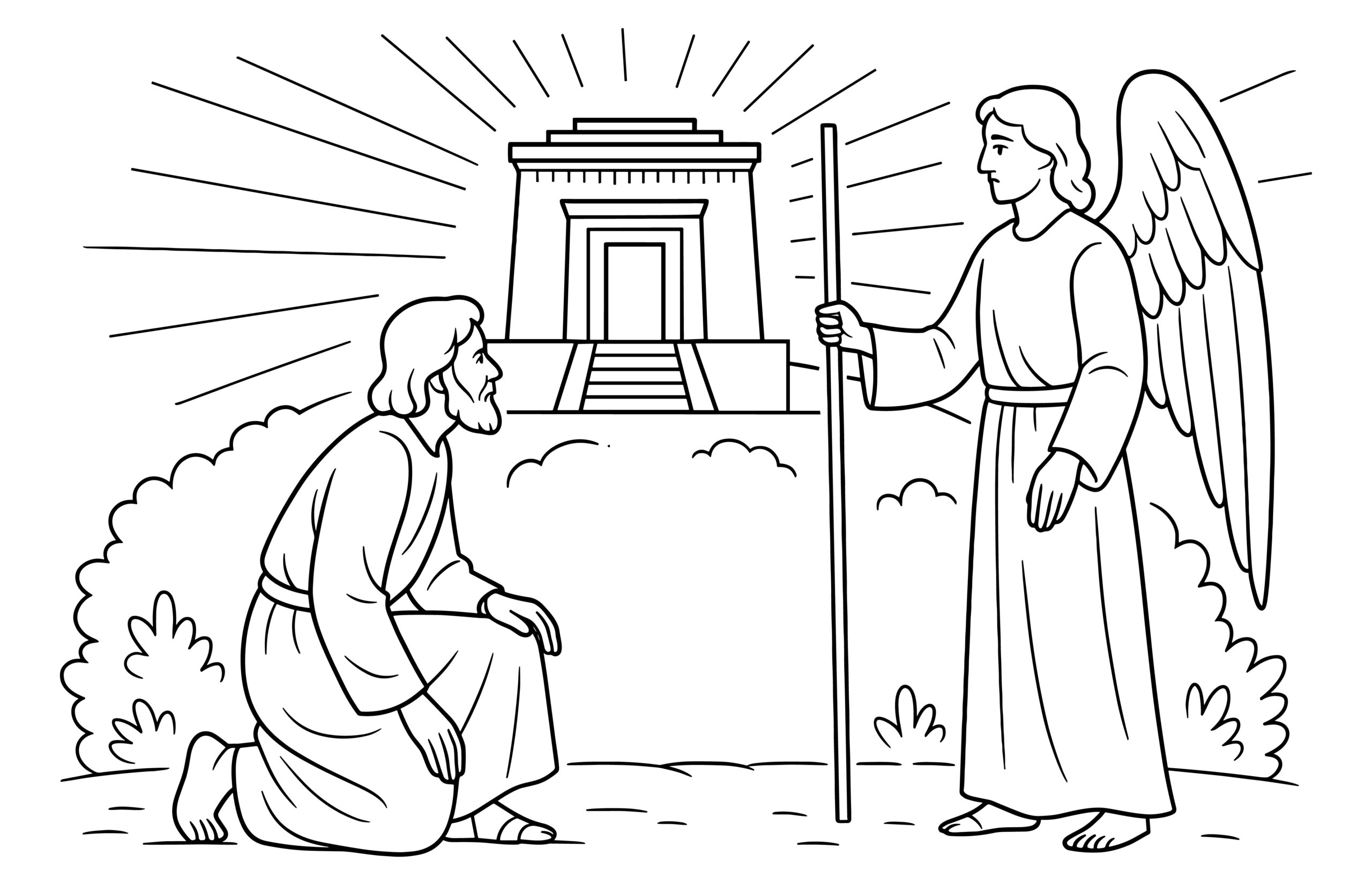
God gives Ezekiel a ‘blueprint’ for the final Temple. The one where His presence is restored to the people. One Israel is still waiting for.
This is the last major vision God gives Ezekiel. Or at least the last one he shares with us. He receives this vision in the 25th year of his exile. We aren’t told how old Ezekiel was when he died, but he prophesied for 20 years. His first vision was in the 5th year of exile and final vision in the 25th. He was also 30 when he had his first vision, making him 50 at the time of this final vision.
Ezekiel vision is of the final temple, the division of the land, and restoration of the glory of the Lord. This also includes how those serving in the Temple are to do so. This vision has still not been fulfilled. It is for the end of days. It is not the Temple that was rebuilt after the exiles returned to Israel.
I have tried before to analyze the layout and instructions given in this vision and other such visions. I’m not going to do that this time. I’m also not going to put in each and every verbal encounter/prophecy. This would be TOO long if I did. I’m going to focus on the personal feelings and experience of Ezekiel instead.
I’m also NOT going to totally ignore the dimensions and such that are given. What I will do instead is link you to several wonderful videos that give you a 3D rendering of the Temple yet to come. So, lets rejoin Ezekiel as God shows him another AMAZING vision.
Holy Spirit I NEED You hand today to guide this journey. I need You to point out where the focus should be. I also seek Your instructions on what I should be taking from all this for my life. I leave this journey in YOUR hands.
♥ ♦ ♥
It has been twenty years since Ezekiel was first called into service by the Lord. He still remembers that first vision, as plane as day. And it still fills him with awe!
Today, Ezekiel is in his customary place, meeting with the Lord. It is a gray day outside but his heart is shining inside. As Ezekiel basks in the inner glow of the presence of the Lord, he feels himself being taken on another vision outside the four walls of his home.
Ezekiel sees himself standing in a city on the mountains of Israel; in Jerusalem. It is not the Jerusalem he knew before he was taken into exile, or even the Jerusalem that was devastated 14 years ago. It is completely different.
There is a man standing beside him. His skin is like bronze and reflects the light. He is dressed in linen with a red linen cord tied at his waist. In his hand is a measuring rod. The rod is six long cubits (long cubit is a cubit and a handspan = 18 – 21 in or 45 – 53 cm; we will use the minimal measurement). Each long cubit is marked out on the reed and it towers above his head but is not unwieldy. This reed is 9 feet/ 2.75 meters tall.
“Son of man, look with your eyes, and hear with your ears, and set your heart upon all that I shall show you, for you were brought here in order that I might show it to you. Declare all that you see to the house of Israel” (Ezekiel 40:4).
Ezekiel looks around him and sees a magnificent Temple. He knows that it is the Temple of the Lord without even being told. The man leads Ezekiel to the Eastern Gate. Here he begins taking the reed he is carrying and measuring out the length, width, chambers, thresholds, and all of its glorious structures. Some are exactly one reed long while others are less or more. Yet each is measured with the reed.
Ezekiel is brought from the Eastern Gate so that he can see the outer courtyard. It is HUGE! The man measures and counts each feature as he shows them to Ezekiel. As he is measuring, the two of them are moving towards the Northern Gate. After measuring from the Eastern Gate to the Northern Gate, the man measures all that is within the Northern Gate as well. The dimensions are exactly the same as the Eastern Gate.
From the Northern Gate, Ezekiel and the man walk on the western side of the outer courtyard and measure each feature and structure. There is no gate on the western side as one of the structure inside the inner courtyard abuts the back wall. Once they reach the Southern Gate, the man measures every feature of it and it is identical to the other two gates.
The three gates and adjoining structures form the outer courtyard. But that’s not all. There is SO MUCH MORE to see! And the man beside Ezekiel is ready to show it all.
Ezekiel and the man enter the space reserved as the outer courtyard through the South Gate. They move through the space of the outer courtyard and enter the inner courtyard through the Southern Gate that is the twin to the one they entered through.
Once inside the inner courtyard, the man leads Ezekiel to the east and north gates. Each of these is a twin to its counterpart on the edge of the outer courtyard. Their beauty and size are not diminished by being constructed in the exact same fashion, but is magnified by the symmetry and orderliness they provide. Even their decorative embellishments of palm trees mirror one another in size and proportion while adding beauty to the overall structure.
There is one significant difference at and within the northern inner gate. There are stone tables placed on the leading edge of the gate for the sacrifices to be slaughtered and then tables just inside the entrance from the outer courtyard for those sacrifices to be washed. This is the gate through which all the sacrifices will be brought.
After measuring the gates, Ezekiel is taken on a tour of the structures inside the inner courtyard. The first structures pointed out are both chambers for the priests. One is beside the north gate facing south, and the other beside the south gate facing north. They are identical in form and structure but quite not in purpose.
“This chamber that faces south is for the priests who have charge of the temple, and the chamber that faces north is for the priests who have charge of the altar. These are the sons of Zadok, who alone among the sons of Levi may come near to the Lord to minister to Him” (Ezekiel 40:45-46).
Ezekiel’s heart soars as he is next led to the Temple itself. The man takes time to measure every feature on the entrance, including counting the 10 steps to the vestibule of the Temple. The roof of the vestibule towers over their heads and even dwarfs the measuring reed.
Once the measurements of the entrance are recorded, Ezekiel and the man pass through the massive doors. These doors are set into a frame that is significantly shorter than the wall height but still impressive in its proportions; easily three times the height of the two men entering through it.
The doors open and Ezekiel’s breath leaves his lungs in a rush at the majesty that lies before him. The man beside him smiles and leads the way into the first chamber. There is only one piece of furnishing in this room. It looks like an altar to Ezekiel.
“This is the table that is before the Lord” (Ezekiel 41:22b) the man says to Ezekiel as he measures and records its dimensions.
There is a second room, beyond a pair of folding doors. This second room is the Holy of Holies. Just stepping into it as the man measures it makes the hairs on Ezekiel’s skin dance with pleasure. Of all the places he has ever been in his whole life, Ezekiel cannot think of one that has filled him with such awe as this room. His visions of the very presence of God were more awesome, but this physical structure comes the closest to that experience. He realizes that this too is a vision, but one day, this WILL occupy this very spot on earth.
“I wish I could be alive to actually walk these halls” Ezekiel says to the man. But his heart knows that Israel is not ready for this manifestation yet. She still has a lot of growing to do. “If only…” he breathes before turning his full attention back to the man and all that he is showing him.
After measuring the inside of the Temple, Ezekiel watches as the man measures the thickness of the walls. Something impossible for regular men to do, except during construction, but easily accomplished by Ezekiel’s guide. Ezekiel’s eyes are also drawn to the carvings of palm trees and cherubim on every wall within the two rooms and on the doors for these rooms.
On three sides of the Temple building itself, there are three tiers of rooms that the man measures. Each tier is measured and counted and Ezekiel’s attention is drawn to the fact that these rooms do not touch the walls of the Temple itself. They share a final covering, a roof, but are separate so as not to defile the Temple in any way.
After measuring every part of the Temple and its surrounding rooms, the man brings Ezekiel to the building behind the Temple structure. This building is separated by a span of 20 cubits and also abuts the western wall surrounding the entire complex of buildings. The man measures this building as well and draws Ezekiel’s attention to each detail.
Once the inner courtyard buildings are all measured, the man brings Ezekiel back into the outer courtyard and begins measuring all the structures contained therein. These structures sit in line with the inner gates around the inner courtyard. They do not extend into the inner courtyard, but served as barriers and sentinels standing guard to preserve its holiness. They continue the span of 20 cubits that separates the Temple structure, with its side chambers, from any other building.
The buildings beyond this span are galleries, chambers, and surrounding walls. The buildings are where the priests will eat the holy portions of the sacrifice, store the gifts given to the Lord, and store their priestly garments, when not in use. The priests cannot wear their garments into the outer courtyard of the Temple compound and must change out of them before entering where the regular people are.
The galleries and chambers of the outer courtyard are three tiers tall and are offset, where the lower tiers are larger than the one above them. This design characteristic mirrors how the chambers alongside the Temple building itself are constructed. And the man measures each feature and dimension of everything within this outer courtyard.
After measuring all the structures within the Temple complex, the man brings Ezekiel outside the complex, through the eastern gate. Here the man measures a span of 500 cubits all around the Temple compound. This area is surrounded by a wall and no buildings or structures occupy this space.
“This is to make a separation from the holy and the common” the man tells Ezekiel.
As soon as all the measurements are taken and recorded for Ezekiel, there is a sound rising from the east. It is a familiar sound to Ezekiel. He has heard it twice before. Each time it announced the visual representation Ezekiel has seen of the glory of the Lord as it moved. The first time Ezekiel had seen this representation was on the Chebar canal. The second was as the glory of the Lord left the Temple, before the destruction of Jerusalem. Now, it announces the return of His glory to His holy Temple.
Ezekiel looks up and watches the now familiar presence of God move with its whirling wheels, its cherubim, and platform moving from the east and coming to rest above the Temple complex. Ezekiel falls on his face in awe and reverence. As he lies prostrate before the Lord, he hears the voice of the Lord speaking from within the Temple itself. The words he hears emanating from the temple draw tears of joy from the depths of his soul.
“Son of man, this is the place of my throne and the place of the soles of my feet, where I will dwell in the midst of the people of Israel forever. And the house of Israel shall no more defile my holy name, neither they, nor their kings, by their whoring and by the dead bodies of their kings at their high places, by setting their threshold by my threshold and their doorposts beside my doorposts, with only a wall between me and them. They have defiled my holy name by their abominations that they have committed, so I have consumed them in my anger. Now let them put away their whoring and the dead bodies of their kings far from me, and I will dwell in their midst forever” (Ezekiel 43:7-9).
Sobs of; “Yes, Lord! Let it be so” issue quietly from Ezekiel’s mouth and heart as the man stands witness beside him. After a minute for Ezekiel to absorb this promise, the Lord speaks again. This time it is with a mission for Ezekiel himself.
“As for you, son of man, describe to the house of Israel the temple, that they may be ashamed of their iniquities; and they shall measure the plan. And if they are ashamed of all that they have done, make known to them the design of the temple, its arrangement, its exits and its entrances, that is, its whole design; and make known to them as well all its statutes and its whole design and all its laws, and write it down in their sight, so that they may observe all its laws and all its statutes and carry them out. This is the law of the temple: the whole territory on the top of the mountain all around shall be most holy. Behold, this is the law of the temple” (Ezekiel 43:10-12).
“I will gladly do the Lord” Ezekiel proclaims from his knees before the Lord.
The Lord is ready to share even more with Ezekiel. He turns his attention to the inner courtyard. Before Ezekiel’s eyes appears a new structure that was not there when he and the man walked and measured what was before them. And, rather than having the man record its dimensions and features, God speaks of His requirements himself.
God gives all the dimensions of the altar, including that this altar will have steps. These will face the east. God them moves onto the requirements of the altar’s dedication. This is important, as not following it would mean that the offerings would not be acceptable to the Lord.
“Son of man, thus says the Lord God: These are the ordinances for the altar: On the day when it is erected for offering burnt offerings upon it and for throwing blood against it, you shall give to the Levitical priests of the family of Zadok, who draw near to me to minister to me, declares the Lord God, a bull from the herd for a sin offering. And you shall take some of its blood and put it on the four horns of the altar and on the four corners of the ledge and upon the rim all around. Thus you shall purify the altar and make atonement for it. You shall also take the bull of the sin offering, and it shall be burned in the appointed place belonging to the temple, outside the sacred area. And on the second day you shall offer a male goat without blemish for a sin offering; and the altar shall be purified, as it was purified with the bull. When you have finished purifying it, you shall offer a bull from the herd without blemish and a ram from the flock without blemish. You shall present them before the Lord, and the priests shall sprinkle salt on them and offer them up as a burnt offering to the Lord. For seven days you shall provide daily a male goat for a sin offering; also, a bull from the herd and a ram from the flock, without blemish, shall be provided. Seven days shall they make atonement for the altar and cleanse it, and so consecrate it. And when they have completed these days, then from the eighth day onward the priests shall offer on the altar your burnt offerings and your peace offerings, and I will accept you, declares the Lord God” (Ezekiel 43:18-27).
After hearing the requirements for dedication of the altar, the man takes Ezekiel back to the front of the Tabernacle complex, in front of the Eastern Gate. As they stand there, the Lord speaks to Ezekiel again.
“This gate shall remain shut; it shall not be opened, and no one shall enter by it, for the Lord, the God of Israel, has entered by it. Therefore it shall remain shut. Only the prince may sit in it to eat bread before the Lord. He shall enter by way of the vestibule of the gate, and shall go out by the same way” (Ezekiel 44:2-3).
The man points out the closed Eastern Gate of the outer courtyard. “The inner doors of this gate, and its corresponding gate will have different rules” the man tells Ezekiel.
After hearing this, the man leads Ezekiel by way of the outer Northern Gate and they watch as the glory of the Lord fills the Temple. Ezekiel falls on his face before the Lord.
(to be continued)
I wanted to put all of this vision together, but it is turning out to be too long, even with leaving many of the exacting details out. I didn’t think we needed those details to understand the story, but I encourage you to read them. I’m attaching videos of graphic renderings and labeling of the Temple Ezekiel is shown.
We will look at the statues and regulations God puts in place for the time of this Temple’s existence. It gets a bit deeper in that section. Another reason I decided to break here for now.
Father God, I cannot imagine the glory contained in this vision. Especially when Your glory fills the Temple. I fully believe that I will see this Temple someday. I’m looking forward to it. It will pale in comparison to seeing You though. I will wait.
Thank You for helping me work through this, even with all the distractions going on in my day. Keep me going with the changes in our lives.