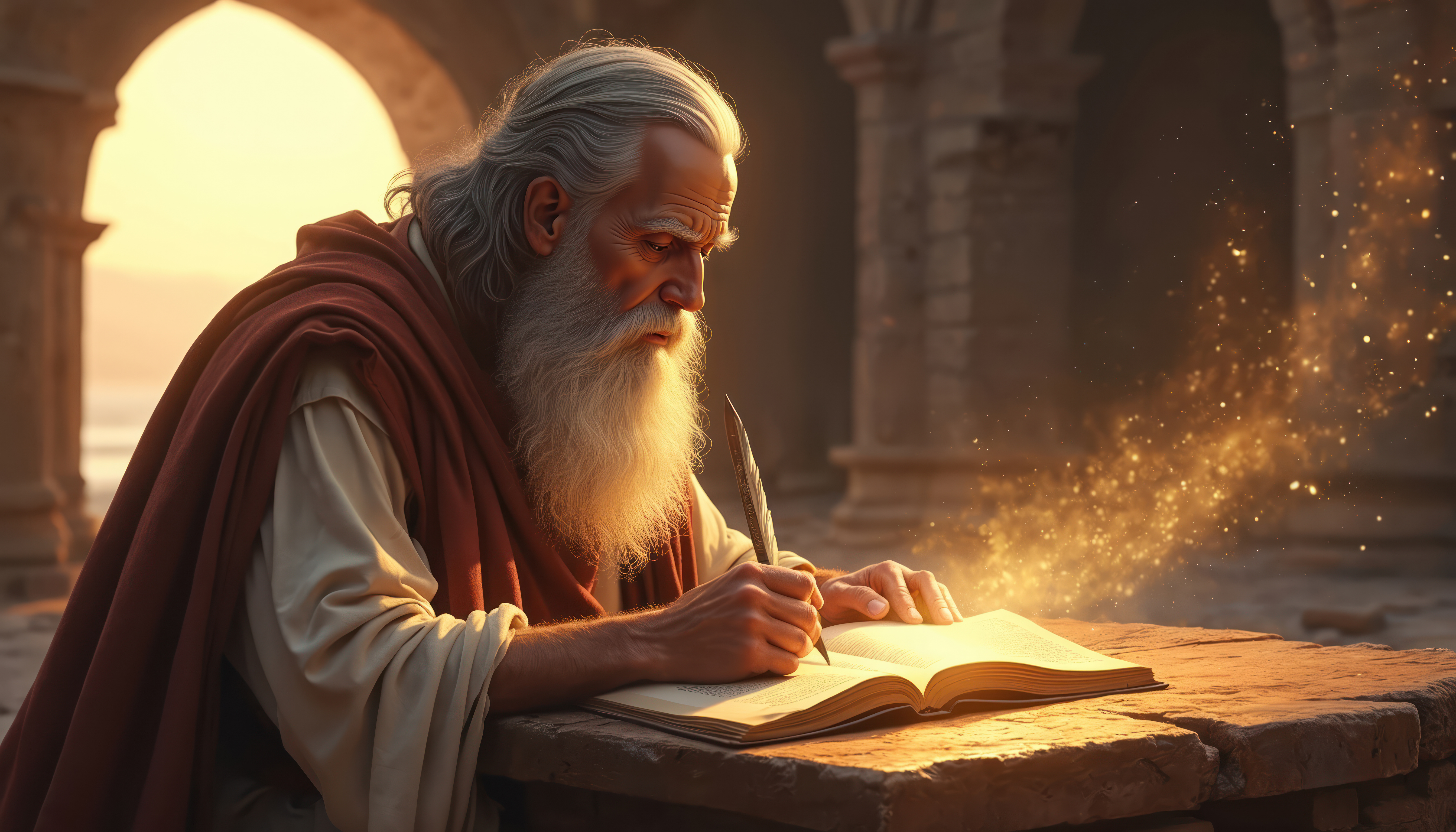
John Picks Up the Pen
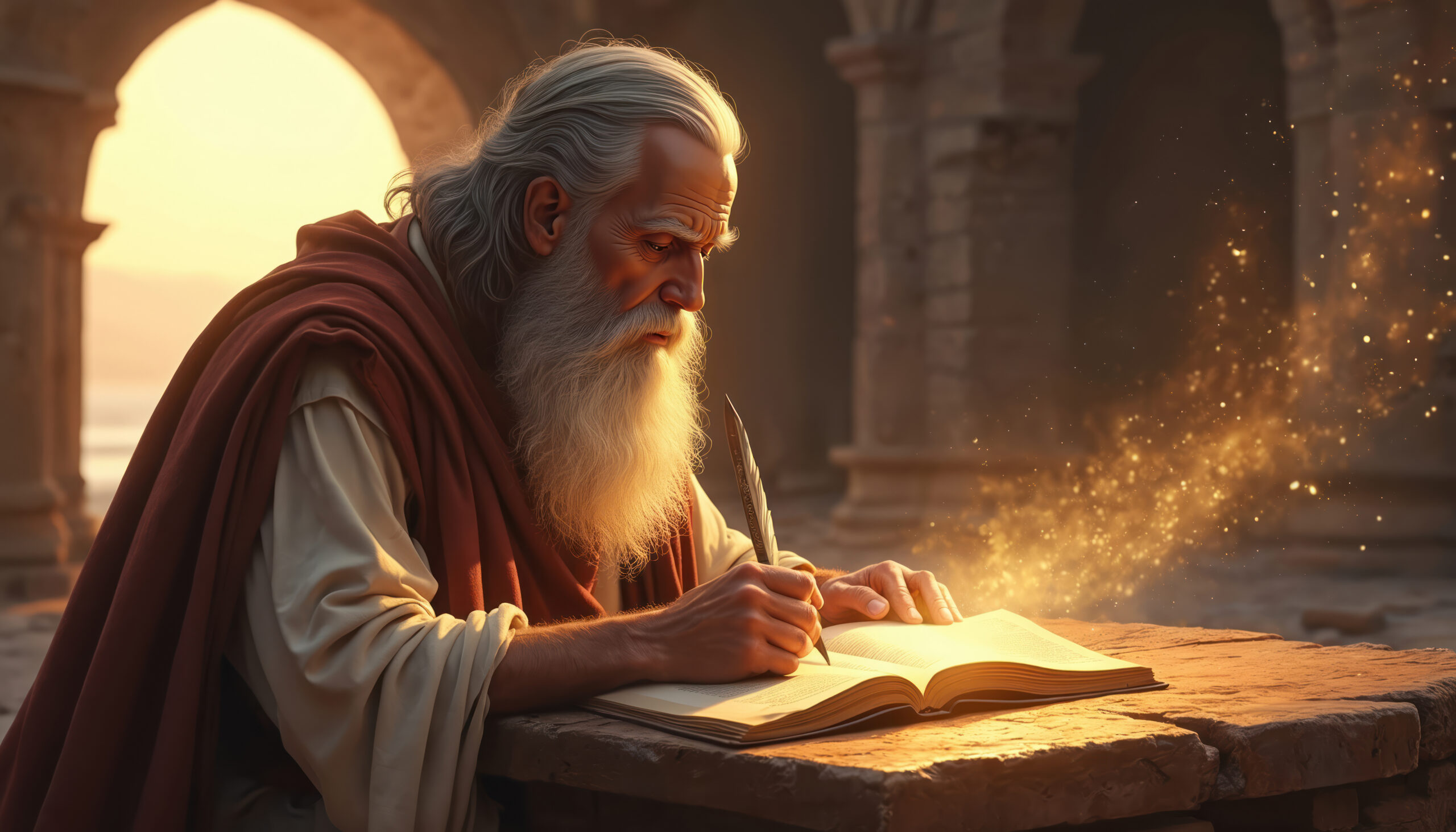
John picks up the pen to tell the story of Jesus in a new and different way. He also writes instructions to the churches and an AMAZING revelation.
John is the second most prolific author in the New Testament. He is second only to Paul. His contribution includes five individual works; for him, but one full work of the Spirit. He is also the latest of all the writers to contribute. It is debated as to exactly when John wrote his contributions, but not that he was the last to contribute.
I also tried to find how long between John writing the gospel and his letters. Because John refers to concepts from his gospel account, the letters had to be written at least a little later. Some sources try and say that they were written concurrently, but I don’t see how that could happen. Regardless of the time between his first contribution and his letters, scholars allow up to ten years between these writings and Revelation. I pray that I do his journey justice. I’m not certain right now how many parts this story is going to take, as there are five books to cover.
Holy Spirit, help me see the heart of John as You worked through him. Let me see his struggle and joys during the process. Take me into Your story and show me all the features You have reserved for this journey. And forgive me for putting it off so long. I’ve been afraid to tackle this final piece early church.
♥ ♦ ♥
It has been many years since John felt his full vigor. His age is catching up on him, but his mind is still sharp, and his heart is in perfect tune with his Lord. He relies daily on the leading of the Lord to guide those around him.
John lives in a modest house in the hills above Ephesus. This is the same home that he brought Jesus’ mother, Mary, to live in after His crucifixion. Mary has gone on to be with the Lord, but John ministers to the believers in the churches Paul planted.
Mark, Luke, and Matthew’s writings, along with copies of many of the letters Paul wrote to the churches have found a home in the archives of Ephesus. John loves spending time reading them. Even with all the knowledge and direction contained in the available writings, issues still find their way into the churches. John does his best to address these as they arise. As the last surviving member of Jesus’ original disciples, many turn to him for direction.
John is enjoying quiet time in prayer when the Lord grabs his attention.
“John.”
“Yes Lord.”
“I have a task for you.”
“What is it Lord. You know I will do anything You ask.”
“I do. That is why I’m giving you this task.”
John waits silently.
“I want you to write My story.”
“Lord, it has already been written three times. What would You have me add that those accounts don’t cover?”
“They did wonderful work, but your focus will be different. You will focus on My divinity. My Spirit will write this work with you, just as He did with all the others. And you will share as one who has already seen the ending of those days. There will be times when you will call on that knowledge to inform readers of what was transpiring in my plan that you didn’t see at the time.”
“Thank You Lord for this assignment. I will try and be worthy of Your calling.”
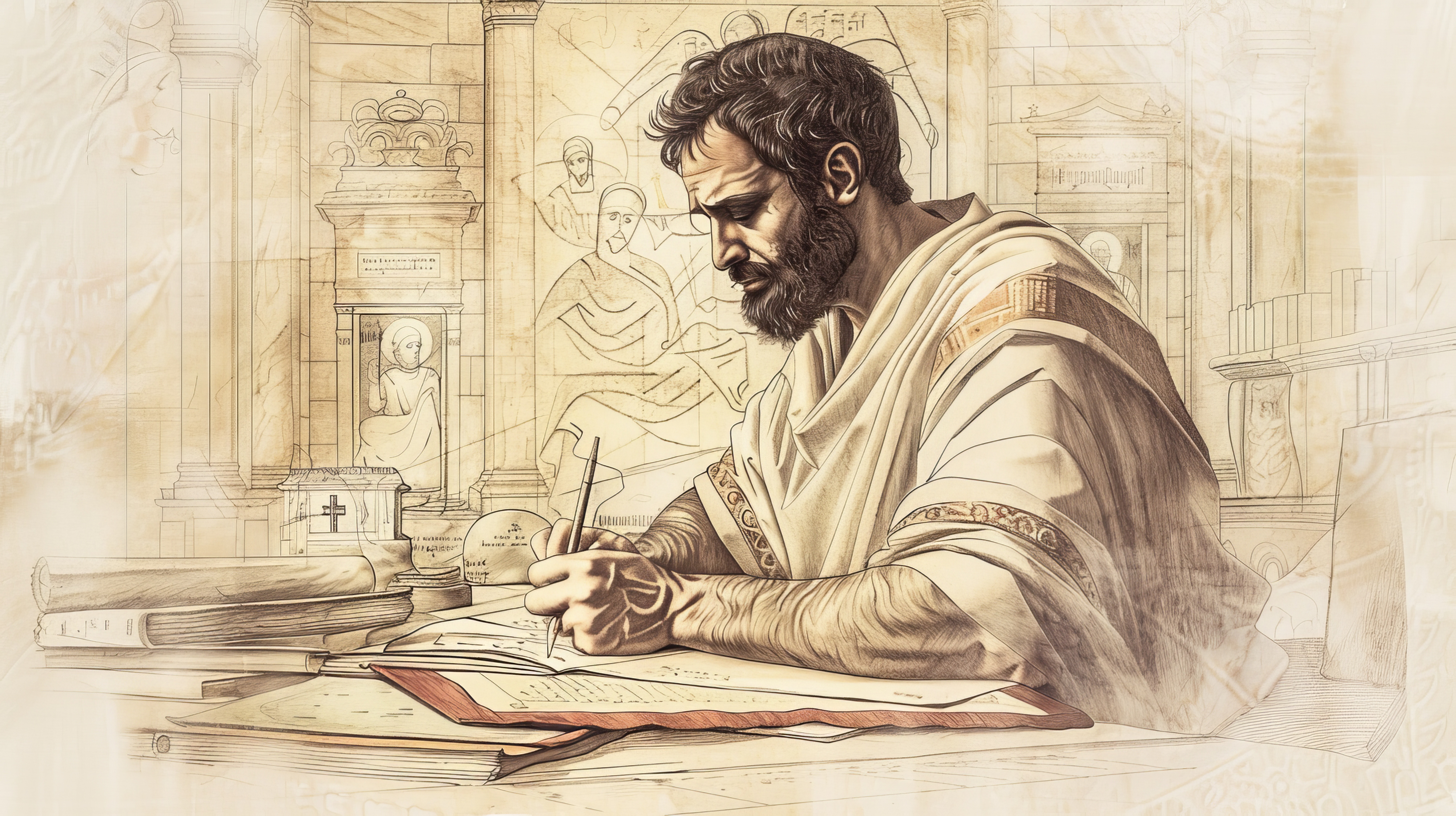
John raises from his aching knees and makes his way over to his cabinet that holds his writing supplies. He starts gathering what he will need. He has no idea where to start, but he has faith that the Holy Spirit does. He wants to be ready when he receives his inspiration.
John settles down onto his favorite stool and pulls his writing table onto his lap. He is near enough his dining table that he can reach his supplies for refreshing whenever he needs. As soon as he is settled, the Spirit gives him an understanding of the beginning of time and how Jesus fit into it. He begins writing immediately, as this feels urgent to share.
“In the beginning was the Word, and the Word was with God, and the Word was God. He was in the beginning with God. All things were made through him, and without him was not any thing made that was made. In him was life, and the life was the light of men. The light shines in the darkness, and the darkness has not overcome it.” (John 1:1-5).
The Spirit quickly ties this beginning to John the Baptizer preparing the way and Jesus’ bringing His light to the world.
“You are AMAZING Lord. You ARE the Light of the world. How much simpler could You put it? And yet, many STILL refuse to believe, even today.”
John was among those who followed the Baptizer when he pointed out his own purpose and who Jesus was. He shares a little of the discussions John had with those sent by the Pharisees.
“And this is the testimony of John, when the Jews sent priests and Levites from Jerusalem to ask him, ‘Who are you?’ He confessed, and did not deny, but confessed, ‘I am not the Christ.’ And they asked him, ‘What then? Are you Elijah?’ He said, ‘I am not.’ ‘Are you the Prophet?’ And he answered, ‘No.” o they said to him, ‘Who are you? We need to give an answer to those who sent us. What do you say about yourself?’ He said, ‘I am the voice of one crying out in the wilderness, “Make straight the way of the Lord,” as the prophet Isaiah said.’
“(Now they had been sent from the Pharisees.) They asked him, ‘Then why are you baptizing, if you are neither the Christ, nor Elijah, nor the Prophet?’ John answered them, ‘I baptize with water, but among you stands one you do not know, even he who comes after me, the strap of whose sandal I am not worthy to untie.’ These things took place in Bethany across the Jordan, where John was baptizing” (John 1:19-28).
John laughs to himself as he remembers these men going away, shaking their heads. “If they had only waited one more day, they would have seen the signs from Heaven when John baptized Jesus. But would they have believed? Probably not” John says to himself, remembering the very next day.
Excitedly, John writes of the moment Jesus came to John the Baptizer.
“The next day he saw Jesus coming toward him, and said, ‘Behold, the Lamb of God, who takes away the sin of the world! This is he of whom I said, “After me comes a man who ranks before me, because he was before me.” I myself did not know him, but for this purpose I came baptizing with water, that he might be revealed to Israel.’ And John bore witness: ‘I saw the Spirit descend from heaven like a dove, and it remained on him. I myself did not know him, but he who sent me to baptize with water said to me, “He on whom you see the Spirit descend and remain, this is he who baptizes with the Holy Spirit.” And I have seen and have borne witness that this is the Son of God’” (John 1:29-34).
“That was my first ‘turning point’ but not when I left everything to follow You Lord.”
John continues on with his memories and Jesus’ story. Of leaving John by the river the following day and accompanying Jesus to where He was staying for the night. “Why didn’t I leave everything behind that night Lord? Instead, I went back to my life after only one night.”
“Everything had and has its time. It wasn’t time yet. I had things I needed to do alone as well.”
“I know. I remember, as well as read about that time in Matthew’s, Mark’s, and even Luke’s telling of Your story.”
The Spirit brings stories to John’s heart that emphasize Jesus’ divinity. Stories of miracles so large that NONE could deny them. “Oh, they tried to deny Your power Lord, but the people saw through their lies.” John huffs out a breath as he admits another truth. “The people saw but were afraid to speak against the religious leaders. They didn’t want to be cast out of the Temple.”
John purposefully tells the entire story of Jesus healing a man who was born blind. A miracle that should have tipped ALL who encountered the healed man over into belief.
“As he passed by, he saw a man blind from birth. And his disciples asked him, ‘Rabbi, who sinned, this man or his parents, that he was born blind?’ Jesus answered, ‘It was not that this man sinned, or his parents, but that the works of God might be displayed in him. We must work the works of him who sent me while it is day; night is coming, when no one can work. As long as I am in the world, I am the light of the world.’ Having said these things, he spit on the ground and made mud with the saliva. Then he anointed the man’s eyes with the mud and said to him, ‘Go, wash in the pool of Siloam’ (which means Sent). So he went and washed and came back seeing.
“The neighbors and those who had seen him before as a beggar were saying, ‘Is this not the man who used to sit and beg?’ Some said, ‘It is he.’ Others said, ‘No, but he is like him.’ He kept saying, ‘I am the man.’ So they said to him, ‘Then how were your eyes opened?’ He answered, ‘The man called Jesus made mud and anointed my eyes and said to me, “Go to Siloam and wash.” So I went and washed and received my sight.’ They said to him, ‘Where is he?’ He said, ‘I do not know.’
“They brought to the Pharisees the man who had formerly been blind. Now it was a Sabbath day when Jesus made the mud and opened his eyes. So the Pharisees again asked him how he had received his sight. And he said to them, ‘He put mud on my eyes, and I washed, and I see.’ Some of the Pharisees said, ‘This man is not from God, for he does not keep the Sabbath.’ But others said, ‘How can a man who is a sinner do such signs?’ And there was a division among them. So they said again to the blind man, ‘What do you say about him, since he has opened your eyes?’ He said, ‘He is a prophet.’
“The Jews did not believe that he had been blind and had received his sight, until they called the parents of the man who had received his sight and asked them, ‘Is this your son, who you say was born blind? How then does he now see?’ His parents answered, ‘We know that this is our son and that he was born blind. But how he now sees we do not know, nor do we know who opened his eyes. Ask him; he is of age. He will speak for himself.’ (His parents said these things because they feared the Jews, for the Jews had already agreed that if anyone should confess Jesus to be Christ, he was to be put out of the synagogue. Therefore his parents said, ‘He is of age; ask him.’
“So for the second time they called the man who had been blind and said to him, ‘Give glory to God. We know that this man is a sinner.’ He answered, ‘Whether he is a sinner I do not know. One thing I do know, that though I was blind, now I see.’ They said to him, ‘What did he do to you? How did he open your eyes?’ He answered them, ‘I have told you already, and you would not listen. Why do you want to hear it again? Do you also want to become his disciples?’ And they reviled him, saying, ‘You are his disciple, but we are disciples of Moses. We know that God has spoken to Moses, but as for this man, we do not know where he comes from.’ The man answered, ‘Why, this is an amazing thing! You do not know where he comes from, and yet he opened my eyes. We know that God does not listen to sinners, but if anyone is a worshiper of God and does his will, God listens to him. Never since the world began has it been heard that anyone opened the eyes of a man born blind. If this man were not from God, he could do nothing.’ They answered him, ‘You were born in utter sin, and would you teach us?’ And they cast him out.
“Jesus heard that they had cast him out, and having found him he said, ‘Do you believe in the Son of Man?’ He answered, ‘And who is he, sir, that I may believe in him?’ Jesus said to him, ‘You have seen him, and it is he who is speaking to you.’ He said, ‘Lord, I believe,’ and he worshiped him. Jesus said, ‘For judgment I came into this world, that those who do not see may see, and those who see may become blind.’ Some of the Pharisees near him heard these things, and said to him, ‘Are we also blind?’ Jesus said to them, ‘If you were blind, you would have no guilt; but now that you say, “We see,” your guilt remains’” (John 9).
John shakes his head as he finishes this story. “They are still blind.”
The Spirit includes in the stories that John is writing evidence that Jesus cared about those who were not Jewish. John shares the story of Jesus’ meeting with a woman of Samaria; the very people most hated by the Jews.
“Of all the people in Samaria, she should have been the one You most avoided. Having known five men and an outcast. Yet, I have NO doubt that Your meeting with her was part of Your plan. You used an outcast in the outcasts to reach a people that You loved from the beginning of time.”
John also includes the story of Jesus healing a Roman official’s son. “Even our oppressors were not beneath Your care.”
As this recounting of Jesus’ ministry aims to highlight Jesus’ divinity, the Spirit brings to mind statements Jesus made during His ministry where He uses the words “I am…” to refer to Himself or describe His mission. Some of these times were reserved only for His disciples ears.
“Some of those times were to bring us comfort in what was still to come. I’m sorry we didn’t listen better.”
“You hear Me now. That’s what matters. And that you are sharing those times with others. They need to know who ‘I am’ as well.”
John is led by the Spirit to delve into the days where Jesus faced His greatest physical challenges. The days before His crucifixion. He backs up a little and shares another miracle that should have proven to ANYONE that He truly was the Messiah; the Son of God. This story is of the resurrection of Lazarus.
John shakes his head as he remembers the story. “I’m sorry for my own confusion during this time. Thank You for carrying me through it to the other side, even if that wasn’t until after You rose from the grave Yourself.”
Again, John shares the whole story. “They need to know it all” he says as he begins to write.
“Now a certain man was ill, Lazarus of Bethany, the village of Mary and her sister Martha. It was Mary who anointed the Lord with ointment and wiped his feet with her hair, whose brother Lazarus was ill. So the sisters sent to him, saying, ‘Lord, he whom you love is ill.’ But when Jesus heard it he said, ‘This illness does not lead to death. It is for the glory of God, so that the Son of God may be glorified through it.’
“Now Jesus loved Martha and her sister and Lazarus. So, when he heard that Lazarus was ill, he stayed two days longer in the place where he was. Then after this he said to the disciples, ‘Let us go to Judea again.’ The disciples said to him, ‘Rabbi, the Jews were just now seeking to stone you, and are you going there again?’ Jesus answered, ‘Are there not twelve hours in the day? If anyone walks in the day, he does not stumble, because he sees the light of this world. But if anyone walks in the night, he stumbles, because the light is not in him.’ After saying these things, he said to them, ‘Our friend Lazarus has fallen asleep, but I go to awaken him.’ The disciples said to him, Lord, if he has fallen asleep, he will recover.’ Now Jesus had spoken of his death, but they thought that he meant taking rest in sleep. Then Jesus told them plainly, ‘Lazarus has died, and for your sake I am glad that I was not there, so that you may believe. But let us go to him.’ So Thomas, called the Twin, said to his fellow disciples, ‘Let us also go, that we may die with him.’
“Now when Jesus came, he found that Lazarus had already been in the tomb four days. Bethany was near Jerusalem, about two miles off, and many of the Jews had come to Martha and Mary to console them concerning their brother. So when Martha heard that Jesus was coming, she went and met him, but Mary remained seated in the house. Martha said to Jesus, ‘Lord, if you had been here, my brother would not have died. But even now I know that whatever you ask from God, God will give you.’ Jesus said to her, ‘Your brother will rise again.’ Martha said to him, ‘I know that he will rise again in the resurrection on the last day.’ Jesus said to her, ‘I am the resurrection and the life. Whoever believes in me, though he die, yet shall he live, and everyone who lives and believes in me shall never die. Do you believe this?’ She said to him, ‘Yes, Lord; I believe that you are the Christ, the Son of God, who is coming into the world.’
“When she had said this, she went and called her sister Mary, saying in private, ‘The Teacher is here and is calling for you.’ And when she heard it, she rose quickly and went to him. Now Jesus had not yet come into the village, but was still in the place where Martha had met him. When the Jews who were with her in the house, consoling her, saw Mary rise quickly and go out, they followed her, supposing that she was going to the tomb to weep there. Now when Mary came to where Jesus was and saw him, she fell at his feet, saying to him, ‘Lord, if you had been here, my brother would not have died.’ When Jesus saw her weeping, and the Jews who had come with her also weeping, he was deeply moved in his spirit and greatly troubled. And he said, Where have you laid him?’ They said to him, ‘Lord, come and see.’ Jesus wept. So the Jews said, ‘See how he loved him!’ But some of them said, ‘Could not he who opened the eyes of the blind man also have kept this man from dying?’
“Then Jesus, deeply moved again, came to the tomb. It was a cave, and a stone lay against it. Jesus said, ‘Take away the stone.’ Martha, the sister of the dead man, said to him, ‘Lord, by this time there will be an odor, for he has been dead four days.’ Jesus said to her, ‘Did I not tell you that if you believed you would see the glory of God?’ So they took away the stone. And Jesus lifted up his eyes and said, ‘Father, I thank you that you have heard me. I knew that you always hear me, but I said this on account of the people standing around, that they may believe that you sent me.’ When he had said these things, he cried out with a loud voice, ‘Lazarus, come out.’ The man who had died came out, his hands and feet bound with linen strips, and his face wrapped with a cloth. Jesus said to them, ‘Unbind him, and let him go’” (John 11:1-44).
The Spirit gives John a personal account of what transpired behind closed doors following this miracle. He writes it exactly as he witnesses it in the spirit.
“Many of the Jews therefore, who had come with Mary and had seen what he did, believed in him, but some of them went to the Pharisees and told them what Jesus had done. So the chief priests and the Pharisees gathered the council and said, ‘What are we to do? For this man performs many signs. If we let him go on like this, everyone will believe in him, and the Romans will come and take away both our place and our nation.’ But one of them, Caiaphas, who was high priest that year, said to them, ‘You know nothing at all. Nor do you understand that it is better for you that one man should die for the people, not that the whole nation should perish.’ He did not say this of his own accord, but being high priest that year he prophesied that Jesus would die for the nation, and not for the nation only, but also to gather into one the children of God who are scattered abroad. So from that day on they made plans to put him to death.
“Jesus therefore no longer walked openly among the Jews, but went from there to the region near the wilderness, to a town called Ephraim, and there he stayed with the disciples” (John 11:45-54).
“That felt like the beginning of the end to us. Little did we know what You had in mind.”
“Now the Passover of the Jews was at hand, and many went up from the country to Jerusalem before the Passover to purify themselves. They were looking for Jesus and saying to one another as they stood in the temple, ‘What do you think? That he will not come to the feast at all?’ Now the chief priests and the Pharisees had given orders that if anyone knew where he was, he should let them know, so that they might arrest him” (John 11:55-57).
John begins sharing Jesus’ last week by sharing the event of Mary anointing Jesus that he had spoken of in the story of Lazarus. He includes the knowledge that was hidden from them at the time; Judas’ motives and heart.
“You knew all the time what Judas was thinking and doing. Yet You never confronted him in a way we could understand. If we had known, we probably would have gotten in the way of God’s plan, which included his betrayal. Were we really that blind that we didn’t see, or were You protecting us by ‘blinding our eyes’ to some of the details?”
John continues with Jesus final days, including His amazing entry into Jerusalem. He shakes his head again, because again, they didn’t understand at the time what was happening. “We thought we knew what was going on, but we were completely wrong!”
John shares God Himself testifying to Jesus’ divinity in a moment when Jesus’ soul was heavy. “The people heard God speak but most of them only heard thunder roll. Those who did hear His voice called it an ‘angel’s’ voice. We didn’t know what to say. After the time on the mountain with You, Moses and Elijah, I knew it was God’s voice. But I had no idea what to do about it. I wasn’t even supposed to share that moment, yet.”
The moments the Spirit brings to John’s mind center on Jesus’ authority and authenticity of His divinity; God’s Son, the Messiah.
“And Jesus cried out and said, ‘Whoever believes in me, believes not in me but in him who sent me. And whoever sees me sees him who sent me. I have come into the world as light, so that whoever believes in me may not remain in darkness. If anyone hears my words and does not keep them, I do not judge him; for I did not come to judge the world but to save the world. The one who rejects me and does not receive my words has a judge; the word that I have spoken will judge him on the last day. For I have not spoken on my own authority, but the Father who sent me has himself given me a commandment—what to say and what to speak. And I know that his commandment is eternal life. What I say, therefore, I say as the Father has told me’” (John 12:44-50).
John also recalls how Jesus went away from the people because they didn’t believe Him. “Or more appropriately, they didn’t have the courage to say they believed” John says as he continues writing.
“When Jesus had said these things, he departed and hid himself from them. Though he had done so many signs before them, they still did not believe in him, so that the word spoken by the prophet Isaiah might be fulfilled: ‘Lord, who has believed what he heard from us, and to whom has the arm of the Lord been revealed?’
“Therefore they could not believe. For again Isaiah said, ‘He has blinded their eyes and hardened their heart, lest they see with their eyes, and understand with their heart, and turn, and I would heal them.’
“Isaiah said these things because he saw his glory and spoke of him. Nevertheless, many even of the authorities believed in him, but for fear of the Pharisees they did not confess it, so that they would not be put out of the synagogue; for they loved the glory that comes from man more than the glory that comes from God” (John 12:36-43).
John struggles to hold back his tears as he moves onto a story that shows Jesus’ heart of a servant; His washing ALL His disciples’ feet. “You even washed Judas’ feet. Knowing…” John chokes back tears as he pens the story.
“Now before the Feast of the Passover, when Jesus knew that his hour had come to depart out of this world to the Father, having loved his own who were in the world, he loved them to the end. During supper, when the devil had already put it into the heart of Judas Iscariot, Simon’s son, to betray him, Jesus, knowing that the Father had given all things into his hands, and that he had come from God and was going back to God, rose from supper. He laid aside his outer garments, and taking a towel, tied it around his waist. Then he poured water into a basin and began to wash the disciples’ feet and to wipe them with the towel that was wrapped around him. He came to Simon Peter, who said to him, ‘Lord, do you wash my feet?’ Jesus answered him, ‘What I am doing you do not understand now, but afterward you will understand.’ Peter said to him, ‘You shall never wash my feet.’ Jesus answered him, ‘If I do not wash you, you have no share with me.’ Simon Peter said to him, ‘Lord, not my feet only but also my hands and my head!’ Jesus said to him, ‘The one who has bathed does not need to wash, except for his feet, but is completely clean. And you are clean, but not every one of you.’ For he knew who was to betray him; that was why he said, ‘Not all of you are clean.’
“When he had washed their feet and put on his outer garments and resumed his place, he said to them, ‘Do you understand what I have done to you? You call me Teacher and Lord, and you are right, for so I am. If I then, your Lord and Teacher, have washed your feet, you also ought to wash one another’s feet. For I have given you an example, that you also should do just as I have done to you. Truly, truly, I say to you, a servant is not greater than his master, nor is a messenger greater than the one who sent him. If you know these things, blessed are you if you do them. I am not speaking of all of you; I know whom I have chosen. But the Scripture will be fulfilled, “He who ate my bread has lifted his heel against me.” I am telling you this now, before it takes place, that when it does take place you may believe that I am he. Truly, truly, I say to you, whoever receives the one I send receives me, and whoever receives me receives the one who sent me’” (John 13:1-20).
John’s pen turns to the last time Judas was with the group of disciples. “We had no idea what was happening Lord. If we had known…”
“After saying these things, Jesus was troubled in his spirit, and testified, ‘Truly, truly, I say to you, one of you will betray me.’ The disciples looked at one another, uncertain of whom he spoke. One of his disciples, whom Jesus loved, was reclining at table at Jesus’ side, so Simon Peter motioned to him to ask Jesus of whom he was speaking. So that disciple, leaning back against Jesus, said to him, ‘Lord, who is it?’ Jesus answered, ‘It is he to whom I will give this morsel of bread when I have dipped it.’ So when he had dipped the morsel, he gave it to Judas, the son of Simon Iscariot. Then after he had taken the morsel, Satan entered into him. Jesus said to him, ‘What you are going to do, do quickly.’ Now no one at the table knew why he said this to him. Some thought that, because Judas had the moneybag, Jesus was telling him, ‘Buy what we need for the feast,’ or that he should give something to the poor. So, after receiving the morsel of bread, he immediately went out. And it was night” (John 13:21-30).
John turns his attention to the final teaching that Jesus did before He was crucified. Jesus gave His disciples a new commandment of love. “A new commandment I give to you, that you love one another: just as I have loved you, you also are to love one another. By this all people will know that you are my disciples, if you have love for one another” (John 13:34-35), tells His disciples that they will ALL flee when the time comes, and promises the Holy Spirit.
“Lord, we didn’t understand anything at that time. Only because of our love for You, were we even given small glimpses into Your plan. THANK YOU for Your gift of the Holy Spirit. We could have used some of His insights then, but we would have gotten in the way, again.”
John shares the two final “I am” statements that Jesus made. Ones that were for His disciples alone, at the time, and for ALL who follow Him now.
‘“Let not your hearts be troubled. Believe in God; believe also in me. In my Father’s house are many rooms. If it were not so, would I have told you that I go to prepare a place for you? And if I go and prepare a place for you, I will come again and will take you to myself, that where I am you may be also. And you know the way to where I am going.’ Thomas said to him, ‘Lord, we do not know where you are going. How can we know the way?’ Jesus said to him, ‘I am the way, and the truth, and the life. No one comes to the Father except through me. If you had known me, you would have known my Father also. From now on you do know him and have seen him.’
“Philip said to him, ‘Lord, show us the Father, and it is enough for us.’ Jesus said to him, ‘Have I been with you so long, and you still do not know me, Philip? Whoever has seen me has seen the Father. How can you say, “Show us the Father”? Do you not believe that I am in the Father and the Father is in me? The words that I say to you I do not speak on my own authority, but the Father who dwells in me does his works. Believe me that I am in the Father and the Father is in me, or else believe on account of the works themselves.’
‘“Truly, truly, I say to you, whoever believes in me will also do the works that I do; and greater works than these will he do, because I am going to the Father. Whatever you ask in my name, this I will do, that the Father may be glorified in the Son. If you ask me anything in my name, I will do it’” (John 14:1-14).
“We see Him now Lord. And the brothers who have already gone to be with You see Him even more clearly than I do today. One day, I will join You again. For You ARE the way, the truth, and the life. And You ARE the True Vine. ‘Dress me’ as a true vine dresser does His vines. Prune away what is not productive. Keep me abiding in You so that I may bear fruit for Your Kingdom.”
John’s heart is reminded of the prayer Jesus spoke over all His disciples before going to spend alone time with His Father. “You prayed these words over us after warning us of what was to come. Of the persecution we would face. Your prayer was for our protection. Thank You for speaking over us.”
“Father, the hour has come; glorify your Son that the Son may glorify you, since you have given him authority over all flesh, to give eternal life to all whom you have given him. And this is eternal life, that they know you, the only true God, and Jesus Christ whom you have sent. I glorified you on earth, having accomplished the work that you gave me to do. And now, Father, glorify me in your own presence with the glory that I had with you before the world existed.
“I have manifested your name to the people whom you gave me out of the world. Yours they were, and you gave them to me, and they have kept your word. Now they know that everything that you have given me is from you. For I have given them the words that you gave me, and they have received them and have come to know in truth that I came from you; and they have believed that you sent me. I am praying for them. I am not praying for the world but for those whom you have given me, for they are yours. All mine are yours, and yours are mine, and I am glorified in them. And I am no longer in the world, but they are in the world, and I am coming to you. Holy Father, keep them in your name, which you have given me, that they may be one, even as we are one. While I was with them, I kept them in your name, which you have given me. I have guarded them, and not one of them has been lost except the son of destruction, that the Scripture might be fulfilled. But now I am coming to you, and these things I speak in the world, that they may have my joy fulfilled in themselves. I have given them your word, and the world has hated them because they are not of the world, just as I am not of the world. I do not ask that you take them out of the world, but that you keep them from the evil one. They are not of the world, just as I am not of the world. Sanctify them in the truth; your word is truth. As you sent me into the world, so I have sent them into the world. And for their sake I consecrate myself, that they also may be sanctified in truth.
“I do not ask for these only, but also for those who will believe in me through their word, that they may all be one, just as you, Father, are in me, and I in you, that they also may be in us, so that the world may believe that you have sent me. The glory that you have given me I have given to them, that they may be one even as we are one, I in them and you in me, that they may become perfectly one, so that the world may know that you sent me and loved them even as you loved me. Father, I desire that they also, whom you have given me, may be with me where I am, to see my glory that you have given me because you loved me before the foundation of the world. O righteous Father, even though the world does not know you, I know you, and these know that you have sent me. I made known to them your name, and I will continue to make it known, that the love with which you have loved me may be in them, and I in them” (John 16:2-26).
John’s breathing becomes heavy as he moves into the next part of Jesus’ story. The moments of His arrest. He stops for a moment to steady his hand. “They need to be able to read and understand this moment. The moment where even His accusers ‘bow down’, even if it wasn’t on purpose.”
“When Jesus had spoken these words, he went out with his disciples across the brook Kidron, where there was a garden, which he and his disciples entered. Now Judas, who betrayed him, also knew the place, for Jesus often met there with his disciples. So Judas, having procured a band of soldiers and some officers from the chief priests and the Pharisees, went there with lanterns and torches and weapons. Then Jesus, knowing all that would happen to him, came forward and said to them, ‘Whom do you seek?’ They answered him, ‘Jesus of Nazareth.’ Jesus said to them, ‘I am he.’ Judas, who betrayed him, was standing with them. When Jesus said to them, ‘I am he,’ they drew back and fell to the ground. So he asked them again, ‘Whom do you seek?’ And they said, ‘Jesus of Nazareth.’ Jesus answered, ‘I told you that I am he. So, if you seek me, let these men go.’ This was to fulfill the word that he had spoken: ‘Of those whom you gave me I have lost not one.’ Then Simon Peter, having a sword, drew it and struck the high priest’s servant and cut off his right ear. (The servant’s name was Malchus.) So Jesus said to Peter, ‘Put your sword into its sheath; shall I not drink the cup that the Father has given me?’” (John 18:1-11, emphasis added).
“We just stood there and watched as they bound Your hands and led you away” John says as he chokes back tears.
“I wouldn’t have had it any other way. You were safe.”
“But…”
“No. Continue the story. It’s important.”
John takes a deep breath and begins to write again. He tells of Peter and himself following Jesus as He was led away. They followed separately, not even aware of the other until John was able to get into Caiaphas’ courtyard and Peter wasn’t.
“I looked back when I heard Peter’s voice as he was denied entrance. My heart was in my throat as I approached the servant girl and asked her to let Peter in. Then my full attention was back on You.”
John fights back the tears as he writes of Jesus standing before Annas and Caiaphas. Like the other gospel writers, John shares the events of Peter’s denial. Mainly because Jesus told him that he would deny even knowing Him before the cock crowed.
As John comes to the point in the story where Peter made his final pronouncement, he has to set his writing table aside. He can no longer control the tears, and he doesn’t want to spoil the work. John slips off his stool and falls face down on the floor. Sobs wrack his body as he remembers his own silence in the courtyard.
“Peter denied You with his lips, but I denied You by my actions. I stood silent as they spat in Your face, as they struck You, as they brought false witnesses to accuse You. I did NOTHING! I didn’t utter a single word or hold up a restraining hand. I abandoned You as fully as if I had fled into the night” John cries.
The Spirit allows John time to express his grief. Even after reading the other accounts of this night, John hadn’t expressed his own shame for his inaction. John is not left to drown in that shame though. The Spirit envelops him in warmth and he hears his Lord’s voice calling him back from that pain.
“It had to be this way. It is alright to feel the pain of that night, but don’t let it consume you. My Father’s will had to be accomplished. Otherwise the joy that waited on the other side would not have been possible. The Spirit held you back, to protect you for My sake.”
John finally rises from the floor and continues his task. Before going any further, his mind goes back to that night and what happened after Peter fled. “I found Peter and comforted him. Thank You for allowing me to do that.” John remembers going and gathering the women as well while Jesus was taken away.
During the time Jesus was before Pilot, John was not there physically, but the Spirit allows him to see all that transpired. How the religious leaders gave Jesus over to Pilot to impose the sentence THEY wanted; death. “Pilot tried to refuse. But he too was afraid. That whole night was one big mess of fear.”
“And it was exactly as My Father planned it.”
John’s stomach twists in knots as he relates the vision the Spirit is giving him of Jesus’ time with the guards.
“Then Pilate took Jesus and flogged him. And the soldiers twisted together a crown of thorns and put it on his head and arrayed him in a purple robe. They came up to him, saying, ‘Hail, King of the Jews!’ and struck him with their hands” (John 19:1-3).
John shakes his head as he relates Pilot’s attempts to release Jesus. “Pilot knew You were innocent. But he wanted to protect himself. He ‘threw You to the wolves’ instead.”
“Pilate went out again and said to them, ‘See, I am bringing him out to you that you may know that I find no guilt in him.’ So Jesus came out, wearing the crown of thorns and the purple robe. Pilate said to them, ‘Behold the man!’ When the chief priests and the officers saw him, they cried out, ‘Crucify him, crucify him!’ Pilate said to them, ‘Take him yourselves and crucify him, for I find no guilt in him.’ The Jews answered him, ‘We have a law, and according to that law he ought to die because he has made himself the Son of God.’ When Pilate heard this statement, he was even more afraid. He entered his headquarters again and said to Jesus, ‘Where are you from?’ But Jesus gave him no answer. So Pilate said to him, ‘You will not speak to me? Do you not know that I have authority to release you and authority to crucify you?’ Jesus answered him, ‘You would have no authority over me at all unless it had been given you from above. Therefore he who delivered me over to you has the greater sin.’
“From then on Pilate sought to release him, but the Jews cried out, ‘If you release this man, you are not Caesar’s friend. Everyone who makes himself a king opposes Caesar.’ So when Pilate heard these words, he brought Jesus out and sat down on the judgment seat at a place called The Stone Pavement, and in Aramaic Gabbatha. Now it was the day of Preparation of the Passover. It was about the sixth hour. He said to the Jews, ‘Behold your King!’ They cried out, ‘Away with him, away with him, crucify him!’ Pilate said to them, ‘Shall I crucify your King?’ The chief priests answered, ‘We have no king but Caesar.’ So he delivered him over to them to be crucified” (John 19:4-16).
John and the women followed as Jesus was brought to the place of His crucifixion. Before John can dissolve into tears again, Jesus gives him comfort.
“You did as the Father required. And you KNOW that I saw you and gave you charge over my mother.”
John nods and quietly continues the story.
“So they took Jesus, and he went out, bearing his own cross, to the place called The Place of a Skull, which in Aramaic is called Golgotha. There they crucified him, and with him two others, one on either side, and Jesus between them. Pilate also wrote an inscription and put it on the cross. It read, ‘Jesus of Nazareth, the King of the Jews.’ Many of the Jews read this inscription, for the place where Jesus was crucified was near the city, and it was written in Aramaic, in Latin, and in Greek. So the chief priests of the Jews said to Pilate, ‘Do not write, “The King of the Jews,” but rather, “This man said, I am King of the Jews.”’ Pilate answered, ‘What I have written I have written.’
“When the soldiers had crucified Jesus, they took his garments and divided them into four parts, one part for each soldier; also his tunic. But the tunic was seamless, woven in one piece from top to bottom, so they said to one another, ‘Let us not tear it, but cast lots for it to see whose it shall be.’ This was to fulfill the Scripture which says, ‘They divided my garments among them, and for my clothing they cast lots.’
“So the soldiers did these things, but standing by the cross of Jesus were his mother and his mother’s sister, Mary the wife of Clopas, and Mary Magdalene. When Jesus saw his mother and the disciple whom he loved standing nearby, he said to his mother, ‘Woman, behold, your son!’ Then he said to the disciple, ‘Behold, your mother!’ And from that hour the disciple took her to his own home” (John 19:16-27).
John, with a heavy heart shares Jesus’ final words, when His attention is solely on His redemptive work.
“After this, Jesus, knowing that all was now finished, said (to fulfill the Scripture), ‘I thirst.’ A jar full of sour wine stood there, so they put a sponge full of the sour wine on a hyssop branch and held it to his mouth. When Jesus had received the sour wine, he said, ‘It is finished,’ and he bowed his head and gave up his spirit” (John 19:28-30).
“This was the moment I took Your imma home. She had seen enough.”
For the rest of the story, John relies on the accounts of the women who stayed with Jesus’ body; from it being pierced to when He was laid in the tomb. The Spirit also gives John the scene of Joseph asking for Jesus’ body.
“Since it was the day of Preparation, and so that the bodies would not remain on the cross on the Sabbath (for that Sabbath was a high day), the Jews asked Pilate that their legs might be broken and that they might be taken away. So the soldiers came and broke the legs of the first, and of the other who had been crucified with him. But when they came to Jesus and saw that he was already dead, they did not break his legs. But one of the soldiers pierced his side with a spear, and at once there came out blood and water. He who saw it has borne witness—his testimony is true, and he knows that he is telling the truth—that you also may believe. For these things took place that the Scripture might be fulfilled: ‘Not one of his bones will be broken.’ And again another Scripture says, ‘They will look on him whom they have pierced.’
“After these things Joseph of Arimathea, who was a disciple of Jesus, but secretly for fear of the Jews, asked Pilate that he might take away the body of Jesus, and Pilate gave him permission. So he came and took away his body. Nicodemus also, who earlier had come to Jesus by night, came bringing a mixture of myrrh and aloes, about seventy-five pounds in weight. So they took the body of Jesus and bound it in linen cloths with the spices, as is the burial custom of the Jews. Now in the place where he was crucified there was a garden, and in the garden a new tomb in which no one had yet been laid. So because of the Jewish day of Preparation, since the tomb was close at hand, they laid Jesus there” (John 19:31-42).
John breathes a deep sigh as the hardest part to write is over. But there are memories that don’t make it into this account. They didn’t make it into the other accounts either.
“Those days and nights were the longest hours in my entire life. In all our lives! We didn’t know what to think. Yes. You told us what would happen, but we didn’t understand. How would You rise from the dead without YOU being there to do the miracle? That’s what we all wondered. And we were afraid that we would be next. I spent most of my time comforting Peter. He was broken after what happened in the courtyard. Your imma was also of utmost importance to me, for her heart was aching as well. Parents are not supposed to see their children die; especially NOT in the fashion You were taken.”
An expectant excitement fills John as he writes the account of Jesus’ resurrection. Much of this he learned first hand from Mary, but he was a participant and actually saw the empty tomb.
“Now on the first day of the week Mary Magdalene came to the tomb early, while it was still dark, and saw that the stone had been taken away from the tomb. So she ran and went to Simon Peter and the other disciple, the one whom Jesus loved, and said to them, ‘They have taken the Lord out of the tomb, and we do not know where they have laid him.’ So Peter went out with the other disciple, and they were going toward the tomb. Both of them were running together, but the other disciple outran Peter and reached the tomb first. And stooping to look in, he saw the linen cloths lying there, but he did not go in. Then Simon Peter came, following him, and went into the tomb. He saw the linen cloths lying there, and the face cloth, which had been on Jesus’ head, not lying with the linen cloths but folded up in a place by itself. Then the other disciple, who had reached the tomb first, also went in, and he saw and believed; for as yet they did not understand the Scripture, that he must rise from the dead. Then the disciples went back to their homes” (John 20:1-10).
“I have no idea why we went home, other than that we were confused.” John shakes his head. “No. It was more than that. It was unbelief. Even after seeing the evidence, we were not convinced. Forgive me Lord for my unbelief.”
“There is nothing to be forgiven. It has been cast into the sea of forgetfulness.”
After shaking his head in wonder, John returns to the story.
“But Mary stood weeping outside the tomb, and as she wept she stooped to look into the tomb. And she saw two angels in white, sitting where the body of Jesus had lain, one at the head and one at the feet. They said to her, ‘Woman, why are you weeping?’ She said to them, ‘They have taken away my Lord, and I do not know where they have laid him.’ Having said this, she turned around and saw Jesus standing, but she did not know that it was Jesus. Jesus said to her, ‘Woman, why are you weeping? Whom are you seeking?’ Supposing him to be the gardener, she said to him, ‘Sir, if you have carried him away, tell me where you have laid him, and I will take him away.’ Jesus said to her, ‘Mary.’ She turned and said to him in Aramaic, ‘Rabboni!’ (which means Teacher). Jesus said to her, ‘Do not cling to me, for I have not yet ascended to the Father; but go to my brothers and say to them, “I am ascending to my Father and your Father, to my God and your God.”’ Mary Magdalene went and announced to the disciples, ‘I have seen the Lord’—and that he had said these things to her” (John 20:11-18).
“Still, no one believed. Lord, HOW did You put up with us so long? I’m surprised that You didn’t choose others who would have listened and believed.”
“I made the right choice. And so did you, eventually. For you DID finally believe::.”
John nods as he writes the story of Jesus removing all doubt from their hearts; or at least most of their hearts.
“On the evening of that day, the first day of the week, the doors being locked where the disciples were for fear of the Jews, Jesus came and stood among them and said to them, ‘Peace be with you.’ When he had said this, he showed them his hands and his side. Then the disciples were glad when they saw the Lord. Jesus said to them again, ‘Peace be with you. As the Father has sent me, even so I am sending you.’ And when he had said this, he breathed on them and said to them, ‘Receive the Holy Spirit. If you forgive the sins of any, they are forgiven them; if you withhold forgiveness from any, it is withheld’” (John 20:19-223).
John chuckles as he recalls the day Jesus appeared to ‘confront’ Thomas’ continued disbelief.
“Now Thomas, one of the twelve, called the Twin, was not with them when Jesus came. 25 So the other disciples told him, ‘We have seen the Lord.’ But he said to them, ‘Unless I see in his hands the mark of the nails, and place my finger into the mark of the nails, and place my hand into his side, I will never believe.’
“Eight days later, his disciples were inside again, and Thomas was with them. Although the doors were locked, Jesus came and stood among them and said, ‘Peace be with you.’ Then he said to Thomas, ‘Put your finger here, and see my hands; and put out your hand, and place it in my side. Do not disbelieve, but believe.’ Thomas answered him, ‘My Lord and my God!’ Jesus said to him, ‘Have you believed because you have seen me? Blessed are those who have not seen and yet have believed.’”
There are more stories that John could tell, but he feels the Spirit bringing this to a close. He does not resist. As his hand pens the final words, John breathes a sigh. Not one of relief but one of contentment. Not only has he completed the work God set out for him, but several of his deepest hurts have been ministered to through this process.
“Now Jesus did many other signs in the presence of the disciples, which are not written in this book; but these are written so that you may believe that Jesus is the Christ, the Son of God, and that by believing you may have life in his name” (John 20: 30-31).
John rises from his stool, careful not to spill the contents of his lap table. He lays everything on his dining table to dry and puts his supplies back in the cabinet. “I should replace the ink but I probably won’t be needing it again.”
“I wouldn’t be too sure of that” he hears in his spirit.
John chuckles. “Well, at least not for a while.”
Once the parchment is dry, John brings his work to the home where the elders of the church are staying. When the door is open and he is standing among the leaders, he pulls the scroll from his bag.
“I want you to be the first to read this.”
“What is it” says the chief elder as he holds his hands out to receive the scroll from John.
“It is what the Lord called me to write. His story.”
The elder’s eyes grow huge and he runs a caressing hand over the width of the scroll. He looks up to see John smiling at him. He blushes and says; “I would be most honored to read this. May I keep it for a while, or do you want me to read it now?”
“You keep it. Bring it back after you have finished and let me know what you think.”
Two days later, John hears a knock on his door. The elder is standing in the doorway, bouncing on his toes in excitement.
“I couldn’t put it down” he exclaims. “I never saw this side of Jesus before. Yes. I have known that He is the Messiah, but I never pictured Him at creation, or as the light of the world. You HAVE to share this.”
Copies are commissioned and are sent to the neighboring churches. John returns to his quiet life of helping in the church wherever needed.
(to be continued)
I know, some of the scenes in this story are not in scripture, but I couldn’t hold them back after the Spirit inspired my imagination. I chose to end here so that this doesn’t become too long. I will turn to John’s letters next.
Forgive me for being so slow in getting this story written. I have been dealing with multiple things in my life, including fear of finishing because I don’t know where to go next. After John’s letters and his Revelation, I’m not certain what to do; other than work on joining and polishing up the stories I have already written to include in future books. I’m slowly working on the next book right now; Moses Moments. Hopefully it will be ready for publication by the end of the year. I’m also hoping to find a traditional publisher to bring the rest of the books to print. We will see what happens though, and how God leads me.
Father God, thank You for the ‘snippets’ of story that You shared with me. I LOVE seeing Your stories come to life, and You do that for me with the little pieces that get plugged in. I pray that my telling of Your stories brings glory and honor to You and encourages others to look deeper into Your word.
Give me direction as to what to do next, including telling me to focus on what You have already given me. I certainly have a few revisions I want to make, since You gave me these new insights. Keep me sensitive to Your leading; even if that means keeping some of it just in my head.