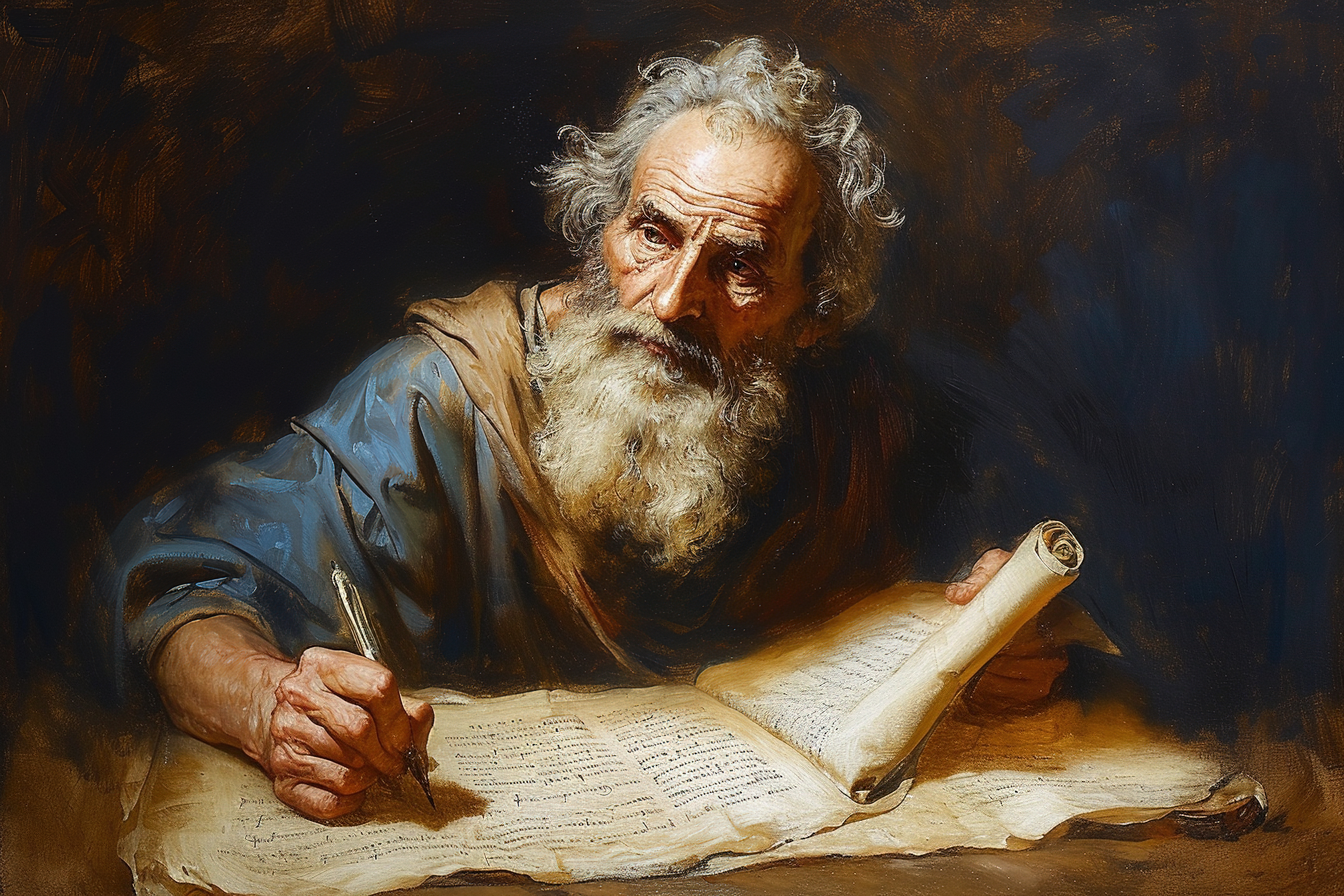

Paul Before Felix

Paul has been smuggled out of Jerusalem in the night because a plot by the Jews. Now he stands before Felix, once the religious leaders come to Caesarea.
Paul made it successfully to Caesarea where he will stand trial again. This time it is before the governor Felix. Felix is NOT swift in rendering a decision. Let’s rejoin our story with Paul in Herod’s palace.
Holy Spirit, thank You for ministering to my spirit today. Help me see Paul’s story now. Show me what You want me to observe in the story. Guide my journey.
♥ ♦ ♥
Paul feels safe in Herod’s palace. He doesn’t take advantage of all the ‘offerings’ available withing these walls. Herod is NOT a Jew who follows the law and his excesses make Paul’s skin crawl. He stays to his little corner and witnesses to his guards, along with any who will listen.
“Jesus came to set the Gentiles free, as well as the Jews” he tells his Roman guards.
Some are receptive and ask for more, but many turn away.
It has been five days of waiting and wondering before Paul is summoned to Felix. As he enters the room, he sees Ananias and several of the Sanhedrin standing to one side. One of the men among them is a lawyer named Tertullus. He will argue the Jew’s case against Paul. Once Paul is in the room, all turn to face Felix and the battle begins.
Tertullus bows respectfully before Felix, then begins presenting the Jew’s case:
“We have enjoyed a long period of peace under you, and your foresight has brought about reforms in this nation. Everywhere and in every way, most excellent Felix, we acknowledge this with profound gratitude. But in order not to weary you further, I would request that you be kind enough to hear us briefly.
“We have found this man to be a troublemaker, stirring up riots among the Jews all over the world. He is a ringleader of the Nazarene sect and even tried to desecrate the temple; so we seized him. By examining him yourself you will be able to learn the truth about all these charges we are bringing against him” (Acts 24:2-8).
Several of the Jews who came along threw their voices in, accusing Paul of horrible things.
Paul listens to the charges slightly shaking his head. He doesn’t want to appear disrespectful, but that small imperceptive shake forces its way through. “If I were half the man they are making me out to be, I would hate me too” thinks Paul.
Once the Jews have finished their accusations, Felix turns to Paul.
“What do you have to say for yourself?” Felix asks while holding out his hand, indicating it is Paul’s turn.
Paul steps forward without a bit of fear or groveling. His voice is strong and confident as he lays out his side of the matter:
“I know that for a number of years you have been a judge over this nation; so I gladly make my defense. You can easily verify that no more than twelve days ago I went up to Jerusalem to worship. My accusers did not find me arguing with anyone at the temple, or stirring up a crowd in the synagogues or anywhere else in the city. And they cannot prove to you the charges they are now making against me. However, I admit that I worship the God of our ancestors as a follower of the Way, which they call a sect. I believe everything that is in accordance with the Law and that is written in the Prophets, and I have the same hope in God as these men themselves have, that there will be a resurrection of both the righteous and the wicked. So I strive always to keep my conscience clear before God and man.
“After an absence of several years, I came to Jerusalem to bring my people gifts for the poor and to present offerings. I was ceremonially clean when they found me in the temple courts doing this. There was no crowd with me, nor was I involved in any disturbance. But there are some Jews from the province of Asia, who ought to be here before you and bring charges if they have anything against me. Or these who are here should state what crime they found in me when I stood before the Sanhedrin— unless it was this one thing I shouted as I stood in their presence: ‘It is concerning the resurrection of the dead that I am on trial before you today’” (Acts 24:10-21).
Felix pays close attention to both sides being presented. He is quite familiar with the Way, but he does not state that before those he is currently judging. Instead, he stalls for time.
“When Lysias the commander comes,” he said, “I will decide your case” (Acts 24:22).
Ananias face screws up with anger but he quickly schools it into neutrality. He does not want to offend Felix and give him reason to rule in Paul’s favor. But Felix’s next words bring him fear.
Felix turns to the centurion and issues orders. “Keep Paul under guard in Herod’s palace, but allow him freedom. Let his friends visit him if they want.”
Paul is pleased to hear that he will have a bit of freedom, but he would prefer to be held somewhere else. Herod has too many excesses. But he will not anger Felix by questioning his orders.
The centurion steps over to Paul and takes his arm. “This way” he says, while directing Paul with a firm hand.
Paul doesn’t resist at all and the centurion drops his hold. A second guard takes up position behind Paul as the three make their way out of the governors’ chambers.
The Jews bow respectfully before leaving.
“I can’t believe Felix giving that scoundrel Paul so much freedom.”
“I wonder if we can use that to our advantage.”
“How so?”
“By sneaking in an assassin and doing away with him.”
“It would have to be someone who realizes that they will probably die as well. There is no way the guards will let the man live who murders the charge under their care. It would mean the guard’s death if he did.”
“True, but I’m certain there are men faithful to us who would gladly make that sacrifice. Maybe even one of the forty who swore themselves to oath.”
“This is a good idea. I will send someone to speak with them.”
Paul’s friends have been waiting outside the governor’s palace for word of Paul’s fate. They follow the guards as Paul is brought back. They are encouraged when no one tries to stop them.
Upon reaching Herod’s palace, the centurion turns to Paul’s friends.
“Governor Felix has seen fit to grant Paul permission to receive his friends. I will require visits to be no more than two at a time, for security reasons. Yet you are allowed to visit anytime during daylight hours.
Luke is the first to step forward and ask to spend time with Paul. He is welcomed warmly by Paul as the two make their way to the room where Paul is staying.
“What do you think of the palace?” asks Luke.
“I would rather be in the barracks, not in the cell though. Too many of Herod’s ‘decorations’ are an affront to the life he claims to be living and the Jewish people. If not for having been exposed to all the gods of the Gentiles, I would be most offended. As it is, I’m uncomfortable, but I appreciate Felix’s gifts to me today so I won’t complain.”
“Well, I for one am grateful for you not being in the barracks. They can get pretty musty and impact a person’s health. I trust that you will be well cared for here.”
After a while Luke leaves. Paul welcomes visitors each day. They bring news of the goings on in both Judea and the lands Paul visited. He is happy to hear that all the churches are doing well and praying for him.
“I trust the Lord in all of this. I’m ready to die if that is His will. Yet I know He will have me witness in Rome before that day. My life is in His hands.”
Felix has still not rendered a decision after a week, but his wife has arrived and he wants to entertain her.
“You must here this prisoner, Paul, speak. He is from the Way and has much to say regarding Jesus of Nazareth.”
“Why is he a prisoner? Is it because of the Jewish religious leaders?”
“You are quite astute my dear. It is indeed on their charges that he is confined.”
“How are you going to rule? Is he guilty of what they are saying?”
“I don’t know. Maybe you hearing him will help me better understand the case.”
“I would welcome the opportunity.”
Paul is brought in to stand before Felix and Drusilla. He bows respectfully upon entering.
“Paul, I would hear more of the Way you spoke of.”
“My lord Felix, I believe you already know of the Way but I will be more than happy to share to gospel with you and your wife.”
Drusilla inclines her head, indicating for Paul to proceed. He spends several hours sharing the gospel and his encounter with Jesus. He also shares the moving of the Spirit in Galatia, Asia, Macedonia, and all surrounding areas.
Being a Jew, Drusilla is skeptical. She listens intently though and asks appropriate questions. Paul carefully answers all her questions skillfully. When Paul begins to speak of righteousness, self-control and the judgment to come, Felix becomes fearful. He ends the encounter.
“That’s enough for now! You may leave. When I find it convenient, I will send for you” (Acts 24:25).
Paul bows politely and is taken back to his holding area. He believes that Drusilla may yet become a follower of Jesus.
Paul is brought before Felix three more times before Paul realizes what he is actually after. He shares this with Luke the next time he comes.
“Felix isn’t really interested in the gospel, even though he has had me stand before him on multiple occasions.”
“How do you know and what do you suppose he is after if not more teaching?”
“He wants me to offer him a bribe. To pay him to release me.”
“It’s a wonder that the religious leaders haven’t paid for your life yet.”
“They probably tried, but as a Roman citizen, he cannot turn me over to them. Caesar would have his head.”
“Are you going to pay him?”
“No. I believe that this is where the Lord wants me to be. I am safe, well cared for, and able to continue spreading the gospel. I will not get in the way of the Lord.”
“That is sound reasoning my brother. I only wish… Never mind. It’s not important. You have to stay in the will of the Lord.”
Felix continues to call for Paul for two full years. Felix wants the Jews’ good favor so he doesn’t release Paul, but neither does he condemn him. He simply waits, hoping Paul will pay for his freedom.
Felix loses his seat as governor without releasing or condemning Paul. The next governor, Porcius Festus, inherits the problem as Felix has never ruled on the matter.
Three days after taking office in Caesarea, Festus travels to Jerusalem to introduce himself to the Jewish leaders. They are more than glad to receive his visit. They see it as an opportunity to get to Paul. All their attempts to reach him in Caesarea have failed.
“Great Festus, we have a favor to ask of you.”
“Speak, and I will see what can be done.”
“There is a prisoner in Caesarea by the name of Paul of Tarsus. He was brought before governor Felix more than two years ago. Felix has kept him imprisoned this whole time. To relieve you of the burden of one of Felix’s undone tasks, we would be more than willing to judge Paul here in Jerusalem. All you need do is authorize a transfer.”
Festus has no idea that the Jews have planned an ambush for Paul, hoping to finally rid themselves of him. Festus, though, is not new to the political scene. He has heard of Paul and the Jews’ disdain for him. He is not willing to grant their request and have his career tainted by ruling without hearing the facts of the matter.
“Paul is being held at Caesarea, and I myself am going there soon. Let some of your leaders come with me, and if the man has done anything wrong, they can press charges against him there” (Acts 25:4-5).
Festus enjoys his time in Jerusalem, being honored among the people, but the time comes when he has to begin his duties. After eight days, he announces that he will be going to Caesarea in the morning.
“I will be hearing the matter of Paul soon after arrival in Caesarea. It would be prudent for you to come along with me on my journey.”
Ananias is loath to travel with a Gentile but he cannot say that out loud. Instead, he comes up with a plausible excuse.
“I have to arrange the group who will be accompanying me to be heard regarding Paul’s crimes. I don’t believe I will be ready in the morning. I will follow soon after though.”
“As you wish. I will see you in my court as soon as you arrive.”
Ananias bows then turns to leave. He didn’t fool Festus one bit, but Festus knows that he needs the Jews on his side to keep the peace.
The day after arriving in Caesarea, Paul is brought to stand before Festus. He is surrounded by the Jews. It is near pandemonium as they all try accusing him at once. Festus holds up a hand for silence.
“This will be done in an orderly manner, or not done at all.”
Ananias bows. “I apologize my lord for our fervor. If you will allow us, we will begin again.”
“Proceed.”
Ananias, and those with him begin accusing Paul of serious crimes, but their testimonies don’t line up. They are conflicting and fabricated. This is obvious to Festus, but he does not say this to the Jews. He allows them their time.
After having heard enough worthless testimony, he turns to Paul. Paul’s answer is short, and to the point.
“I have done nothing wrong against the Jewish law or against the temple or against Caesar” (Acts 25:8).
Festus still wants to show the Jews some favor, so he has a proposal for Paul.
“Are you willing to go up to Jerusalem and stand trial before me there on these charges?”
Paul knows the Jews are up to something and he will not let himself fall victim to their schemes.
“I am now standing before Caesar’s court, where I ought to be tried. I have not done any wrong to the Jews, as you yourself know very well. If, however, I am guilty of doing anything deserving death, I do not refuse to die. But if the charges brought against me by these Jews are not true, no one has the right to hand me over to them. I appeal to Caesar!” (Acts 25:10-11).
Festus calls for a recess and confers with his own council.
“He has a right as a Roman citizen to make this demand.”
“Fine” Festus says before calling all the injured partis back into the room.
As Paul stands before him to the left and the Jews to the right, Festus rules. “You have appealed to Caesar. To Caesar you will go!” (Acts 25:12).
While awaiting arrangements for Paul to be taken to Rome, King Agrippa and Bernice arrive in Caesarea. They plan to spend several days with Festus. On their second night with him, Festus shares his dilemma with Agrippa.
“There is a man here whom Felix left as a prisoner. When I went to Jerusalem, the chief priests and the elders of the Jews brought charges against him and asked that he be condemned.
“I told them that it is not the Roman custom to hand over anyone before they have faced their accusers and have had an opportunity to defend themselves against the charges. When they came here with me, I did not delay the case, but convened the court the next day and ordered the man to be brought in. When his accusers got up to speak, they did not charge him with any of the crimes I had expected. Instead, they had some points of dispute with him about their own religion and about a dead man named Jesus who Paul claimed was alive. I was at a loss how to investigate such matters; so I asked if he would be willing to go to Jerusalem and stand trial there on these charges. But when Paul made his appeal to be held over for the Emperor’s decision, I ordered him held until I could send him to Caesar” (Acts 25:14-21).
Agrippa is intrigued by Festus’ dilemma. “I would like to hear this man myself” (Acts 25:22).
“Then tomorrow you will” replies Festus
The next morning, Agrippa and Bernice dress in their royal robes before joining Festus in his judgment hall. Once everyone is ready, Paul is brought in. Rather than addressing Paul, Festus addresses the rest of the room.
“King Agrippa, and all who are present with us, you see this man! The whole Jewish community has petitioned me about him in Jerusalem and here in Caesarea, shouting that he ought not to live any longer. I found he had done nothing deserving of death, but because he made his appeal to the Emperor I decided to send him to Rome. But I have nothing definite to write to His Majesty about him. Therefore I have brought him before all of you, and especially before you, King Agrippa, so that as a result of this investigation I may have something to write. For I think it is unreasonable to send a prisoner on to Rome without specifying the charges against him” (Acts 25:24-27).
Agrippa addresses Paul. “You have permission to speak for yourself” (Acts 26:1).
Paul is excited to have this opportunity, and being the animated speaker he is, he launches into full form. He spreads his arms wide, encompassing all those present.
“King Agrippa, I consider myself fortunate to stand before you today as I make my defense against all the accusations of the Jews, and especially so because you are well acquainted with all the Jewish customs and controversies. Therefore, I beg you to listen to me patiently…” Paul holds his hands out as if pleading to Agrippa.
“…The Jewish people all know the way I have lived ever since I was a child, from the beginning of my life in my own country, and also in Jerusalem. They have known me for a long time and can testify, if they are willing,…” Paul motions as if pointing out the Jewish people. “…that I conformed to the strictest sect of our religion, living as a Pharisee. And now it is because of my hope in what God has promised our ancestors that I am on trial today. This is the promise our twelve tribes are hoping to see fulfilled as they earnestly serve God day and night. King Agrippa, it is because of this hope that these Jews are accusing me. Why should any of you consider it incredible that God raises the dead?…” Paul raises his hands questioning this vital point. Then he places his hand on his own chest.
“…I too was convinced that I ought to do all that was possible to oppose the name of Jesus of Nazareth. And that is just what I did in Jerusalem. On the authority of the chief priests I put many of the Lord’s people in prison, and when they were put to death, I cast my vote against them. Many a time I went from one synagogue to another to have them punished, and I tried to force them to blaspheme. I was so obsessed with persecuting them that I even hunted them down in foreign cities.
“On one of these journeys I was going to Damascus with the authority and commission of the chief priests. About noon, King Agrippa, as I was on the road, I saw a light from heaven, brighter than the sun, blazing around me and my companions…” Paul points heavenward. “… We all fell to the ground, and I heard a voice saying to me in Aramaic, ‘Saul, Saul, why do you persecute me? It is hard for you to kick against the goads.’
“Then I asked, ‘Who are you, Lord?’
“‘I am Jesus, whom you are persecuting,’ the Lord replied. ‘Now get up and stand on your feet. I have appeared to you to appoint you as a servant and as a witness of what you have seen and will see of me. I will rescue you from your own people and from the Gentiles. I am sending you to them to open their eyes and turn them from darkness to light, and from the power of Satan to God, so that they may receive forgiveness of sins and a place among those who are sanctified by faith in me…’” Paul puts his hand on his chest again.
“… So then, King Agrippa, I was not disobedient to the vision from heaven. First to those in Damascus, then to those in Jerusalem and in all Judea, and then to the Gentiles, I preached that they should repent and turn to God and demonstrate their repentance by their deeds. That is why some Jews seized me in the temple courts and tried to kill me…” Paul points towards Jerusalem. “… But God has helped me to this very day; so I stand here and testify to small and great alike…” Paul spreads his arms encompassing the room again. “… I am saying nothing beyond what the prophets and Moses said would happen— that the Messiah would suffer and, as the first to rise from the dead, would bring the message of light to his own people and to the Gentiles” (Acts 26:2-23).
Festus has been listening intently to Paul’s assertions and cannot hold his tongue.
“You are out of your mind, Paul!” he shouts. “Your great learning is driving you insane” (Acts 26:24).
Paul both smiles and shakes his head for a moment before continuing. “I am not insane, most excellent Festus. What I am saying is true and reasonable…” Paul holds a hand out towards Agrippa. “… The king is familiar with these things, and I can speak freely to him. I am convinced that none of this has escaped his notice, because it was not done in a corner. King Agrippa, do you believe the prophets? I know you do.” (Acts 26:25-27).
Agrippa gives Paul a scrutinizing look. “Do you think that in such a short time you can persuade me to be a Christian?” (Acts 26:28).
Paul spreads his arms and says with absolute sincerity; “Short time or long—I pray to God that not only you but all who are listening to me today may become what I am, except for these chains” (Acts 26:29).
Agrippa’s eyes go wide and he draws back. After a moment, he stands to leave. Bernice and Festus quickly follow, leaving Paul alone with his guards.
Paul drops his hands. He had hoped to reach these men for the Lord.
The three of them begin quickly talking with one another. “This man is not doing anything that deserves death or imprisonment” (Acts 26:31).
Agrippa turns and faces Festus with hands raised in the air. “This man could have been set free if he had not appealed to Caesar” (Acts 26:32).
“I agree. There is nothing I can do now but send him onto Rome.”
(to be continued)
Paul KNOWS where his journey is supposed to take him. And it is NOT backwards. He has been called by God to speak the gospel in Rome. Not only in letters, but in person.
I don’t know what I would do in his position. First of all, I don’t do well speaking in public. I would trip over my tongue or shake so bad my words would be muddied. But Paul trusted in God. He was able to deliver a rousing reply to the charges AND share the gospel with those in power.
We all have places where we can serve that others might not be able to. I pray I’m serving in the place God has set aside for me.
Father God, let me be as fearless in the places You have given me to serve as Paul was. Lead me to where You have prepared me to be, and help me do the tasks you set before me.
It has been hard this week, spending time writing as I’m dealing with health issues for my husband. First of all, THANK YOU for getting people to FINALLY listen to me regarding what is going on. And for getting THEM to address it. Help him heal from this latest intervention. Second, THANK YOU for carrying him safely through it all. I pray our lives settle down a little now.
Thank You for helping me refocus too on our time together. Keep me coming Lord. I NEED our time like I need air.