
Jesus’ Second Day
With His arrival on a donkey, Jesus completed His first day of His final work. It is the second day, and Jesus has MUCH to say to the people.
This day will begin and end with a fig tree. In between are a mountain of parables. If only the people had actually listened. But, that too, is part of God’s plan.
Holy Spirit, guide this journey again today. It breaks my heart to KNOW that there was no other way. God’s plan demands these days be accomplished; EACH and EVERY one of them. Show me what to take from this day in Jesus’ life for my own life. Show me Your story, ‘in living color.’
♥ ♦ ♥
Last night, Jesus and His disciples left Jerusalem and returned to Bethany; to Lazarus’ house. All the way home, the disciples talked amongst themselves about what Jesus did.
“I can hardly believe the way the people reacted to Jesus’ arrival! It is as if they have been waiting for this moment all of eternity. With that reception, I don’t think we will have to worry about Jesus’ safety anymore” Andrew beams.
“I won’t be letting my guard down any time soon” Peter replies. “We have seen how fast the crowds can shift.”
“True. But did you see…”
“We all saw” echoes from all the disciples.
Jesus smiles to Himself; but only a small one. He knows what lies ahead. EVERY detail of it.
Morning breaks and Jesus is up and moving. “Be quick about it. We need to get on the road. There is much to do in Jerusalem today.”
The disciples put a little more speed into getting ready to go. Instead of sitting to table to eat the morning meal, they grab bread and dates to eat along the way. Jesus doesn’t grab anything. His focus is elsewhere.
Half way to Jerusalem, Jesus begins to get hungry. He chides Himself for not grabbing something to eat. In the distance He sees a fig tree. It is covered in leaves and appealing to the eye. It’s not the season for figs, but there should be nodules on the tree that He can eat. These are the ‘first fruits’ of a fig tree. The more nodules, the greater the later harvest.
Jesus starts searching the branches of the tree, looking for something to eat. He finds not a single nodule. This tree is fruitless. It is certainly old enough to produce fruit, but it hasn’t produced a single thing. It ‘looks good’ from a distance, but is full of death up close.
This instantly reminds Jesus of the Pharisees and religious leaders of Israel. He has been speaking against them from the beginning. Jesus curses the tree right then and there. “May no one ever eat fruit from you again” (Mark 11:14).
Jesus’ disciples hear Him as He curses the fig tree. They are surprised by this, but say nothing. The last time they saw Him looking so disgusted with something was when He cleared the Temple courts of the merchants.
Andrew realizes that Jesus is still hungry. He looks in the sack he brought with him and finds a good sized piece of cheese, wrapped in a cloth. He takes it out and hands it to Jesus.
“Here Lord. Share some of mine.”
Jesus takes it gratefully from Andrew’s hand. “Thank you” He says with a smile.
The rest of the journey to Jerusalem is uneventful. But once they enter the gates of the city, things change. Jesus heads straight for the Temple. He is interested to see if things have returned to ‘business as usual’ inside the Court of the Gentiles again.
As they approach, it is clear that the marketplace is now surrounding the Temple instead of inside it. Apparently, the merchants KNEW Jesus was coming back again and didn’t want a repeat demonstration of yesterday. Jesus smiles as He looks around.
After a few minutes, Jesus continues on into the Temple. It is still packed with people, but they are worshiping the Lord instead of conducting business. Jesus makes His way across the Court of the Gentiles and stops right at the boarder of the Outer Court. He is standing where both Jew and Gentile alike can come and listen. For He has much to say to both of them today.
Jesus’ entrance into the Temple didn’t go unnoticed. People begin to gather around Him almost as soon as He stops His forward motion. The Pharisees and Sadducees also notice Jesus’ arrival.
“Not again” they groan. “Something HAS to be done about Him” they complain to one another.
“Something WILL be done” vows their leader. “Soon!”
The people who have gathered around Jesus begin to ask Him to heal them or bless them. Jesus doesn’t hesitate. He heals all those who come to Him.
The group of religious leaders head straight for Jesus. They make certain to stay within the Outer Court as they ready for their first confrontation of the day.
“By what authority are you doing these things, or who gave you this authority to do them?” (Mark 11:28).
Jesus looks over at the group. Every face is sour as they challenge Him. He schools His face to match. “I will ask you one question; answer me, and I will tell you by what authority I do these things. Was the baptism of John from heaven or from man? Answer me.” (Mark 11:29-30).
This is NOT what the religious leaders were expecting. They have to confer with one another. “If we say, ‘From heaven,’ he will say, ‘Why then did you not believe him?’ 32 But shall we say, ‘From man’?” (Mark 11:31-32). They don’t even dare finish that thought. They know that the people considered John a prophet. If they say, “From Man” they will probably make the people angry.
They are no closer to an answer than they were the moment Jesus posed His question. Their leader decides to speak for all of them. “We do not know.” (Mark 11:33).
Jesus nods His head knowingly. It is exactly as He expected. “Neither will I tell you by what authority I do these things” (Mark 11:34) Jesus says to them.
Without taking His eyes off the religious leaders, Jesus begins speaking parables for all to hear. Especially the
“What do you think? A man had two sons. And he went to the first and said, ‘Son, go and work in the vineyard today.’ 29 And he answered, ‘I will not,’ but afterward he changed his mind and went. 30 And he went to the other son and said the same. And he answered, ‘I will, sir,’ but did not go. 31 Which of the two did the will of his father?” (Matthew 21:28-31a).
Without hesitation, the religious leaders answer. “The first” (Matthew 21:31b).
Jesus looks straight at them and replies; “Truly, I say to you, the tax collectors and the prostitutes go into the kingdom of God before you. For John came to you in the way of righteousness, and you did not believe him, but the tax collectors and the prostitutes believed him. And even when you saw it, you did not afterward change your minds and believe him” (Matthew 21:31c-32).
Eyes pop open and mouths begin to sputter in the group of the religious leaders. They know who Jesus is talking about. Before they can start their retort, Jesus continues with another parable.
“Hear another parable. There was a master of a house who planted a vineyard and put a fence around it and dug a winepress in it and built a tower and leased it to tenants, and went into another country. When the season for fruit drew near, he sent his servants to the tenants to get his fruit. And the tenants took his servants and beat one, killed another, and stoned another. Again he sent other servants, more than the first. And they did the same to them. Finally he sent his son to them, saying, ‘They will respect my son.’ But when the tenants saw the son, they said to themselves, ‘This is the heir. Come, let us kill him and have his inheritance.’ And they took him and threw him out of the vineyard and killed him. When therefore the owner of the vineyard comes, what will he do to those tenants?” (Matthew 21:33-40).
With indignation at the tenants, they answer, “He will put those wretches to a miserable death and let out the vineyard to other tenants who will give him the fruits in their seasons” (Matthew 21:41).
Jesus nods and His eyes narrow again. “Have you never read in the Scriptures: ‘The stone that the builders rejected has become the cornerstone; this was the Lord’s doing, and it is marvelous in our eyes’? Therefore I tell you, the kingdom of God will be taken away from you and given to a people producing its fruits. And the one who falls on this stone will be broken to pieces; and when it falls on anyone, it will crush him” (Matthew 21:42-44).
This time, the religious leaders are certain that Jesus is speaking about them. Their jaws clench and their hands curl into fists. But they are afraid of the people, who believe that Jesus is a great prophet. So, they do nothing but seethe in anger. They can’t even arrest Him without risking a riot.
Jesus isn’t done with them though. This time, He addresses His parable to all those listening. “The kingdom of heaven may be compared to a king who gave a wedding feast for his son, and sent his servants to call those who were invited to the wedding feast, but they would not come. Again he sent other servants, saying, ‘Tell those who are invited, “See, I have prepared my dinner, my oxen and my fat calves have been slaughtered, and everything is ready. Come to the wedding feast.”’ But they paid no attention and went off, one to his farm, another to his business, while the rest seized his servants, treated them shamefully, and killed them. The king was angry, and he sent his troops and destroyed those murderers and burned their city. Then he said to his servants, ‘The wedding feast is ready, but those invited were not worthy. Go therefore to the main roads and invite to the wedding feast as many as you find.’ And those servants went out into the roads and gathered all whom they found, both bad and good. So the wedding hall was filled with guests.
“But when the king came in to look at the guests, he saw there a man who had no wedding garment. And he said to him, ‘Friend, how did you get in here without a wedding garment?’ And he was speechless. Then the king said to the attendants, ‘Bind him hand and foot and cast him into the outer darkness. In that place there will be weeping and gnashing of teeth.’ For many are called, but few are chosen” (Matthew 22:2-14).
The religious leaders withdraw and Jesus allows the people a little bit to digest these parables. It isn’t the end of the battle with the religious leaders, but it is a reprieve where Jesus can focus on the people around Him. Jesus continues to heal all those who come to Him and to teach them about the kingdom of God.
While He engages with the people, the Pharisees are preparing for another attack. Their plan is to ensnare Him in His own words. To make Him look foolish in the eyes of the people. In hopes that He will lose favor with them as well.
After the midday meal, the Pharisees send their ‘well prepared’ disciples, along with a select group of Herodians, out to confront Jesus. These men were not in the original confrontation. They were ‘new’ to the battle, and could act the part of innocent seekers.
“Teacher, we know that you are true and teach the way of God truthfully, and you do not care about anyone’s opinion, for you are not swayed by appearances. Tell us, then, what you think. Is it lawful to pay taxes to Caesar, or not?” (Matthew 22:16-17).
They are not fooling Jesus one bit. He calls them out. “Why put me to the test, you hypocrites? Show me the coin for the tax” (Matthew 22:18-19).
Quickly, someone produces a denarius from his purse. “Hold it up so all can see” Jesus says.
With the coin lifted in the air, Jesus asks; “Whose likeness and inscription is this?” (Matthew 22:20).
The group confronting Him says, in unison; “Caesar’s” (Matthew 22:21a).
Looking them straight in the eyes, Jesus answers; “Therefore render to Caesar the things that are Caesar’s, and to God the things that are God’s” (Matthew 22:21b).
The disciples of the Pharisees and their Herodian counterparts have been put in their places. They quickly withdraw to devise another strategy.
The Sadducees decide to give it a try. This group differs from the Pharisees in that they don’t believe in a resurrection from the dead. They know that Jesus does though. So, they decide to use THIS avenue to attack Jesus.
The group walks over to where Jesus is and takes up a position to the right of Him. “Teacher, Moses said, ‘If a man dies having no children, his brother must marry the widow and raise up offspring for his brother.’ Now there were seven brothers among us. The first married and died, and having no offspring left his wife to his brother. So too the second and third, down to the seventh. After them all, the woman died. In the resurrection, therefore, of the seven, whose wife will she be? For they all had her” (Matthew 22:24-27).
Jesus knows exactly who He is being confronted by and their ulterior motives. He wags His head as He answers. “You are wrong, because you know neither the Scriptures nor the power of God. For in the resurrection they neither marry nor are given in marriage, but are like angels in heaven. And as for the resurrection of the dead, have you not read what was said to you by God: ‘I am the God of Abraham, and the God of Isaac, and the God of Jacob’? He is not God of the dead, but of the living” (Matthew 22:29-32).
Several of their mouths begin opening and closing like a fish, but no one utters a word. After a minute they turn as a group and leave. Jesus’ answer put them in their place; again. And He supported the resurrection through scripture.
The Sadducees return to the group of religious leaders, defeated. “Now what” is the question on everyone’s lips. The Pharisees begin devising another plan of attack.
“He has broken SO MANY of the laws. If we come at Him regarding the Law, we will be able to reveal His utter disregard of God’s Laws.”
One of the men in the group is an accomplished lawyer, and well known in the region. “Let me be the one to pose the question to Him.”
It is quickly agreed and they all advance on Jesus again.
Jesus sees them coming. “Here we go again” He thinks silently to Himself. Outwardly, he isn’t showing any signs of stress or frustration, even though this has been going on all day.
The Pharisees stop, in mass, and fire their next barrage. “Teacher, which is the great commandment in the Law?” (Matthew 22:36).
Without any hesitation, Jesus answers them. “The most important is, ‘Hear, O Israel: The Lord our God, the Lord is one. 30 And you shall love the Lord your God with all your heart and with all your soul and with all your mind and with all your strength.’ 31 The second is this: ‘You shall love your neighbor as yourself.’ There is no other commandment greater than these” (Mark 12:29-31).
The lawyer who had posed the question is in awe of Jesus’ answer. He recognizes it a perfect truth. He says to Jesus; “You are right, Teacher. You have truly said that he is one, and there is no other besides him. 33 And to love him with all the heart and with all the understanding and with all the strength, and to love one’s neighbor as oneself, is much more than all whole burnt offerings and sacrifices” (Mark 12:32-33).
Jesus is pleased with this man’s response. More than that, He sees how close the man is to accepting the whole truth. He says to him; “You are not far from the kingdom of God.” (Mark 12:34).
The rest of the group is not happy with the lawyer’s interaction, but they have no defense against it. Before the group can storm off to devise another plan of attack, Jesus has a question for them. “What do you think about the Christ? Whose son is he?” (Matthew 22:42a).
They know the answer to this one, so respond without hesitation. “The son of David” (Matthew 22:42b).
Jesus spreads His hands and asks them; “How is it then that David, in the Spirit, calls him Lord, saying, ‘The Lord said to my Lord, ‘Sit at my right hand, until I put your enemies under your feet”’? If then David calls him Lord, how is he his son?” (Matthew 22:43-45).
Jesus can see the anger of the Pharisees rising. And His anger is not too far behind their. But His is a righteous anger. An anger that is born out of a desire to protect the people from this group of hypocrites.
The Pharisees withdraw and don’t ask Him any more questions. They are out of ideas on how to trap Jesus.
Jesus watches them retreat. As they leave, Jesus turns to address the people and His disciples. He begins warning the people against them and pronouncing ‘woes’ over the religious leaders. He knows that they can hear His words as well as the people nearby.
“The scribes and the Pharisees sit on Moses’ seat, so do and observe whatever they tell you, but not the works they do. For they preach, but do not practice. They tie up heavy burdens, hard to bear, and lay them on people’s shoulders, but they themselves are not willing to move them with their finger. They do all their deeds to be seen by others. For they make their phylacteries broad and their fringes long, and they love the place of honor at feasts and the best seats in the synagogues 7 and greetings in the marketplaces and being called rabbi by others…”
Jesus zeros in on His disciples. “…But you are not to be called rabbi, for you have one teacher, and you are all brothers. And call no man your father on earth, for you have one Father, who is in heaven. Neither be called instructors, for you have one instructor, the Christ. 11 The greatest among you shall be your servant. Whoever exalts himself will be humbled, and whoever humbles himself will be exalted.” (Matthew 23:2-12).
Jesus turns in the direction of the religious leaders. “But woe to you, scribes and Pharisees, hypocrites! For you shut the kingdom of heaven in people’s faces. For you neither enter yourselves nor allow those who would enter to go in. Woe to you, scribes and Pharisees, hypocrites! For you travel across sea and land to make a single proselyte, and when he becomes a proselyte, you make him twice as much a child of hell as yourselves.
“Woe to you, blind guides, who say, ‘If anyone swears by the temple, it is nothing, but if anyone swears by the gold of the temple, he is bound by his oath.’ You blind fools! For which is greater, the gold or the temple that has made the gold sacred? And you say, ‘If anyone swears by the altar, it is nothing, but if anyone swears by the gift that is on the altar, he is bound by his oath.’ You blind men! For which is greater, the gift or the altar that makes the gift sacred? So whoever swears by the altar swears by it and by everything on it. And whoever swears by the temple swears by it and by him who dwells in it. And whoever swears by heaven swears by the throne of God and by him who sits upon it.
“Woe to you, scribes and Pharisees, hypocrites! For you tithe mint and dill and cumin, and have neglected the weightier matters of the law: justice and mercy and faithfulness. These you ought to have done, without neglecting the others. You blind guides, straining out a gnat and swallowing a camel!
“Woe to you, scribes and Pharisees, hypocrites! For you clean the outside of the cup and the plate, but inside they are full of greed and self-indulgence. You blind Pharisee! First clean the inside of the cup and the plate, that the outside also may be clean.
“Woe to you, scribes and Pharisees, hypocrites! For you are like whitewashed tombs, which outwardly appear beautiful, but within are full of dead people’s bones and all uncleanness. So you also outwardly appear righteous to others, but within you are full of hypocrisy and lawlessness.
“Woe to you, scribes and Pharisees, hypocrites! For you build the tombs of the prophets and decorate the monuments of the righteous, saying, ‘If we had lived in the days of our fathers, we would not have taken part with them in shedding the blood of the prophets.’ Thus you witness against yourselves that you are sons of those who murdered the prophets. Fill up, then, the measure of your fathers. You serpents, you brood of vipers, how are you to escape being sentenced to hell? Therefore I send you prophets and wise men and scribes, some of whom you will kill and crucify, and some you will flog in your synagogues and persecute from town to town, so that on you may come all the righteous blood shed on earth, from the blood of righteous Abel to the blood of Zechariah the son of Barachiah, whom you murdered between the sanctuary and the altar. Truly, I say to you, all these things will come upon this generation.” (Matthew 23:13-36).
Jesus turns back towards the crowd, but appears to be looking beyond the people. He is looking at the very spirit of the city. He cries out against it as well.
“O Jerusalem, Jerusalem, the city that kills the prophets and stones those who are sent to it! How often would I have gathered your children together as a hen gathers her brood under her wings, and you were not willing! See, your house is left to you desolate. For I tell you, you will not see me again, until you say, ‘Blessed is he who comes in the name of the Lord’” (Matthew 23:37-39).
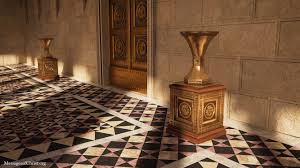
Jesus is finished with teaching, for now. He walks over to where the offerings are deposited. He sits down to watch as the people bring their alms to the Lord. People come in, drop their coins into the collection device, and receive personal glory for the clattering, trumpet, sounds their donations make. The rich drop in large donations, leading to the sound ringing out in recognition.
Then, a widow approaches the donation trumpet. She stretches out her hand and drops in two small coins. Jesus knows exactly what she put in and what is in her heart as she does so. The sound created by her two small coins goes almost unnoticed by the people. But no by Jesus.
Jesus calls His disciples attention to the woman. He points her out so they all can see her.
“Truly, I say to you, this poor widow has put in more than all those who are contributing to the offering box. For they all contributed out of their abundance, but she out of her poverty has put in everything she had, all she had to live on” (Mark 12:43-44).
Jesus sits a while longer before deciding to end His day. He is tired. His shoulders drop and he turns to Peter.
“It is enough for today” He says.
Peter nods and motions for the rest of the disciples to come closer. Once everyone is assembled, Peter says; “The Teacher is done for the day. We need get Him safely out of the city.”
The disciples form up around Jesus and begin moving through the crowd with Him in their center. They maintain this formation until they are well outside the city walls. Once past all the crowds, they drop back and let Him lead.
As they walk along, they approach the fig tree that Jesus had cursed in the morning. It takes a moment for them to realize it is the same tree, as the leaves are gone from it now. It holds no glory on its own.
Peter calls out to Jesus; “Rabbi, look! The fig tree that you cursed has withered” (Mark 11:21).
Jesus looks at His disciples. This is the PERFECT time for another lesson. “Have faith in God. Truly, I say to you, whoever says to this mountain, ‘Be taken up and thrown into the sea,’ and does not doubt in his heart, but believes that what he says will come to pass, it will be done for him. Therefore I tell you, whatever you ask in prayer, believe that you have received it, and it will be yours. And whenever you stand praying, forgive, if you have anything against anyone, so that your Father also who is in heaven may forgive you your trespasses” (Mark 11:22-25).
The disciples look back at the tree occasionally, until if fades from sight, as they continue on their journey to Bethany. It has been a long day and everyone is tired. They are all ready for the meal that Martha is sure to have waiting for them.
(to be continued)
This day holds the largest amount of teaching for Him in the Temple. I was surprised by how many parables He shared in this single day. The people had a lot to think about as they did their own business.
I wonder how many of them listened, but had their minds on their own cares as Jesus spoke. How many were ‘good soil’ and ‘stony ground’? The Pharisees were certainly ‘stony ground’.
The next day Jesus does some private teaching, and Judas makes a decision that is part of God’s plan. But changes Judas’ life forever.
Father God, thank You for sharing Your stories with me. Thank You for helping me focus on our time together, even in the midst of this busy day. I would have LOVED to see Jesus put the religious leaders in their places that day! But I would have wanted to be in the private teaching the next day even more. To spend time at His feet without the crowd pressing in.
Help me during the crowd that is coming today. Help me be a gracious hostess and have the ‘Martha spirit’ my husband would normally be exhibiting.