
John Prepares the Way

It’s time to get the people’s hearts ready for the appearance of their Messiah. John prepares the way, in the spirit of Elijah. This was his mission from conception.
I tried researching how long John had been calling out to the people before Jesus stepped into His role in history. My brain HURTS from this! I can’t reconcile all the events of John and Jesus’ life with the available data. One of the big hurdles for me is when Herod the Great actually died. We need time between Jesus’ birth, the wise men’s visit, time in Egypt, and Herod’s death to fix a date. Let me just say, it’s beyond my little brain and my limited grasp of history.
So, I not going to worry about the DATE John started ministering. Matthew and Luke both give us a pretty specific time frame for John to begin, but not an age for him. John wasn’t serving in the Temple, but he was a Levite and their ministry isn’t supposed to begin until they are 30 years of age. We have Jesus beginning His ministry at 30 and ending with His death at 33. We KNOW that John started first, so I’m leaning towards a six-month head start. Which is consistent with their difference in ages.
The number of months really doesn’t matter. What matters is that God brought BOTH of them onto the scene in HIS timing. Let’s rejoin our story by going back in time a little bit. I want to see John growing up before we bring him onto the ‘stage’.
Holy Spirit, lead this journey today. Show me what is important and what to leave lying on the ground. Show me God’s hand in all of this and what I should take for my own life.
♥ ♦ ♥
Zechariah and Elizabeth are THRILLED to have a son. They couldn’t be prouder of how his heart LONGS for the words of God. His abba can’t seem to fill him fast enough with the scriptures. He always asks questions and seeks deeper knowledge and understanding. He is not satisfied with the surface truths that the people of Israel have been consuming for years.
Even as a young child, John asked to hear the stories of Israel’s time with God over and over again. He asked questions even then. Some that his abba had to go search out before he could answer. Zechariah loved this because it challenged him too.
John goes with his family every year to Jerusalem for Passover. It is a time he gets to meet with his extended family, including Jesus. The cousins spend time in discussion every year and challenge one another to grow in the Lord’s words.
Another thing particular about John is his love for solitude. He does his best ‘thinking’ and growing when he is alone. It started when he was a child.
Elizabeth is looking for John. She calls his name but receives no answer. She looks all through the house; still no John. “Where could that boy have gotten off to” she says to herself.
She goes out into the garden and searches again. She notices a small pile of clay pots in a corner of their garden. “Could he have gone behind the pots and fallen asleep?” she worries. Who know what is over there. She moves to the pots to search for her missing child. There, sitting behind the pots, is John.
“John” Elizabeth says in a stern voice. “Didn’t you hear me calling you?”
John hops up and faces his ima. “No, ima. I didn’t.”
“What are you doing over here anyway?”
“I like it here. It is quiet” answers John with pure innocence.
“It’s time for dinner, so go into the house.”
The next day, when John goes missing, Elizabeth starts in the garden. Day after day, this is where John goes. He sits in solitude. Elizabeth tells Zechariah about John’s behavior. Zechariah laughs. “You can’t blame a boy for wanting a place of his own.”
That evening, Zechariah brings out the tent they use when traveling to and from Jerusalem. He sets it up in John’s corner. John watches as his abba arranges everything, including putting the pots around the perimeter of the tent so John can have his ‘special space’. John is ecstatic! This is perfect for his need for solitude.
John spends many youthful years in his ‘special space’. This is also where he goes to ponder the deep questions he brings to his abba. Also, where he goes to mull over the answers. THIS is his ‘training ground’ before anyone realizes it.
As John grows, his quiet place moves farther away from people. He begins wandering in the wilderness each day. He comes home every evening, as his ima insists, but as soon as his chores are done for the day, he is back in the wilderness the next morning.
When John is fifteen, his abba convinces his ima to allow him to do a few overnights each week in his wilderness. This allows John to stretch his independence and self-reliance during these times. He insists that he needs NO food or water to take with him on his journeys.
“I can find all I need from the things God provides in the wilderness.”
Elizabeth stops arguing and allows this time of stretching. “One day he is going to walk off into that wilderness and not come back to us” she tells Zechariah.
“It is where he meets with the Lord the best. He has a task that he was born to do. This is his place of preparation.”
Zechariah and Elizabeth were advanced in years when John was born. His birth brought a bit of ‘youth’ back into their years in the beginning, but their lives are nearing an end. John divides his time between caring for his aging parents, learning more of the scriptures, and pondering them in his quiet place. He struggles to maintain the balance. His heart is drawn to the Lord like a moth to a flame. But, as a loving son, he cannot abandon his parents, especially in their declining years.
One evening, in his quiet place, he brings this conflict to the Lord. At the time, he is nearing his 20th birthday.
“Lord, You know my heart. How it is torn in two. I want to spend every waking moment with You, but I also need to spend time with my parents. I know that they won’t be with me much longer. What would You have me do?”
In his spirit he hears God’s heart. “Honor your parents, that it may go well with you.”
John nods. “I will honor them as long as they live.”
Two days after the celebration of John’s 20th year of life, he comes into the house and finds it quiet; too quiet. The lamps are still dark and there is no smell of his ima’s cooking. John calls out for his parents but receives no answer. He moves to the door of their bedroom and listens. No sounds come from the room behind it. John knocks and calls to them, in case they are sleeping. Still no answer.
John hesitates on the outside of the door, working up the courage to invade his parent’s private space. He takes a deep breath and slowly opens the door. The first thing he sees is his abba’s foot. It is peeking from beneath the covers. He continues to open the door slowly. Finally, John can see both his parents, lying peacefully in bed. He steps over beside the bed, but notices something strange.
His parents’ faces are pale. There is a look of pure peacefulness in the stillness of their faces. John knows immediately that they are gone.
A mournful cry rips from John’s throat and he tears his robe. He bends down and tenderly kisses each of his parents. Afterwards, he goes to the Synagogue to ask for help with the last duties of care and burial. If it were just one of his parents who had died, he could have assisted the other in the preparations for burial. He can’t do both.
Help quickly arrives in the form of two Levites and their wives. John helps wash his abba while the women prepare his ima. When all is ready, their bodies are carried together and placed in a tomb beside one another. The stone is rolled in front of the tomb and John turns to go.
John walks to his place in the wilderness and doesn’t return. The Levites will have to clean out his parents’ home and ready it for its next occupant.
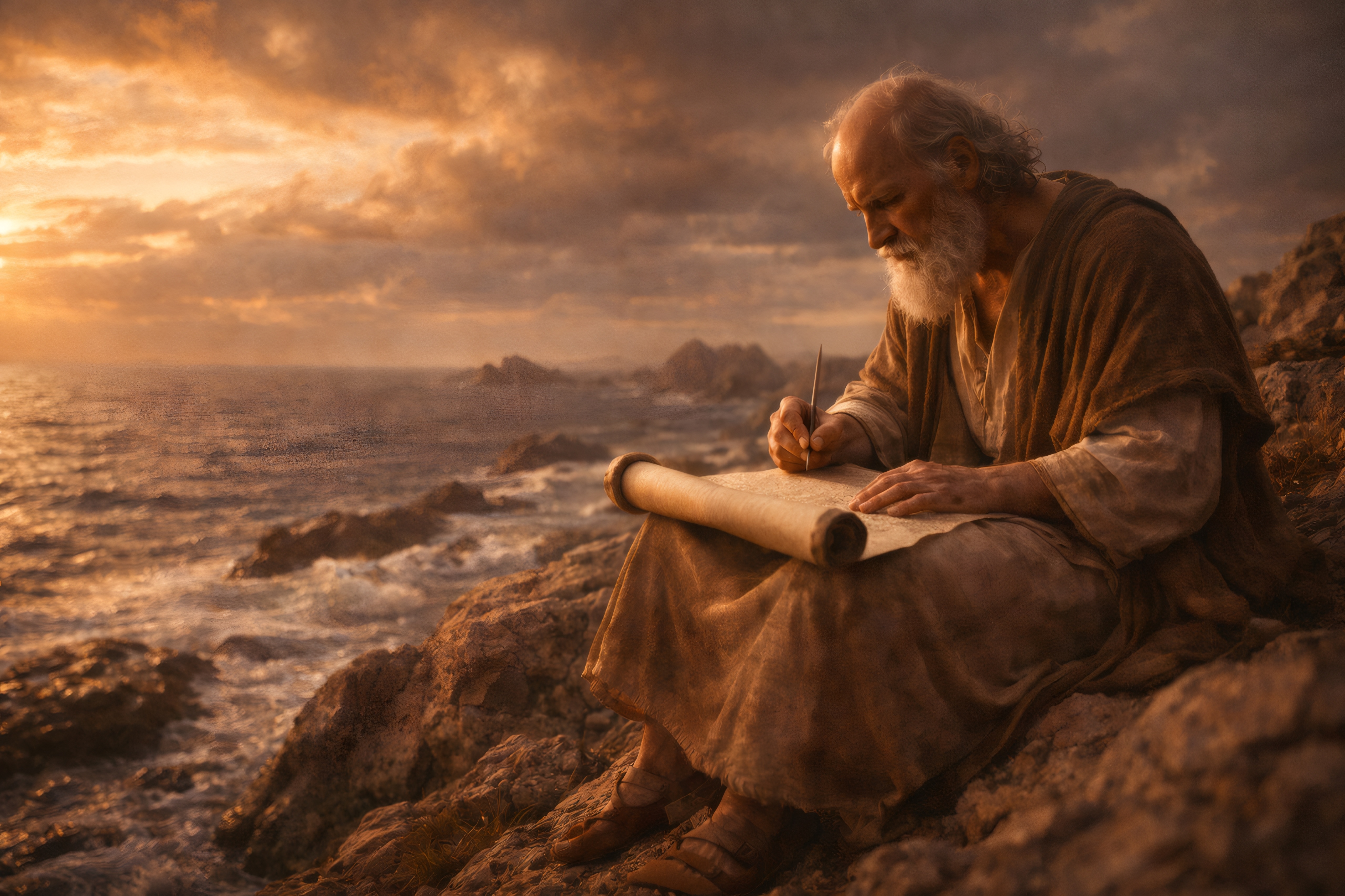
John remains in the wilderness spending every day with the Lord. He eats locust and wild honey. His clothing is made of camel skin. And there is nothing soft about him. At the age of 30, God tells him; “It’s time.”
All his life, John has been waiting for this moment. He has known the Spirit of the Lord since before his birth. His life has been leading up to this purpose; to proclaim the year of the Lord. To call the people to repentance. To turn the hearts of the fathers to their children and the children to their fathers. To announce the coming of the Messiah.
“The voice of one crying in the wilderness: ‘Prepare the way of the Lord, make his paths straight. Every valley shall be filled, and every mountain and hill shall be made low,
and the crooked shall become straight, and the rough places shall become level ways,
and all flesh shall see the salvation of God’” (Luke 3:4-6).
John begins doing exactly that; calling the people to repentance. Those who hear his words and repent of their sins, he baptizes in the Jordan River. He welcomed the people that came to him; except the religious leaders. To those, he called out; “You brood of vipers! Who warned you to flee from the wrath to come? Bear fruits in keeping with repentance. And do not begin to say to yourselves, ‘We have Abraham as our father.’ For I tell you, God is able from these stones to raise up children for Abraham. Even now the axe is laid to the root of the trees. Every tree therefore that does not bear good fruit is cut down and thrown into the fire” (Luke 3:7-9).
The people that come to him ask what they should do to show ‘fruit’ of their repentance.
“What then shall we do?” (Luke 3:10)
John looks out at the people. “Whoever has two tunics is to share with him who has none, and whoever has food is to do likewise” (Luke 3:11).
Tax collectors come to him, asking what they must do. “Teacher, what shall we do?” (Luke 3:12).
John knows their hearts and their customs. “Collect no more than you are authorized to do” (Luke 3:13).
Soldiers come to him also and ask; “And we, what shall we do?” (Luke 3:14a).
“Do not extort money from anyone by threats or by false accusation, and be content with your wages” (Luke 3:14b).
The people are in awe of John’s message. Many of them start to speculate that he might be the Messiah himself. The Spirit within John hears their hearts and gives John a clear message for all the people.
“I baptize you with water, but he who is mightier than I is coming, the strap of whose sandals I am not worthy to untie. He will baptize you with the Holy Spirit and fire. His winnowing fork is in his hand, to clear his threshing floor and to gather the wheat into his barn, but the chaff he will burn with unquenchable fire” (Luke 3:16-17).
John has many men who cling to his message and follow him. They become his disciples. Learning from him and sharing the words he shares. They don’t baptize people, but they lead them to the one who is.
John is NOT shy about confronting ANYONE about their sins. One day, Herod and Herodias, his wife, who is the former wife of his brother, come near where John is preaching. They have heard tell of his fiery ministry. As the two sit, couched on their royal carriage, John approaches them. His finger is extended in accusation.
“You Herod have sinned before man and God. You have taken for your own, the wife of your brother, Philip. You make her an adulteress and detestable in God’s sight. End this relationship, or suffer the consequences!”
Herodias face goes pale and her mouth drops open. She tries to say something but no words emerge. Herod sees her distress and tells his servants to take them away from John, immediately!
Herodias vows to ‘make John pay’ for his insult. She storms back and forth in her room for hours. At evening, she approaches Herod.
“That vile man insulted me! What are you going to do about it?”
“I cannot punish a man for speaking the truth. You knew this when you sought me for your bed.”
Herodias’ ears turn red and, if it were possible, fire would shoot from her eyes. She turns on her heel and leaves. “I WILL get even with that man!”
Herod is interested in what John says and his words prick his heart. But he refuses to give up the enchanting Herodias. This is not the end of the litany of sins laid at Herod’s feet by John, speaking in the Spirit of the Lord.
John continues to teach and baptize all those who come in repentance. One day, as he is speaking to the people along the banks of the Jordan, Jesus emerges from the crowd.
John instantly knows Him. Yes. He is John’s cousin, but more than that. He is the Messiah. The Son of God. The one that the Spirit in John testifies about.
“I need to be baptized by you, and do you come to me?” (Matthew 3:14), John says as Jesus approaches.
Jesus smiles at John. Then, with a face filled with conviction, He says; “Let it be so now, for thus it is fitting for us to fulfill all righteousness” (Matthew 3:15).
John doesn’t resist any longer. He takes Jesus by the hand and the two of them step into the Jordan river. They walk out until the water is at their waists. John drops Jesus back into the water until He is fully submerged, then he brings Jesus back to standing. At that moment, the clouds overhead separate and a shining light burst through. From that light, what looks like a dove descends and lands on Jesus’ head. John recognizes this as the Spirit of God. At the same time, a voice speaks from the shining light in the heavens; “This is my beloved Son, with whom I am well pleased” (Matthew 3:17).
John was told by the Lord that this very thing would happen. Seeing it and being part of it is a LOT different that knowing about what is to come. John is speechless as he walks with his cousin, the Messiah out of the Jordan River. John watches Jesus’ retreating back. Jesus has just completed the first step in His own ministry.
Normally, John would point out Jesus as the Messiah, but right now, his spirit is telling him to remain quiet. Jesus needs time alone. And, just because Jesus has stepped onto the scene, doesn’t mean that John is supposed to fade away. He returns to the crowd and calls them to repentance. He baptizes many that day. But NONE will ever be as special as that moment in the river with his Savior.
(to be continued)
I made the assumption that Zechariah and Elizabeth die before John began his ministry. They were advanced in years before John was even born. I wonder what they thought of their son’s calling. They knew he would be a prophet from the beginning, but I wonder if they saw their son as the one calling people to be baptized and standing up to Herod.
I don’t think I could be a ‘John the Baptist’ kind of person. One who doesn’t pull punches. One who calls out sin wherever he sees it. And won’t back down! I find myself trying to use love to win someone. It’s hard for me to outright tell someone that I think their behavior is wrong; especially my grown children and grandchildren. The thing is, they all know what I think of their behavior, but they also KNOW without a doubt that I love them. I will never reject them. And I pray that someone they will listen to will come into their lives.
Father God, thank You again for sharing Your stories. For letting me see a little more into the life of John. Sometimes, I wish I could be more like him, but I KNOW that is not the role You gave me in Your kingdom. One reason I don’t feel You condemning me for not taking hard stands, is when You spoke over my life and said I would be a “peace maker”. I certainly did NOT fit that mold at the time, but You continued to mold me until I fit YOUR design for me. I pray that the stories I tell won’t spart huge amounts of controversy but will speak of Your love and hand throughout ALL of time. Even now, You have You ‘John the Baptist’ ministers at work, calling people back to You. And You know EXACTLY what it will take to bring my children and grandchildren to You. I leave them in Your hands; again.