
Paul’s Solo Time
Berea became dangerous for Paul, so the brothers sent him on ahead. He now has time on his hands and goes solo into teaching the people at Athens.
Silas and Timothy remained behind at Berea while Paul escaped. Paus asks for them to come as soon as he lands. Maybe because there is ‘safety in numbers’ or it was easier to reach people with others who support you. But God is going to use Paul all on his own while he waits for his fellow missionaries to join him. Lets rejoin Paul in Athens and see how he spreads the gospel.
Holy Spirit, take me into Your story. Let me see what Paul saw, hear the people, understand their biases, and watch as You transform them. You NEVER leave any of us the way You found us, unless we insist and push You away. Don’t let me EVER do that!
♥ ♦ ♥
Paul is exploring the streets of Athens. It is a beautiful city and certainly a very busy place. But all their ‘business’ is focused in trying to appease their MULTIPLE gods. Paul has lost count of how many idols he has passed just walking into the city. The whole city seems dedicated to making sure NO god is left out.
“There have to be some here who believe in the Lord” Paul tells himself. He feels rewarded when he comes upon a Jewish synagogue. He enters the structure and looks around. It feels like ‘home’, the familiar surroundings and usual setup. He breathes in the fragrances for a minute before continuing on his journey.
“I know where I will be come Sabbath” he tells himself. It is still two days away. Until then, Paul will observe. One thing that Paul observes are alters made for “An Unknown God.” As Paul gazes at one of these, memories begin to surface in his mind from teachings he received as a student.
Along with studying Torah (Instruction/Law), Nevi’im (Prophets), and Ketuvim (Writings), Paul also studied many of the philosophers, and history of the nations around the known world. Greek philosophers were certainly among them. At the time, Paul saw no benefit to studying these foreign philosophies and gods, but today he begins to wonder if God might have been planning something in his life all along. For now, he notes the altars and remembers the story behind them.
The Sabbath arrives and Paul is relieved to be standing amongst his Jewish brothers once again. These are men and women who serve the true God, but he is pretty certain that they know little of the gospel of Jesus. That changes today.
As a guest, Paul is invited to share following the reading of the Torah and Nevi’im. He welcomes this opportunity to open the people’s eyes to the truth; that the Messiah has come and set His people free. Not physically yet, but spiritually at least.
Paul has had a lot of practice sharing the gospel and proving Jesus as the Christ. The people in the synagogue easily follow along with Paul’s message. Both Jews and Greek receive the message with gladness and come to faith in Jesus.
The next morning, Paul takes the message to the streets. He stands in the marketplace and talks with anyone who cares to listen. One day a group of Epicurean and Stoic philosophers happen upon him. They are curious about his message. He has mixed reactions from this group.
“What does this babbler wish to say?” (Acts 17:18a) one man asks.
“He seems to be a preacher of foreign divinities” (Acts 17:18b) another answers.
Paul is speaking of Jesus and the resurrection, which is totally new to these people. And THAT is something that the people of Athens crave! They are always looking for something new and exciting to introduce to others. Being the first to find a ‘new thing’ brings great recognition.
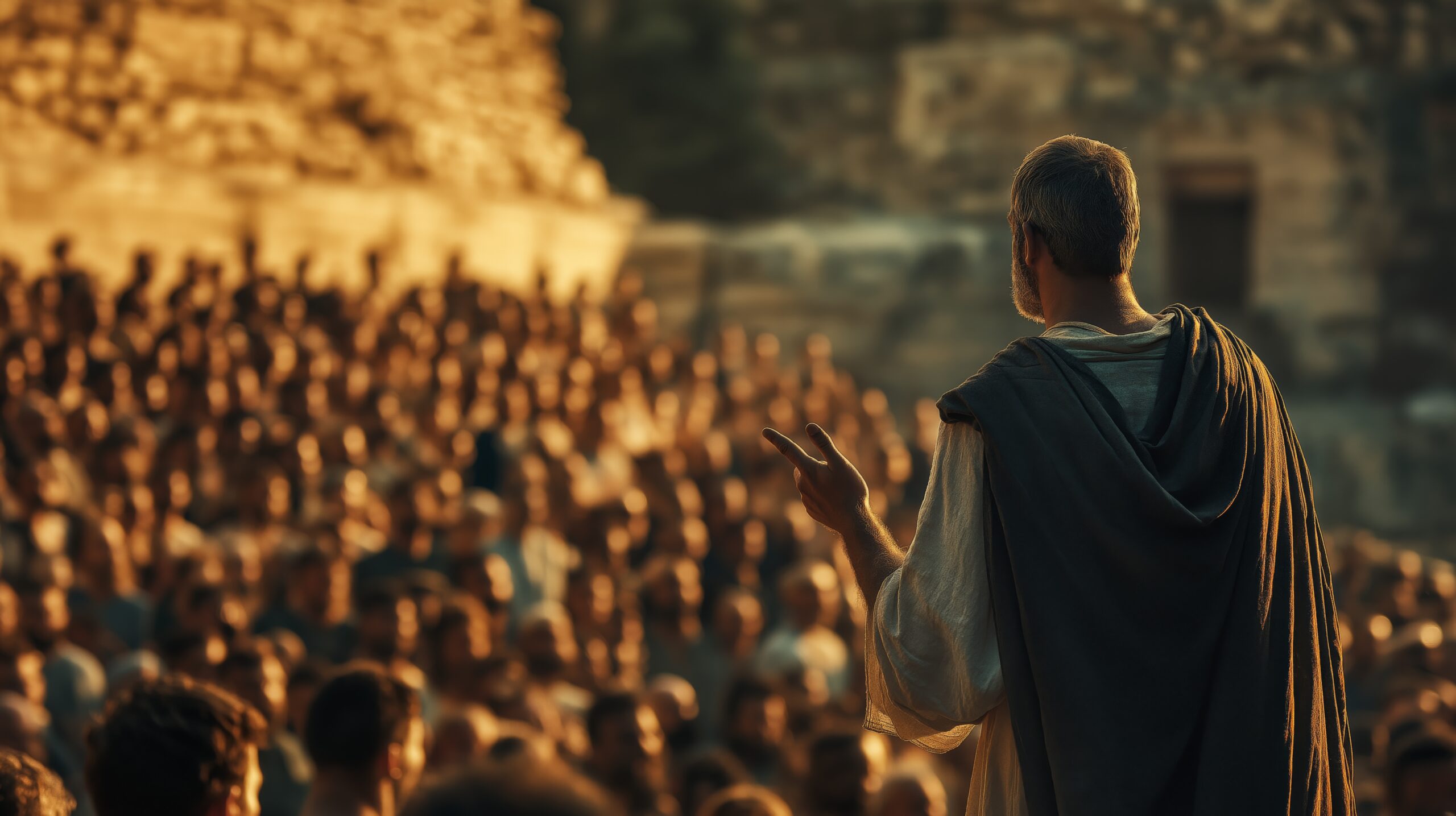
The group of philosophers convince Paul to come with them. They take him to the Areopagus. This is a rocky hill, rising above the city, where religious, philosophical, and government debates are conducted. Everyone is welcome to observe the proceedings of the day.
Paul is brought to the pinnacle of the Areopagus and asked to speak to the people.
“May we know what this new teaching is that you are presenting? For you bring some strange things to our ears. We wish to know therefore what these things mean” (Acts 17:19-20).
Paul is more than willing to share the gospel with the people. He is honored to be given such a platform, even if it has been used by many for the opposite of enlightenment. As Paul prepares to speak, the memories of the alters to an unknown god rise in his spirit, along with the history lessons pertaining to it. Rather than using Jewish scripture to persuade the people, Paul uses their own ‘spirituality’ to lead the people to the truth.
Paul looks out over the people and appeals to them with his eyes. “Men of Athens, I perceive that in every way you are very religious. For as I passed along and observed the objects of your worship, I found also an altar with this inscription: ‘To the unknown god.’ What therefore you worship as unknown, this I proclaim to you. The God who made the world and everything in it, being Lord of heaven and earth, does not live in temples made by man, nor is he served by human hands, as though he needed anything, since he himself gives to all mankind life and breath and everything. And he made from one man every nation of mankind to live on all the face of the earth, having determined allotted periods and the boundaries of their dwelling place, that they should seek God, and perhaps feel their way toward him and find him…”
Paul raises his hand towards heaven. “…Yet he is actually not far from each one of us, for ‘In him we live and move and have our being’; as even some of your own poets have said, ‘For we are indeed his offspring.’…”
Paul gives them a moment to remember their own story of sacrifices offered to the unknow god through the direction of one of their great philosophers; Epimenides. He had instructed them to build these altars and offer sacrifice to end an epidemic in the area.
Paul continues after a moment. “…Being then God’s offspring, we ought not to think that the divine being is like gold or silver or stone, an image formed by the art and imagination of man. The times of ignorance God overlooked, but now he commands all people everywhere to repent, because he has fixed a day on which he will judge the world in righteousness by a man whom he has appointed; and of this he has given assurance to all by raising him from the dead” (Acts 17:22-31).
Many of the listeners mock Paul, but others ask to hear more.
“We will hear you again about this” (Acts 17:32).
Among those who wish to hear more are Dionysius the Areopagite and a woman named Damaris. The gospel begins to grow with this group as its foundation. Paul explains all to them before leaving for Corinth.
Paul has been to Corinth before. On his last visit, he became familiar with the town and its people. While visiting the market, Paul hears that there is a new tent maker in town. It is a couple named Aquila and Priscilla. They are Jews who recently came from Italy when they were displaced by the Roman governor, Claudius.
Paul goes in search of this Jewish couple and finds them in a small stall, making tents. The three strike up a conversation and are soon fast friends.
“Where are you from” Priscilla asks Paul.
“That is a LONG story, but I am originally from Tarsus. I am on a journey for the Lord, spreading the news of Jesus the Christ.”
“We have heard some talk of Him but would like to learn more” exclaims Aquila.
“I would be honored to share with you the good news of Jesus.”
Paul begins to lay out the gospel and prove through prophecies that Jesus fulfilled the requirements of the Messiah. While he speaks, he sits down beside the couple and takes up a needle. He expertly joins them in stitching the project they are working on.
Priscilla raises and eyebrow and smiles at Aquila. They both shake their heads and keep working while listening to Paul.
After the tent they are working on is finished, Priscilla asks Paul to stay with them.
“You have blessed us doubly today. First by sharing the word of the Lord and by helping in our work. Please accept our invitation.”
Paul gladly accepts; “On one condition though.”
“What is that” asks Aquila.
“That you allow me to work beside you in your trade. I have missed having my hands immersed in twine and linen.”
“You are certainly welcome to join us in our work! We are grateful for your assistance and skill.”
Paul moves into the home of Priscilla and Aquila and joins them in their trade. But he does not neglect spreading the word. His first stop, as usual is the synagogue his first Sabbath in Corinth.
Paul speaks in the synagogue for weeks, arguing and pointing to the evidence of Jesus as the Messiah. Most of the Jews refused to listen. After several weeks of trying, the Jews become hostile, shouting him down and insulting him in the most demeaning ways they can imagine.
Having had enough, Paul grabs hold of the front of his robe with both hands and shakes it out, as if shaking crumbs or dust from it. As he does this, he calls out to them in condemnation.
“Your blood be on your own heads! I am innocent. From now on I will go to the Gentiles” (Acts 18:6).
Paul turns and walks out of the synagogue. He doesn’t have far to go, as one of the leading men of the believers in Jesus lives next door to the synagogue. His name is Titus Justus. He welcomes Paul.
About this same time, Timothy and Silas arrive from Macedonia. Paul is glad to see them and they share stories well into the night. Paul also shares what is currently happening in Corinth.
“The Jews have refused the Lord, again. It is time to turn to the Gentiles.”
The three men begin speaking in the streets and anywhere they can, sharing the gospel with all who will listen. Many of the Corinthians become believers, including the leader of the synagogue, Crispus, and his whole household. As many as believe, Paul, Silas, and Timothy baptize.
One night, while Paul is asleep in the home of Aquila, he receives another vision. In it the Lord speaks to him regarding the city of Corinth.
“Do not be afraid, but go on speaking and do not be silent, for I am with you, and no one will attack you to harm you, for I have many in this city who are my people” (Acts 18:9-10).
Paul shares his vision with those closest to him the next morning.
“Thanks to the Lord’s leading, I plan to be here for some time. If any of you want to move on ahead, or even go back, I will pray that God goes with you. You are, however, also welcome to continue on the work here with me. Until the Lord moves me on, of course.”
After a month, Paul’s spirit is troubled over the believers they left in Thessalonica. He wants to go to them himself, but feels the Spirit telling him to stay here in Corinth. Paul finally calls on Timothy for help.
“Timothy, I want you to travel back to Thessalonica and see how the church is doing. Bring me back a report. How they are doing, what concerns they are having, and how we might strengthen them.”
Timothy leaves that same day and makes his way back into Macedonia. He takes with him three of the brothers of Corinth, for traveling safety.
Paul and Silas continue teaching the word, baptizing people, and working alongside their brothers and sisters in Corinth. They think about Timothy and the brothers daily, praying for their safety and safe return.
Three months later, Timothy and the brothers arrive with news from the body in Thessalonica.
“They are doing quite well. They are growing daily, in spite of persecution. Their greatest area of ‘concern’ or uncertainty is the end of days. They are especially concerned that those who have died before the day of the Lord will miss out.”
Paul nods. “We need to write to them. To address their fears and strengthen them.”
Paul, Silas and Timothy sit down together and pen a letter to the believers. Silas is the scribe for the group and Timothy will carry this letter to the church. Paul dictates the letter.
He starts with telling the believers how grateful he is that they are staying strong in the Lord.
“We give thanks to God always for all of you, constantly mentioning you in our prayers, remembering before our God and Father your work of faith and labor of love and steadfastness of hope in our Lord Jesus Christ” (1 Thessalonians 1:2-3).
Paul also commends them to keep sharing their faith, working in their communities, and following the example he, Silas, and Timothy set for them while among them. Especially that of working and providing for their families. Paul commends them greatly for the reports he has heard and encourages them to keep growing in faith. Then he turns to their concern.
“Timothy has brought me word that you have questions regarding the coming of the Lord and those who have died before that day. I want to give you comfort in this area, for God will not allow those who have died to be left out of His glory. ‘But we do not want you to be uninformed, brothers, about those who are asleep, that you may not grieve as others do who have no hope. For since we believe that Jesus died and rose again, even so, through Jesus, God will bring with him those who have fallen asleep. For this we declare to you by a word from the Lord, that we who are alive, who are left until the coming of the Lord, will not precede those who have fallen asleep. For the Lord himself will descend from heaven with a cry of command, with the voice of an archangel, and with the sound of the trumpet of God. And the dead in Christ will rise first. Then we who are alive, who are left, will be caught up together with them in the clouds to meet the Lord in the air, and so we will always be with the Lord. Therefore encourage one another with these words’ (Acts 18:13-18).”
Paul closes this letter with warm wishes, including being able to see one another again, and commending them to keep on in the love of the Lord.
Silas finishes recording Paul’s words and the three of them read them over. Once they are satisfied, Timothy is given the task of returning again to Thessalonica with this encouragement from Paul, Silas, and himself.
Timothy sets off again, with the same group of brothers, for Macedonia. This is a great honor for these men, even if it requires them to be away from their families for an extended period of time. Paul chose this specific group because they are unmarried; leaving no wife or children uncared for in their absence.
It will be six months before Timothy and the brothers return. They stay with the church in Thessalonica, helping them through any difficulties.
While Timothy is gone, the ‘climate’ changes in Corinth. A new proconsul sits over the region. His name is Gallio. The capital of the region he rules over is Corinth. The Jews who oppose Paul decide that they will find an ally in Gallio against Paul. The Jews organize an attack against Paul.
Paul is seized in the city by several members of this Jewish opposition, and dragged before Gallio. The leader of the group stands and accuses Paul.
“This man is persuading people to worship God contrary to the law” (Acts 18:13).
Paul is ready to defend himself, but before he can even get a word out, Gallio rules on the matter.
“If it were a matter of wrongdoing or vicious crime, O Jews, I would have reason to accept your complaint. But since it is a matter of questions about words and names and your own law, see to it yourselves. I refuse to be a judge of these things” (Acts 18:14-15).
Gallio turns to his guards. “Drive them from here. I will here no more of their petty bickering.”
The group is pushed and shoved back out of the tribunal area. Paul escapes their grasp, so they seize Sosthenes, the ruler of the synagogue. In frustration, they beat him mercilessly, within sight of Gallio and his guards. Gallio does nothing to help or hinder them, believing that he is getting what he deserves for creating this disturbance to begin with.
When the group sees that they are accomplishing nothing, they disband, leaving Sosthenes lying in the street. The believers come and retrieve him, binding up his wounds and returning him to his family.
This event leaves a lasting mark on his spirit. One that will one day bear fruit.
Paul continues to minister to the people after this time. He knows that the Lord will protect him, just as He promised. In time, Timothy returns with another report from Thessalonica. He brings a mainly good report. One problem that has arisen is that some of the new believers think it is acceptable to benefit from the other brothers’ and sisters’ efforts without contributing anything to the community. They have ignored Timothy’s rebukes. A second issue is false letters being sent to the churches, claiming to be Paul and preaching false doctrine.
“These have to be addressed immediately” says Paul after hearing Timothy’s report.
The three missionaries create a second letter to the church at Thessalonica. The three perform the same roles that they did with the first letter. This letter begins much as the last one did, with Paul commending the church for their faithfulness and steadfast love.
Paul turns next to the fear that is raging through the believers because of other letters sent to them. Those letters claim that they have ‘missed’ the day of the Lord. Paul is meticulous in crafting the argument so that their fears will be permanently put to rest.
“Now concerning the coming of our Lord Jesus Christ and our being gathered together to him, we ask you, brothers, not to be quickly shaken in mind or alarmed, either by a spirit or a spoken word, or a letter seeming to be from us, to the effect that the day of the Lord has come. Let no one deceive you in any way. For that day will not come, unless the rebellion comes first, and the man of lawlessness is revealed, the son of destruction, who opposes and exalts himself against every so-called god or object of worship, so that he takes his seat in the temple of God, proclaiming himself to be God. Do you not remember that when I was still with you I told you these things? And you know what is restraining him now so that he may be revealed in his time. For the mystery of lawlessness is already at work. Only he who now restrains it will do so until he is out of the way. And then the lawless one will be revealed, whom the Lord Jesus will kill with the breath of his mouth and bring to nothing by the appearance of his coming. The coming of the lawless one is by the activity of Satan with all power and false signs and wonders, and with all wicked deception for those who are perishing, because they refused to love the truth and so be saved. Therefore God sends them a strong delusion, so that they may believe what is false, in order that all may be condemned who did not believe the truth but had pleasure in unrighteousness” (2 Thessalonians 2:1-12).
Paul turns to the other issue cited by Timothy; that of some of the brethren being lazy and expecting others to support them. This is completely contrary to the example he, Silas, and Timothy provided while they were among them. And he is certain that Timothy continued providing a good example while there alone.
“Now we command you, brothers, in the name of our Lord Jesus Christ, that you keep away from any brother who is walking in idleness and not in accord with the tradition that you received from us. For you yourselves know how you ought to imitate us, because we were not idle when we were with you, nor did we eat anyone’s bread without paying for it, but with toil and labor we worked night and day, that we might not be a burden to any of you. It was not because we do not have that right, but to give you in ourselves an example to imitate. For even when we were with you, we would give you this command: If anyone is not willing to work, let him not eat. For we hear that some among you walk in idleness, not busy at work, but busybodies. Now such persons we command and encourage in the Lord Jesus Christ to do their work quietly and to earn their own living.
“As for you, brothers, do not grow weary in doing good. If anyone does not obey what we say in this letter, take note of that person, and have nothing to do with him, that he may be ashamed. Do not regard him as an enemy, but warn him as a brother” (2 Thessalonians 3:6-15).
Paul ends this letter with a special signature, that he instructs the believers to look for in all of his letters. This will prove their authenticity.
Timothy is sent off again to Macedonia. He has become very familiar with the route and loves the people he is going to minister to. It doesn’t matter the distance to him. This journey is a labor of love.
Paul stays in Corinth for a total of eighteen months before he feels called by the Lord to leave. To help the church here, he leaves Silas behind.
“You will be crucial to the church as they grow. Share with them the knowledge, love, and Spirit of the Lord.”
“Where will you go next?” Silas asks.
“I am going to Ephesus. Aquila and Priscilla have agreed to go with me.”
“Go with God, Brother Paul.”
Paul, Aquila and Priscilla go first to Cenchreae. Here Paul goes into the synagogue and shaves his head as a sign of having completed a vow to the Lord. He had lived as a Nazarite, setting himself apart to the Lord and abstaining from wine, while in Corinth. This act is also an act of recognition of God’s protection while in Corinth.
After cutting his hair, Paul wraps it carefully. He will take it to the Temple in Jerusalem and burn nit before the Lord.
The three set off for Ephesus the next morning. It is a short journey by boat, compared to making it by walking. Two and a half days on the sea. When they land in Ephesus, Paul leaves Aquila and Priscilla behind and goes into the synagogue.
Paul begins reasoning with the Jews in the same manner he always does. Several people become believers, but others want to hear more.
“Will you come and speak to us again?”
As much as he would like to, Paul feels bound to complete the rest of his vow in Jerusalem.
“I cannot stay now, but I leave with you two of my closest friends and believers, Aquila and Priscilla. I must return to Jerusalem. But, if the Lord allows it, I will return to you.”
The new believers in Ephesus see Paul off at the dock. Aquila and Priscilla remain in Ephesus to be of whatever assistance they can to the believers.
The ship Paul sails on is a direct connection and takes just under a week to deposit him on the docks of Caesarea. Paul is still in a hurry to reach Jerusalem, so he spends no time in Caesarea.
Four days of walking brings Paul to the gates of Jerusalem. It has been some time since he looked on these gates. He stops for a minute to take in the view. He also says a silent prayer of thanks to the Lord for bringing him home safely.
Paul goes to the home of Mary, the mother of John Mark. He doesn’t know if the apostles are still in Jerusalem or where to find them. They move often for reasons of safety.
Mary welcomes Paul warmly and offers him a place to stay.
“Are the apostles still in Jerusalem?”
“Some are, but they move around, as you well know.”
“I do. I don’t plan on being here long, but I need three days to purify myself before going to the Temple.”
“I see this is a serious visit. Few people even bother with a single day’s purification. You are free to remain here as long as you need.”
Paul prays and fasts for the three days before entering the temple with his hair. It is clear why he is here, as his head is barely showing regrowth. It isn’t anything that others draw attention to.
When it is Paul’s turn to stand before the priest, he hands him the cloth bundle holding his hair. The priest takes it, unties it and brings it to the altar. There he throws it into the fire. Paul stands where he is until the cloth is handed back to him.
After leaving the Temple, Paul goes to the home where the apostles are staying. He wants to greet them and share the news of his latest journey before returning to Antioch.
Paul is warmly welcomed by the brothers and they are thrilled to hear of the churches’ growth. They are very interested in hearing that Silas have been left to build up the church. They hold their doubts about Timothy to themselves, as they have never met the young man. Paul’s words of praise are enough for now.
Paul sets off for Antioch the following day, arriving three weeks later. He gladly shares the news with the body and apologizes for leaving one of their best leaders behind. When they learn of Silas’ task though, they readily agree that he is where God needs him to be.
After sharing all the stories, Paul goes to his home. It has been waiting for him for two years. It is a little lonely without Barnabas, but it is home; for now.
(to be continued)
This was a LONG journey, but not Paul’s longest one. I wonder if he sent word back from time to time. We aren’t told that he did, but it’s not beyond the realm of possibilities. I know I would want to know where my family is over that long of a period.
Maybe they simply trusted God to care for him, no matter where he went. And God did, with help from the people too. They were His hands and feet. Which is what we are to be as well.
Father God, thank You for sharing Your stories with me. I cannot imagine the walking that Paul did. Not on my best week could I walk 20 miles a day! I’m grateful once again for the time in history that You have placed me.
I also understand the Thessalonian’s fear of missing Your return. That is something that I worried about for years. But You have removed that from my heart through Your words; including those that You shared through Paul. Thank You for speaking these words to us. Promises that we can hold onto until that day does come.